
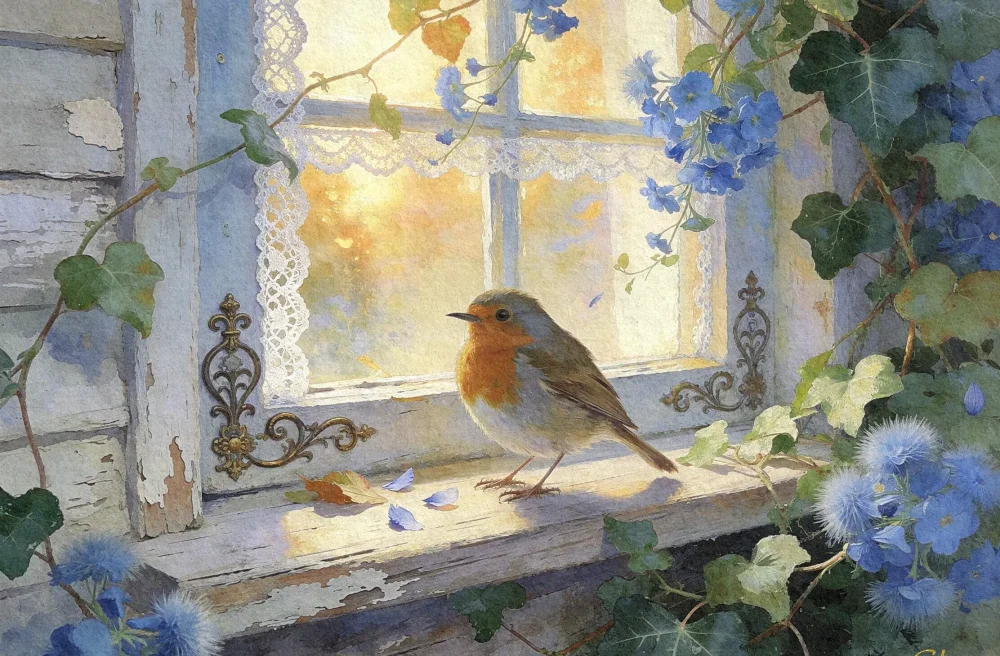
The Robin on the Sill
Messenger from a Past Love
The morning had arrived without permission, as mornings tend to do when one is not particularly eager to meet them. Beth had lain awake since four, watching the ceiling's familiar geography — the hairline crack near the cornice, the pale watermark that had been there since the winter of 2011 — and had felt the particular weight of her body with an acuity that unsettled her. Not pain, precisely. More a heaviness. A density of self, as though her bones had been quietly filling with something leaden in the night.
She was seventy years old, and she had spent the better part of three weeks receiving a sequence of medical verdicts that came wrapped in careful language. Doctors, she had noticed, were extraordinarily gifted at saying difficult things without quite saying them. Words like monitoring and further investigation and we want to be thorough had been arranged around the central fact of her situation like furniture around a draught, and she had sat through each appointment with her hands folded in her lap, nodding, performing a composure she did not entirely feel.
It was not that she was afraid of dying. She had lived long enough to have made a certain peace with the abstract idea of it. What frightened her, if she was honest with herself in those pre-dawn hours, was something more specific: the fear of becoming small. Of shrinking into dependency, into worry that burdened those she loved, into a version of herself diminished by circumstance rather than expanded by it. She had always been a woman who occupied her own life fully — who gardened with muddy knees and laughed loudly and drove herself to appointments — and the prospect of losing that particular quality of presence felt like the truest loss she could imagine.
By seven she had made herself get up. This was important. She understood, with the bone-deep practicality of a woman who had weathered her share, that inertia was a particular enemy — that it compounded itself, that it fed on stillness. She put on the sky-blue cardigan her mother had knitted so many years before, and thought of it as a kind of armour, and she went downstairs to the kitchen, and she filled the kettle, and she stood at the window above the sink while she waited for it to boil.
The garden was doing what gardens did in late spring, which was to say it was doing rather a lot without her. The climbing roses along the back fence had put out new growth, reddish and urgent. The ivy she had never quite managed to contain continued its slow annexation of the wall. The bird feeder needed filling, she noted, the seed level visibly depleted. She made a mental note and then let it go, because she had been making mental notes for several weeks and acting on none of them, and this was part of the lowering feeling she carried through each day.
She took her tea to the sitting room.
The room faced east, and at this hour it caught the early light in a way that she had always loved — a quality that was neither warm nor cool but something between, golden and diffuse, the light that old paintings tried to approximate and occasionally achieved. The net curtain at the window stirred faintly, though she had not opened anything; there must have been a gap she hadn't noticed, some small failure in the frame. The house was old, like her, and it had its own opinions about where air should be permitted.
She sat in the chair that had been her chair for thirty years — a wingback in faded green velvet, worn at the arms to a kind of softness that no new fabric could replicate — and she held her mug in both hands and looked out.
Outside the window, a climbing clematis had wound itself along the lower reaches of the frame and across the breadth of the ledge, its pale blue flowers open to the morning with the unhurried confidence of something that had been quietly establishing itself for years. Each bloom was star-shaped and delicate, five petals arranged with a simplicity that bordered on the architectural, their colour neither assertive nor retreating — that particular blue Beth had always loved, somewhere between sky reflected in still water and the faded ink of an old letter. They moved now in the barely perceptible morning air, not swaying so much as trembling, catching the early light and releasing it again in small, fleeting adjustments. The clematis had not been planted there deliberately; it had migrated from the trellis along the wall, finding its own way to the window as though drawn by something Beth could not account for. Looking at it now, at the quiet insistence of all those pale open faces, she felt something loosen very slightly in her chest.
She was not thinking about anything in particular. This was itself unusual. Beth was, by temperament, a thinker — her mind generally ran several threads simultaneously, practical and analytical and occasionally philosophical, a busy interior hum that she had come to regard as simply the sound of being herself. But that morning, for a few minutes, she was simply sitting. Present. Empty in the way a room is empty before people arrive.
And then the robin landed amongst the pale blue flowers.
It came from nowhere she had tracked — from the garden, presumably, from somewhere in the ivy — and it landed with the small definite thump of a creature that has decided to be somewhere. It stood with its characteristic posture, that slight forward lean, head tilted at a questioning angle. The red-orange of its breast caught the morning light and seemed almost to generate its own warmth, a small coal burning amid the trembling blue blooms, the contrast so vivid it seemed almost arranged.
Beth did not move.
She had seen robins all her life. Her garden attracted them reliably; she knew this bird, or one of its predecessors, as a feature of the landscape. Robins were bold and territorial and endearing, and she had always been fond of them in the sensible, appreciative way she was fond of most wildlife — with pleasure but without sentimentality.
But something happened in that moment that she could not entirely account for.
The robin turned its head and looked directly at her. She knew, rationally, that birds do not apprehend glass as a barrier to vision in the way humans do; she knew it was simply orienting, registering movement or warmth or the shape of things. She knew all of this. And yet the quality of that small dark eye, the directness of it, the way the creature held its ground rather than startling — something in the arrangement of that moment reached into her with a precision that rational knowledge did not touch.
Then it sang.
Not a full territorial proclamation — nothing so assertive as that. A brief, liquid phrase, three or four notes descending and then curling upward at the close, the kind of sound that seemed to come from somewhere deeper than the small body producing it. Beth felt it in her sternum before she heard it consciously. The robin held her gaze as it sang, its beak opening and closing with the unhurried precision of a creature that understood it had time, that it was being attended to, that whatever it was communicating was, in fact, arriving. When it finished, it remained still for a moment, as though allowing the notes to settle. It was the quality of comfort given without fuss, without excess — direct and warm and entirely sufficient.
She thought of her mother.
It arrived not as a thought, precisely, but as a recognition — a sudden apprehension of presence, the way a scent can deliver a person whole and unannounced into one's nervous system. Her mother had been dead for twenty-three years. Beth had been forty-seven when she lost her, old enough to have known it was coming, not remotely old enough to feel prepared for it. Grief, she had learned then, did not respect one's readiness.
Her mother had been a woman of extraordinary constancy. This was the word that returned to Beth now, watching the robin among the pale blue flowers: constancy. In a world that moved and shifted and disappointed and revised itself, her mother had been reliably, almost stubbornly present — not in a suffocating way, but in the way that certain structures are present, the way a well-built wall is present. You don't think about it, precisely. You simply know it's there, and you feel its solidity, and when it's gone you discover that you had been leaning on it without knowing.
She had been a woman who did not say I love you with particular frequency but who said it with everything else. Who arrived unannounced with soup when you were ill. Who knitted a sweater pouring her love into every stitch, each row a quiet act of devotion carried out in the lamplight of winter evenings, her needles clicking with the steady rhythm of a heart that did not waver. Who sat beside you in silence without making the silence uncomfortable. Who, in Beth's darkest moments, had never offered easy comfort, but had instead offered herself: present, steady, making tea, asking nothing.
Beth's eyes had filled, though she had not quite decided to cry.
The robin on the ledge shifted its weight from foot to foot, the blue flowers trembling faintly around its small feet. Then it was still again, attending.
There was a tradition — she had read about it somewhere, seen it shared in the way things are shared now, in grief groups and memorial pages and the softer corners of the internet — that robins appeared at significant moments, that they carried something of the dead. She had encountered this idea years ago and had received it with the mild scepticism of a practically minded woman who did not incline towards the supernatural. She was not the sort to look for signs. She had always mistrusted people who found meaning in coincidence, had feared that such looking was a kind of grief that hadn't been fully processed, a need dressed up as belief.
And yet.
Sitting in her green chair, in the quiet house, on a morning she had woken to with dread, she found she could not entirely organise herself against it. Not because she had decided to believe, but because something in her had simply stopped requiring proof. She was seventy years old and she was ill and she was frightened, and the robin was there among her beloved blue flowers, and something about its presence — its small, burning certainty, its song delivered with such unhurried directness — settled into her like a hand placed quietly on the shoulder. Not a visitation, not a miracle. Something stiller and more intimate than either: the felt sense that love, once given completely, does not dissipate when the person who gave it is no longer there to give it. That it persists in the one who received it, structural and warm, like heat retained in stone.
Stay positive, her mother would have said. Except she would not have said it quite like that — that phrasing was too modern, too self-help, too abstract for a woman who expressed things concretely. She would have said, Get dressed, Beth. Eat something. It doesn't help to sit in it. She would have said, You've been through worse, though it doesn't feel like it. She would have said, I'm here, which was the simplest and most complete thing.
Her mother had loved her with a love that was, when she examined it honestly, the most reliable fact of her existence. More reliable than her own judgements, more reliable than the various certainties she had held and revised over seven decades. It had not been a perfect love — her mother had been imperfect, after all, as all humans are — but it had been constant, and constancy, Beth thought now, might be the more important quality. Anyone can love in the exhilarating moments. The constancy is the love.
The robin dropped from the ledge into the garden.
She watched it land on the path, peck once or twice at the gravel, and then rise again in a low arc towards the ivy. Gone.
The sitting room settled back into its ordinary morning self. The quality of light had shifted imperceptibly, moving further from gold towards the neutral brightness of mid-morning. From somewhere down the road came the sound of a car starting, and from outside the back garden, faintly, birdsong she had not consciously registered until it was the only sound remaining.
Beth sat for a moment longer with her cooling tea.
Then she set the mug down on the side table and stood up, slowly, because she was seventy and some mornings the body required negotiating with, and she went upstairs and washed her face in cold water and changed into clothes that were not the ones she slept in, which had been her habit of late and which she recognised now as a small, telling abdication. She put on the earrings she wore when she felt like herself. She looked at herself in the bathroom mirror with something approaching directness rather than the peripheral glance she had been managing.
She looked like a woman who was managing something difficult, which was accurate. She also looked, she thought, like her mother — around the jaw, the set of the eyes — which was not something she had always been able to receive comfortably. Her mother's face in her own face had sometimes felt like an encroachment. This morning it felt, instead, like a continuity.
She went downstairs and found the birdseed in the cupboard under the stairs and she went out into the garden in her coat and she refilled the feeder. The air was cool and smelled of new growth and the morning was still and clear. Above the back wall, the sky was the particular pale blue that sometimes appeared between the weather systems that rolled in from the Atlantic, a borrowed clarity, possibly temporary. She stood looking at it for a moment with her hands in her pockets, and something about the colour — her colour, her mother's knitting and winter lamplight and all the years between — made her press her lips together briefly against a feeling too large and too tender to name.
She did not expect the robin to return, and it did not. But the feeder was full, and the garden was doing its persistent, unconsulted growing, and she was standing upright in it, her own feet on her own ground, and something had shifted in the architecture of the day. Not resolved — nothing was resolved, the appointments lay ahead, the uncertainty persisted — but different. Less dense. As though some interior weight had been redistributed, made more bearable by the simple act of acknowledging that she was not, in any final sense, without support.
Her mother had loved her for forty-seven years. Beth had been carrying that love for twenty-three more.
It occurred to her, standing in the garden on a Tuesday morning in May, that perhaps the carrying was the point — that love given does not disappear but becomes portable, becomes part of the architecture of the person who received it, and travels with them, structural and invisible, into every room they subsequently inhabit. A sweater knitted stitch by stitch in lamplight. A hand on a shoulder. Three notes descending and then curling, unexpectedly, upward.
She went inside and made fresh tea, and she sat at the kitchen table rather than alone in the dimness of the sitting room, and she opened the notebook she had not touched in weeks, and she wrote, in her own handwriting, the words I am still here. She looked at them for a long moment. Then she added, beneath: and so, I think, are you.
At the window ledge, the pale blue flowers continued their trembling in the morning air — small, persistent, luminous. Somewhere beyond the ivy, the robin was already gone, its mysterious errand completed, its small purposeful body arrowing back through the garden towards a nest where other lives, new and urgent and entirely dependent, were waiting to be fed.