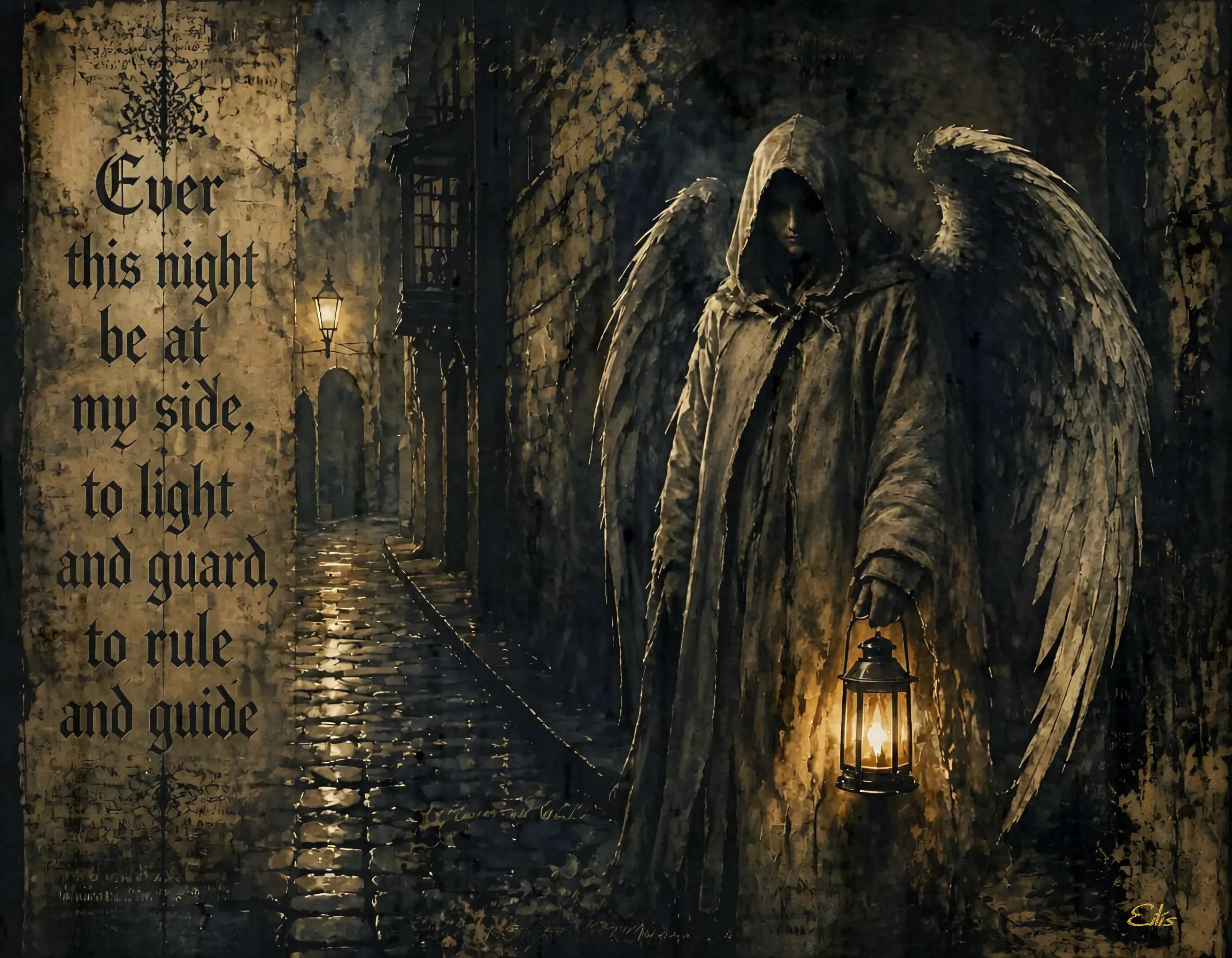
The Guardian
Carrying the Lantern
The Guardian had carried the lantern for longer than the alley had existed.
That was the first thing — the thing that distinguished his fatigue from any human version of the word. It was not the tiredness that came from distance walked or weight borne, though he had walked distances that no geography could measure and the lantern, for all its modest size, was never entirely without heaviness. It was something more structural: the fatigue of sustained attention, of a vigilance so complete and so unrelenting that it had long ceased to feel like effort and had become, instead, the very texture of his existence. He did not watch because he chose to. He watched because the watching was what he was.
The alley had been wet again that night. It was, he had come to understand, always wet — the cobblestones held moisture the way old stone held memory, drawing it up from somewhere beneath the surface, some reservoir of accumulated nights that never fully drained. The stones caught the lantern's light and returned it fractured, scattered across their irregular surfaces in small, unsteady gleams that shifted as he moved. Not movement in the ordinary sense — he did not arrive at places so much as he was simply, at intervals, somewhere different. A forward progression so measured, so continuous and unhurried, that it carried its own quality of stillness within it.
The alley did not end. He had long ago stopped expecting it to.
It bent, always, just far enough ahead that what lay beyond remained permanently withheld, and this was not accidental. He understood that now, in the way one understands a thing that has been true for so long that understanding it feels less like insight than like recognition. The architecture of the dark was not random. The high walls on either side — their stone the colour of old water, their surfaces pocked and weathered by seasons that had long since ceased to have names — were not obstacles. They were the form that necessary difficulty took. They pressed inward without touching. They created the narrow passage that gave the journey its character: not a road, not a path, but a passage — the kind through which one moved because remaining still was not, in the end, available.
He had walked beside enough lives to know what the alley was.
Each one the same passage, each one entirely unrepeatable. The cobblestones underfoot were the accumulated weight of ordinary days: the decisions made in inadequate light, the losses that arrived without preparation, the long stretches of grey persistence between one moment of clarity and the next. The walls were everything that pressed inward without quite crushing. And the bend — always the bend, always precisely far enough ahead to deny full visibility — was simply the condition of being alive in the particular way that humans were alive: moving forward through what they had not chosen, toward an end they could feel approaching without ever being able to see it directly.
He held the lantern lower than was strictly necessary. He had noticed this about himself — noticed it the way one notices a habit that has calcified so gradually it precedes self-awareness. The lantern could have been raised higher. Its light would have carried further, would have revealed more of the stones ahead, more of the bend and whatever gathered in the archway's shadow beyond. But he held it at the height of a human hand, its light calibrated not to the maximum extent of visibility but to the specific, immediate need: the next few stones, the current gradient, the precise texture of the surface underfoot.
Enough. Always exactly enough, and no more.
The one beside him had stopped.
The Guardian felt it before he registered it — a shift in the quality of the air, a sudden density in the silence, the way the dark seemed briefly to thicken around a single point of arrested motion. He did not turn sharply. He turned the way the lantern moved: slowly, without urgency, with the full weight of his attention following at its own deliberate pace. The figure stood perhaps two steps behind him on the wet stones, one hand extended toward the wall for steadiness, the other pressed flat against their sternum in the unconscious gesture of someone managing the physical reality of fear.
The breathing had changed. The Guardian knew that breathing — had heard its like across more nights than the dark could count. Short, effortful inhalations. The chest working too hard for too little. The body's honest report of what the mind was struggling to process alone.
He waited.
"I can't see where it goes," the voice said finally. Quiet, stripped of everything except the fact of itself. Not a question. Barely even a statement. More like something released than something spoken.
He considered the bend ahead — the way the alley curved away from the lantern's reach into an obscurity that was absolute and, in its absoluteness, not unkind. There was nothing false in the dark beyond the bend. It withheld nothing that cruelty had placed there. It simply held, as it always held, what came next.
"No," the Guardian said. "You can't."
The hand against the wall pressed harder. The fingertips whitened against the old stone.
"Is there — " A pause. The chest steadied itself with visible effort. "Is there anything beyond it?"
He looked down at the cobblestones between them — at the specific stones the lantern illuminated at that precise moment: uneven, dark with moisture, each one distinct in its imperfection, each one entirely solid underfoot. He had answered this question before. He would answer it again. The answer did not change and did not need to.
"There is the next part of the path," he said. "And I will be beside you on it.".
The hand did not leave the wall immediately. That was correct — that was, in fact, the right response. He had no impatience with the hand on the wall, with the pause before movement resumed, with the full duration of whatever was required before the body trusted the ground again. The covenant he carried did not specify a pace. It specified a presence. Ever this night be at my side — to light and guard, to rule and guide. The words had existed before he remembered first encountering them, which meant, in practical terms, that they had always existed: not inscribed in the air or on the stone but layered into whatever constituted the deepest foundation of the arrangement between himself and the one who walked beside him. A covenant made not once but continuously — renewed in each specific night by the simple, absolute fact of his being here rather than elsewhere. This night. Not the night as a philosophical category. This particular darkness, these particular stones, this specific moment of a hand pressed to cold stone while the breathing tried to find its way back to something steadier.
He waited until the hand dropped from the wall of its own accord.
They picked their way onward.
Far ahead — far enough that its light was more suggested than felt, more atmospheric than functional — the gas lamp on the far wall cast its pale amber glow across the archway and the wet stones beneath it. He had noted it on every passage through this alley, which meant he had noted it more times than he had noted almost anything else. It did not illuminate what lay beyond the bend. It had never been positioned to do that. What it did was mark the far boundary of what the eye could reach: a fixed point of warm light at the outer edge of vision, neither beckoning nor receding, simply present at the limit of the seeable world.
He had watched people see it differently depending on where they were in the passage. Early on — when the stones were still unfamiliar underfoot and the walls had not yet acquired the quality of the known — the distant lamp read as destination, as the promise of arrival, as the specific warm room that waited at the end of the difficult walk. Later, when the alley had made itself fully felt, when the cobblestones had delivered their full education in unsteadiness, the lamp changed its meaning without changing its position. It became simply what it was: a light at the end of things. Not reward. Not resolution. Just the far edge of the passage, visible from within it, approached across whatever length of wet dark stones remained.
He did not point it out.
The one beside him had seen it — he knew this from the brief alteration in the quality of their attention, the slight adjustment of the head, the way the eyes held the distant glow for a moment longer than the immediate dark required. What it meant to them he could not know with precision. He had learned, across all the nights he had walked these stones, that the distant lamp meant something different to each person who saw it, and that none of those meanings were wrong, and that his role was not to correct the meaning but to remain present while it was felt.
"That light," the voice said. Careful. Not quite a question.
"Yes," he said.
A silence that had weight in it — not the absence of speech but the presence of something being turned over, examined from several angles, set down and picked up again.
"It's a long way."
"It is," he said.
He adjusted the lantern — a small adjustment, almost imperceptible, so that its light fell a fraction further along the immediate stones. One additional cobblestone illuminated in the sequence ahead. It was not much. It was, given what he understood of the mathematics of darkness, precisely the right amount.
His wings shifted behind him as they walked, the layered feathers catching the lantern's peripheral glow. They had never been the smooth, ceremonial things that certain traditions imagined — those arrangements of white and weightlessness that implied a guardian who observed from a clean remove, from an altitude above the territory being watched. His were heavy, grey-gold, textured with the long evidence of proximity: ruffled at their lower edges where turbulence had passed through them, coloured by years of walking in air that carried the damp of these very stones. They were the wings of something that had been present in the world — not above it, not at a commemorative distance from its difficulty, but in it, moving through its weather rather than surveying it from elsewhere.
He had chosen this, insofar as choice was a category that applied to him. Or perhaps the covenant had defined it — which amounted to the same thing.
The cloak was heavy with the night's moisture, its fabric drawing the damp into itself with the patient absorption of old stone. He had stopped experiencing the weight as something to be managed. It was information — confirmation of his position at the level of the ground, among the physical things, in the material dark where the walking was actually happening. The cloak trailed across the cobblestones. The lantern swung slightly with each step. The one beside him breathed in the specific rhythm of someone who had found, for now, a sustainable pace.
The alley bent ahead.
Beyond the bend was everything the Guardian could not show them and had never tried to: the nature of what waited, the shape of what was coming, the full length of what remained. These were not his to illuminate. His task was the passage itself — the unrepeatable experience of moving through it — and the passage required not a destination made visible but a companion made present. The covenant had always stated this, with a precision that needed no revision across all the nights he had carried it. Not that the dark would be lifted. Not that the stones would dry. Not that the walls would open into something easier on the other side of the bend.
Only this: that no one would walk it alone.
The Guardian had always found this to be what was needed.
The cobblestones stretched forward, wet and particular and real, each one catching its fragment of lantern light and returning it slightly altered. The distant lamp held its position at the far boundary of the visible world, neither closer nor further, as it had always been. The cold air moved between the high walls with the low, continuous breath of something older than either of them.
He held the lantern steady.
They walked on. Together.