Angels
Wings of Light
I did not mean to paint a theology. I meant to express in images something I could not name.
Most of us carry it — that particular longing that has nothing to do with anything that happens in everyday life. A sense of having come from somewhere, of still being faintly connected to it, the way a kite is connected to the hand that launched it. Not a memory exactly. More like the ghost of one. Something that predates language, predates even the body we inhabit, and occasionally surfaces in the dark hours when the mind has stopped performing and something older takes its place.
These twelve works are my attempt to give that feeling a shape. Wings seemed right. Not because of any doctrine, but because wings are the oldest visual shorthand we have for the idea that something exists between states — neither fully here nor fully elsewhere. Exactly where I was trying to locate what I wanted to say.
The Weight of Having Seen
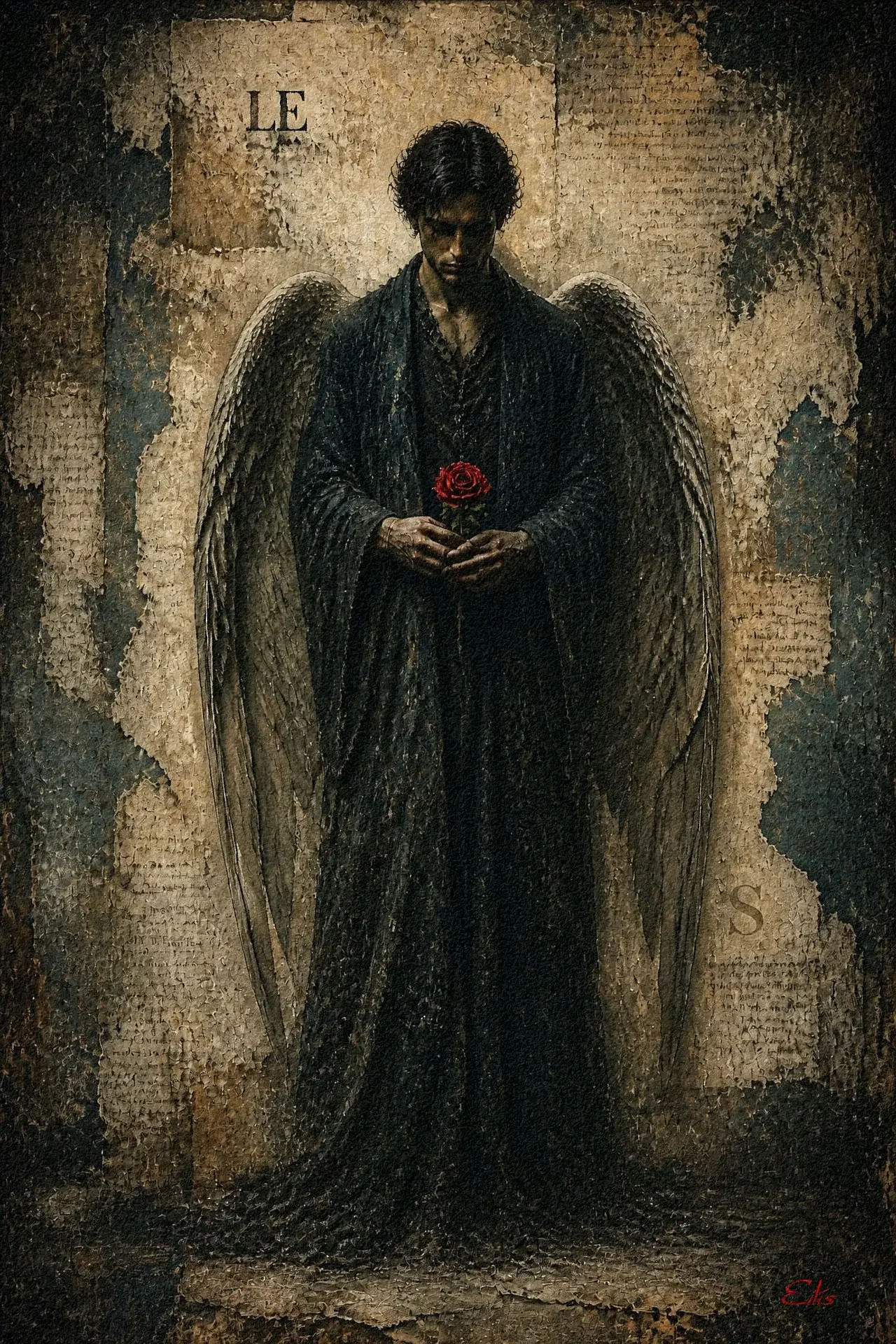
The figure that opens the collection stands in stillness so complete it feels almost geological. Draped in black against a background of ancient manuscript — letters that were never quite legible, words that have been worn back to texture — this angel holds a single red rose in both hands and looks at it as though it is the last evidence of something. Not grief, exactly. Something older and more considered than grief. The kind of quiet that comes after a long time of witnessing.
If I think of the guardian angel not as a separate being but as a part of oneself that has been present for far longer than this particular life — the part that watches, that registers, that does not look away — then this is what it might look like after enough years of faithful attendance. Dark, yes. Heavy with what it knows. But still holding the rose. Still making the argument for beauty, even in the silence of a room made of crumbling words.
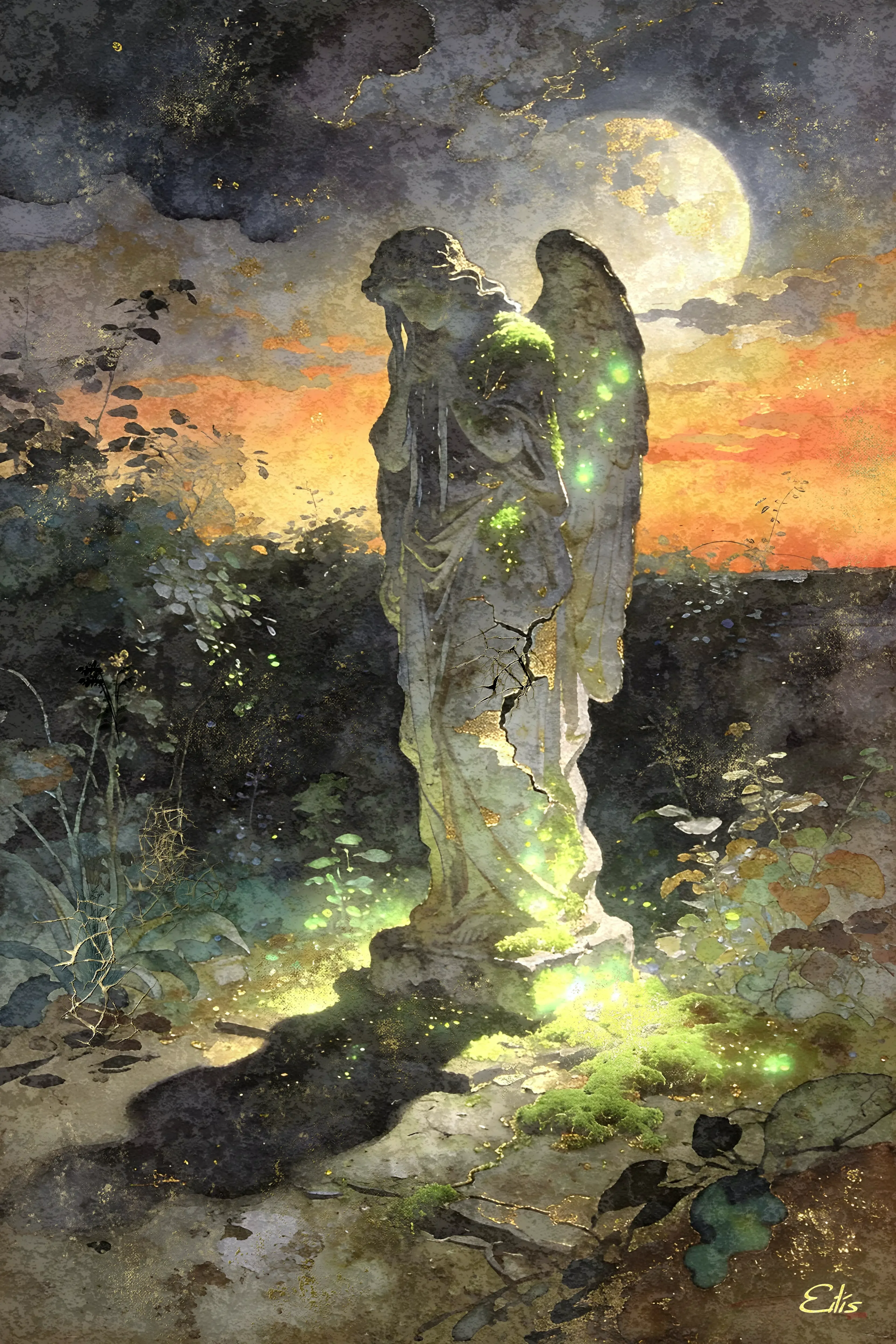
There is a companion to this figure that stands in a wild garden under a moon too bright for comfort. Stone, but not inert — the cracks in its body run with gold, and where the moss has taken hold it glows, green and improbable, as though the light it carries has simply found another way out. It does not face us. It does not look at the burning horizon behind it. It holds something close to its chest — or tries to — and the trying is everything. This is the guardian at the moment it understands that it cannot protect us from all of it. That the most it can do is stay.
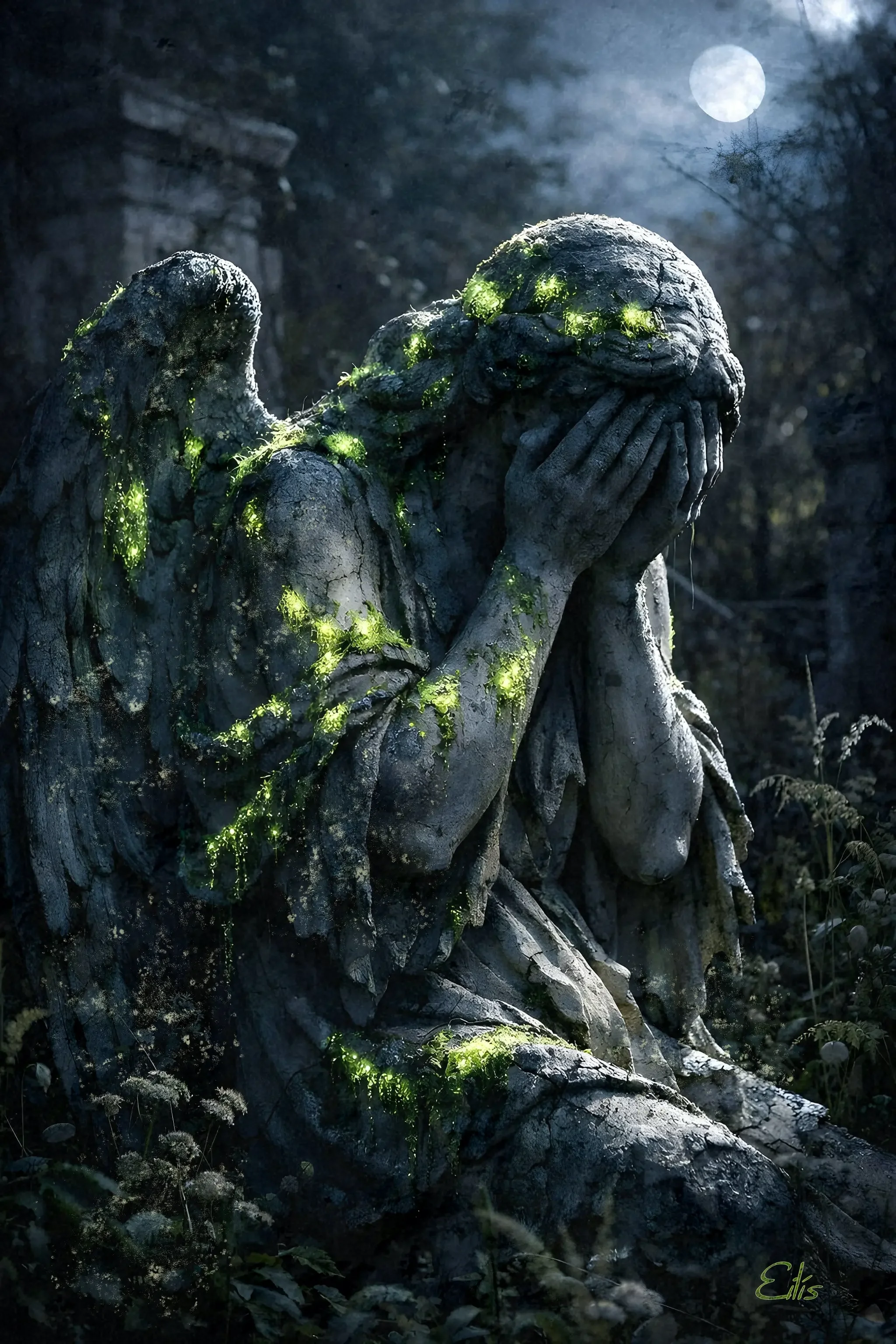
And then there is the one in the graveyard, the oldest and heaviest of the stone figures, face buried entirely in its hands, wild things growing around its feet, a full moon hanging above it with the indifference of celestial bodies. The bioluminescent green that dots its surface is not decoration. It is proof of persistence. Life finding its way through the cracks in what was meant to be permanent. Even the stone that grieves is not entirely stone. Even the part of us that has gone cold still carries, somewhere in its fractures, something alive.
When Feeling Overflows Its Form
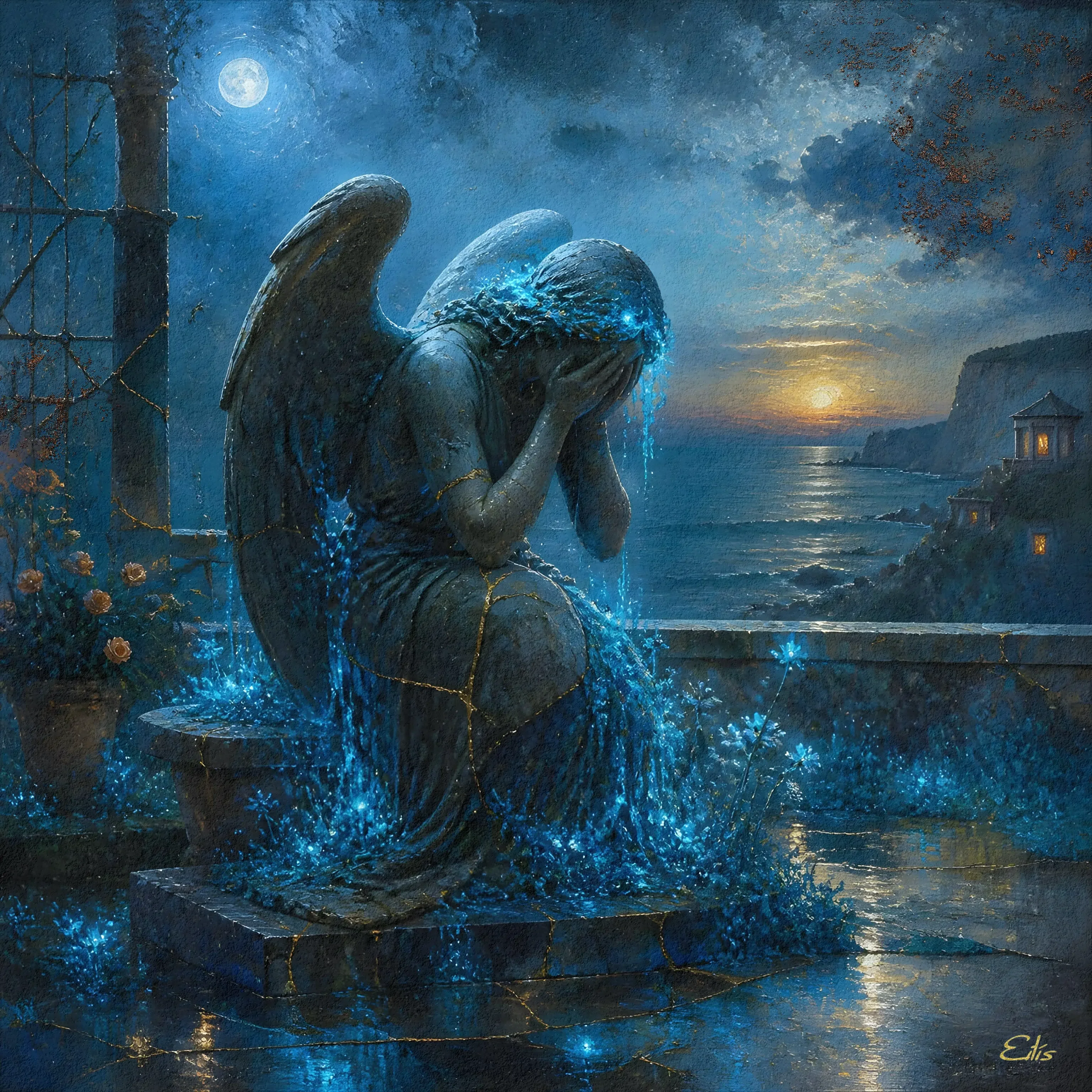
There is a stone figure on a terrace above the sea — night, and a sunset happening simultaneously at the horizon, that impossible hour when darkness and warmth occupy the same sky. The figure is weeping. Not with ordinary tears, but with cascading blue light, bioluminescent, torrential, pooling at its feet and spreading across the stones in something that looks almost like a garden, almost like it is being planted by sorrow. The kintsugi gold that runs through its cracks catches the last of the light.
I have looked at this image many times and understood something different each time. Some days it reads as simple heartbreak. Other days it feels like a different kind of overflow entirely — not the emptying-out of loss, but the fullness of having cared for too long, too deeply, without release. The guardian who has held its vigil across more than one lifetime, and is finally, briefly, allowed to feel the accumulated weight of all that love.
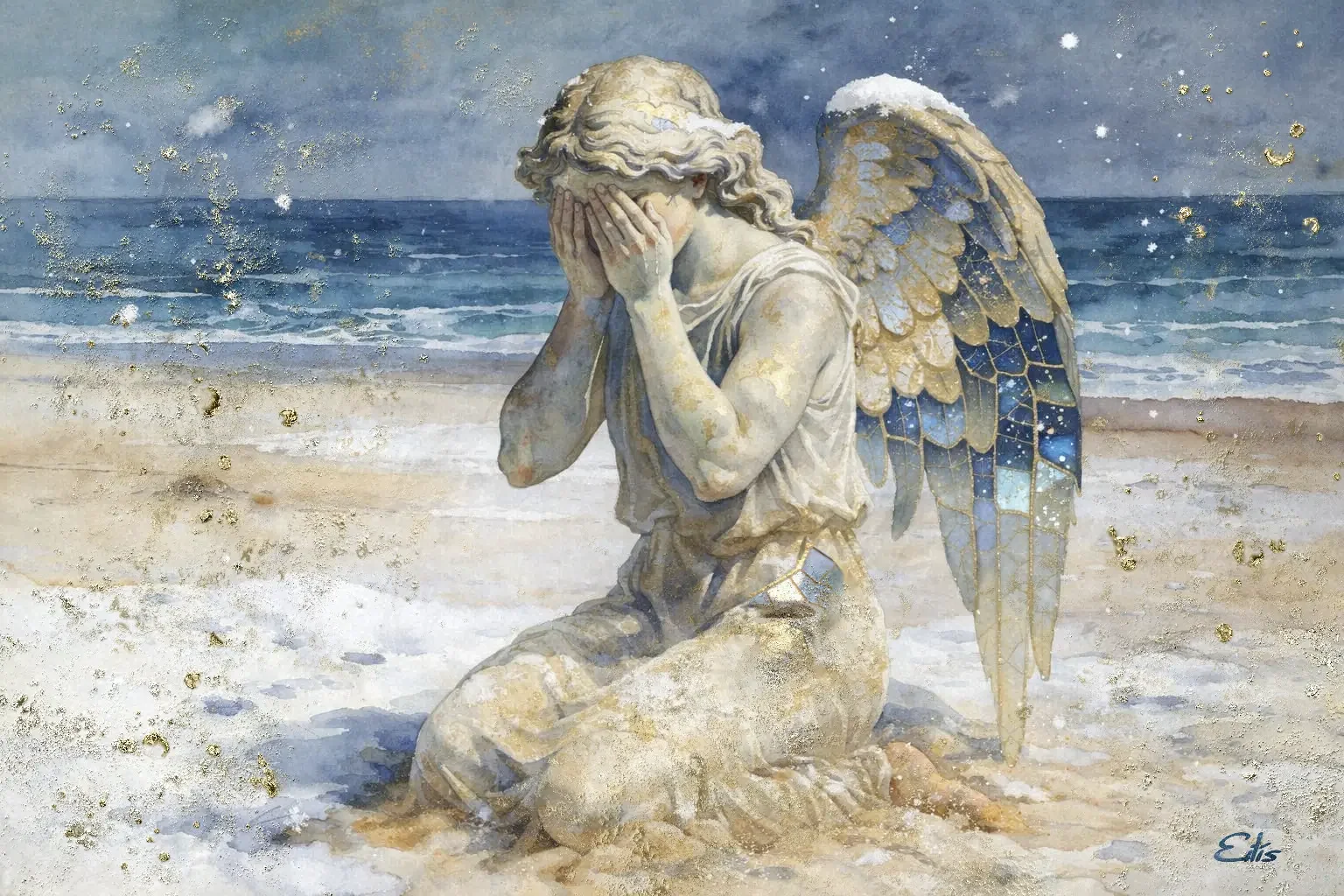
On the beach, a figure kneels with its face in its hands, and behind it the ocean is indifferent and magnificent, scattered with gold. Its wings are extraordinary — part feather, part stained glass, cobalt and amber and the deep blue of late evening sky. They carry the whole history of longing in their geometry. And yet the figure kneels. Even with wings like that, something has brought it down to its knees. Not punishment, and not defeat. Simply the necessary moment of stopping — of letting what has been carried across more than one existence be felt, at last, without defence or diminishment.
These are not images of defeat. They are images of honesty.
The Ones Who Watch the Horizon
Of all the figures in the collection, perhaps the most unsettling is the one that does not show us its face at all.
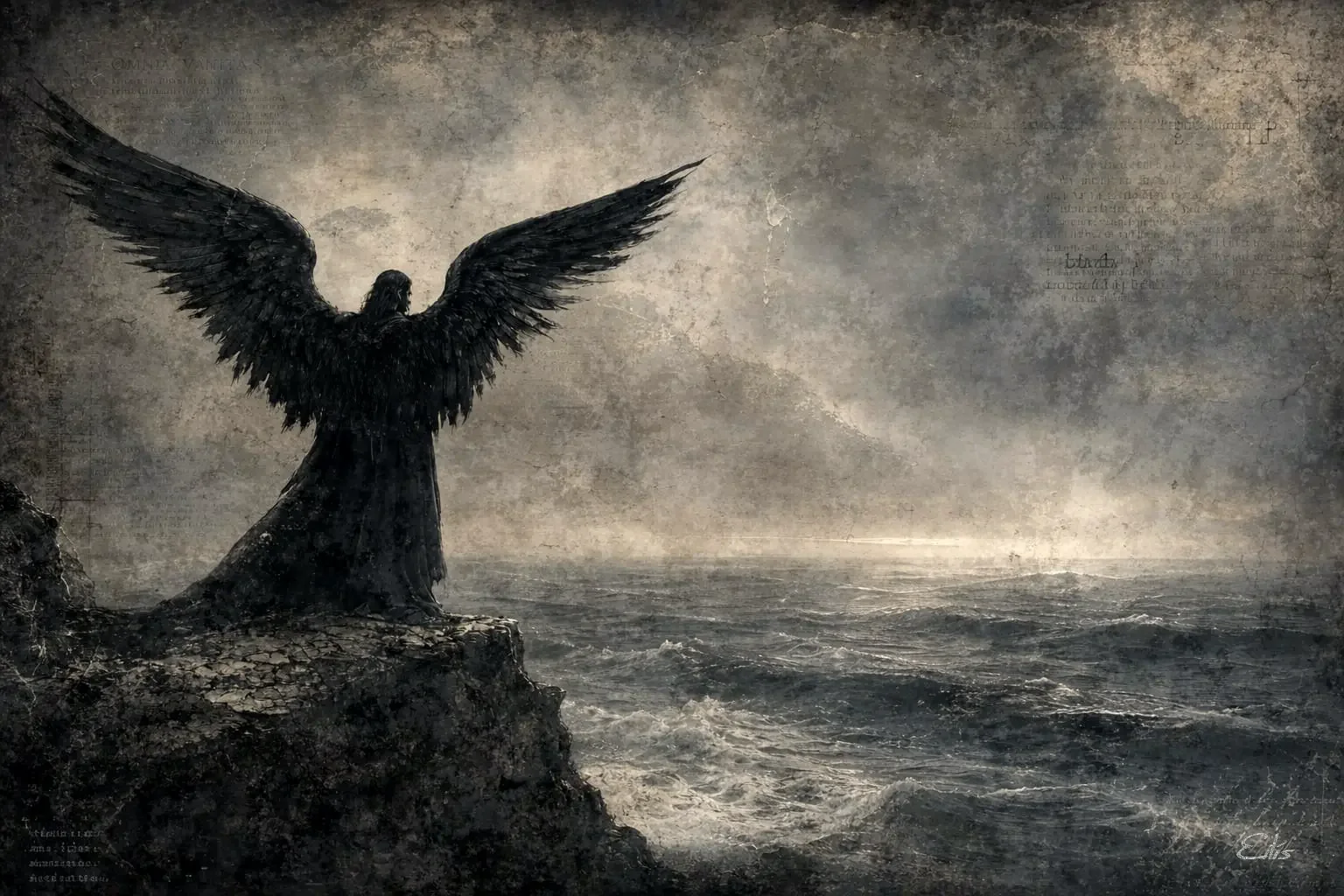
On a cliff above a churning sea, a dark winged shape stands with its back to us, wings spread wide against a sky of mist and uncertain light. It might be waiting. It might be preparing to leave. It might have been there for centuries, watching the same water move. The texture of the image is distressed — aged paper, faint script, the surface of something old — and the figure merges into it, as though it has always been part of that landscape, part of that particular quality of grim and beautiful endurance.
What strikes me most is that it does not look at us. The guardian that faces away is not abandoning us. It is watching in the direction we cannot see from where we stand. It is the part of our interior that monitors the threshold — between what was and what is yet to come, between the existence before this one and whatever waits beyond its end. We may not be able to see what it sees. But it knows. It has always known.
We Are Not Alone in This Silence
Some of the most quietly powerful works in the collection are the ones that refuse singularity.
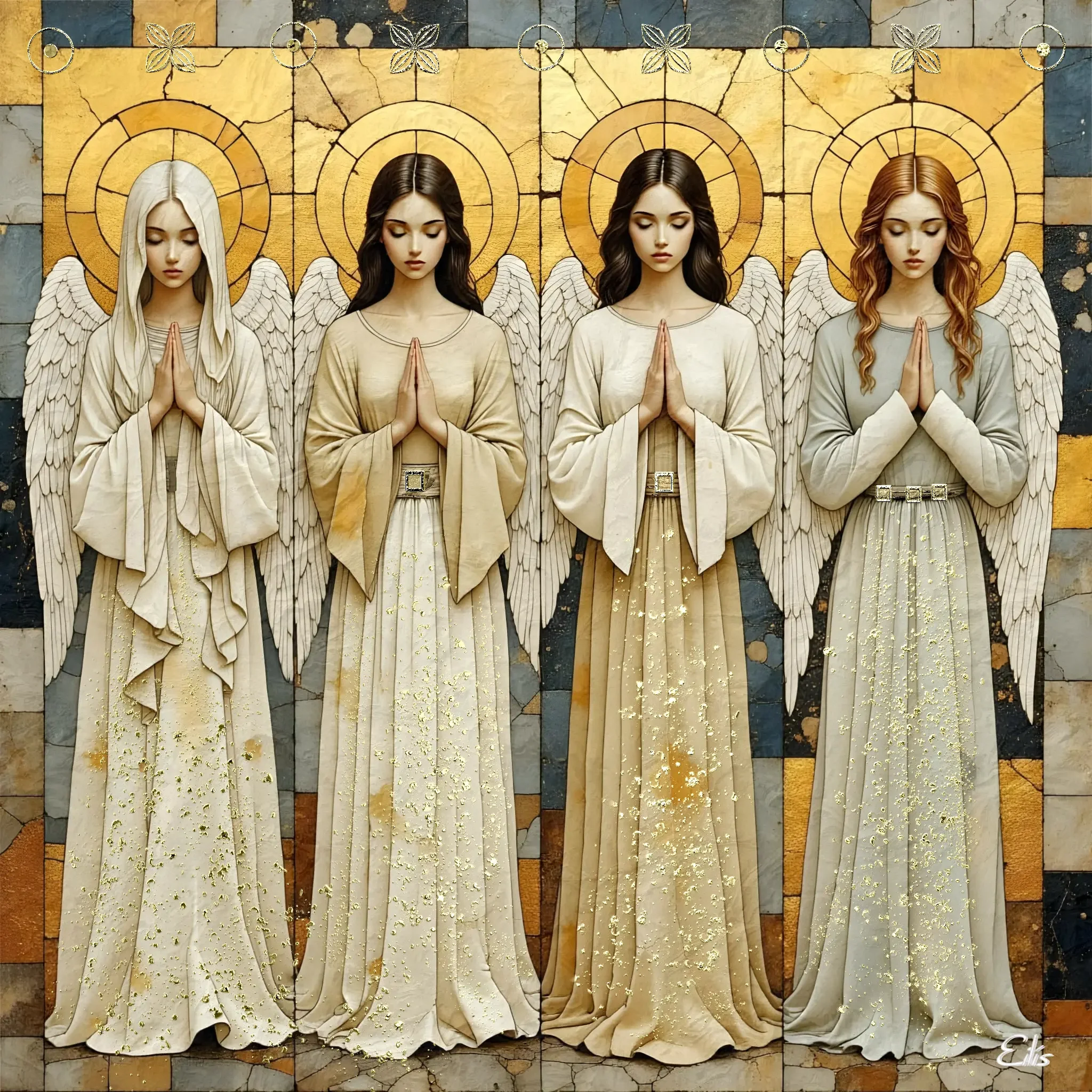
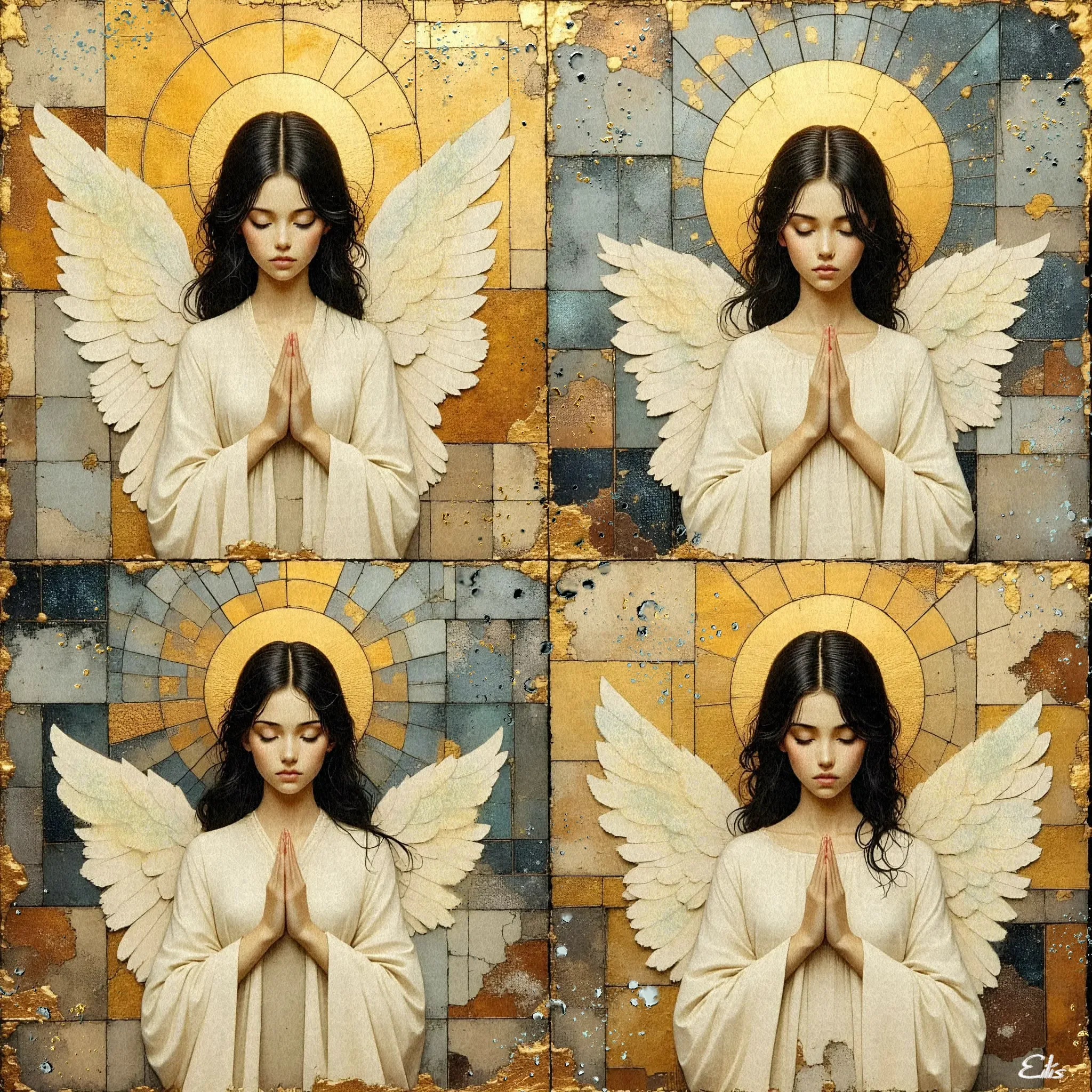
Four figures stand in a row against backgrounds of mosaic tile, warm ochre and slate and gold, concentric halos of hammered light behind each head. Their hands are folded. Their eyes are downcast or closed. They stand close enough to touch but do not touch. And in the four-part grid of individual figures — the same face approached from different angles, in different lights, with the same inward attention — there is a different kind of truth: that the inner life which feels so private, so unreachably personal, is in fact being felt in exactly this way by every version of us that has ever existed.
The mosaic aesthetic earns its place here. Those early artists who worked in tile and gold understood that certain things cannot be rendered in smooth paint on a seamless surface. The sacred, the interior, the luminous — these require fragmentation, require the grout-lines between pieces, require you to see the joins. Because the joins are not flaws. They are proof that something was assembled from parts, held together by intention, and is still, improbably, whole.
There is a kind of companionship in that. The recognition that our inner guardian is not uniquely burdened. That the silence it keeps is a silence held in common with every other such guardian, across every other such life. A choir, even when it does not sing.
The Moment of Becoming
Then the collection opens.
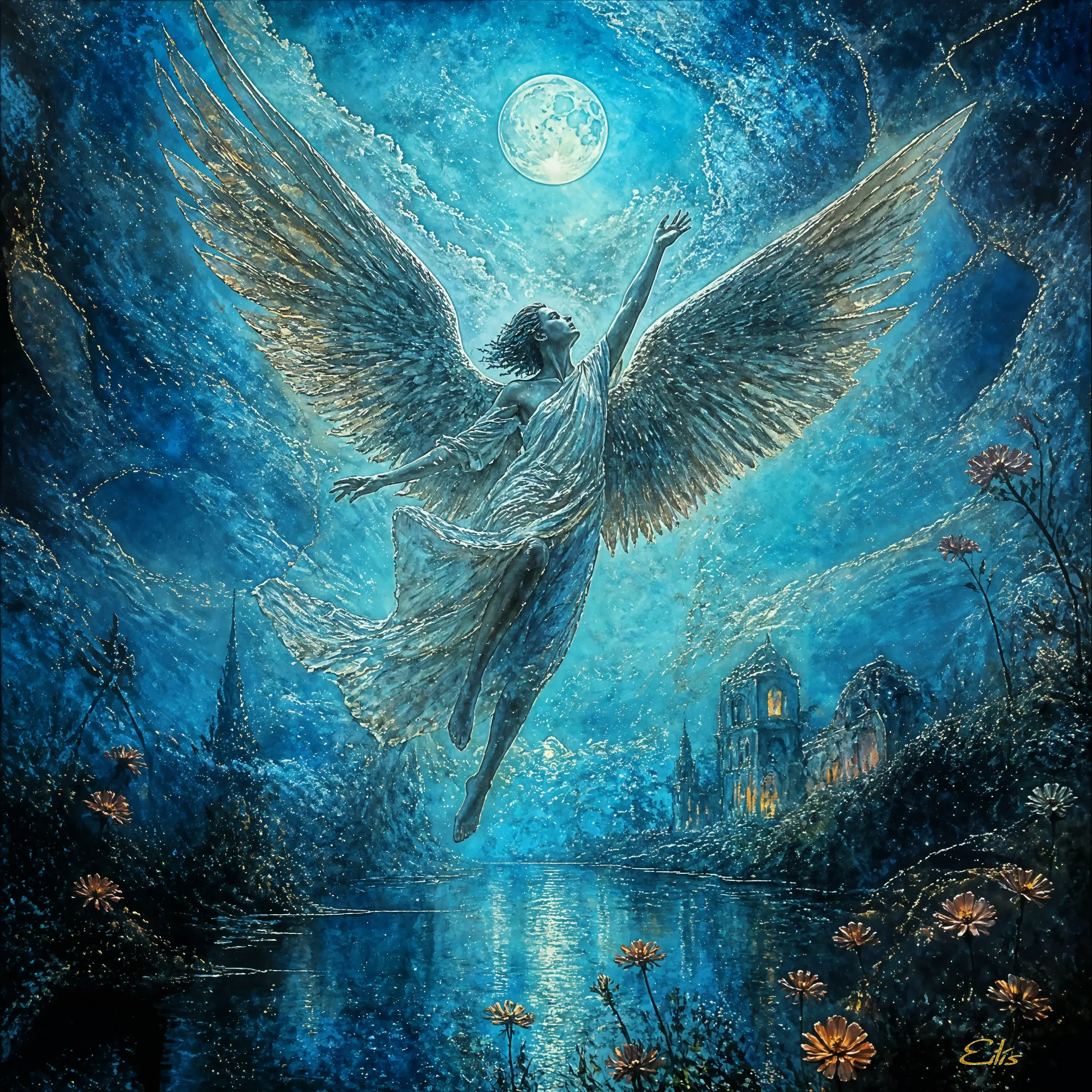
Over a moonlit lake, between wildflowers and a distant ruin glowing with warm light, a figure rises. Arms wide, head lifted, wings filling the upper half of the canvas in silver and gold. Its reflection holds in the water below, perfectly still, as though the lake has been waiting to receive this image for some time. The full moon presides. The blue is the particular blue of two in the morning, the hour when the world has run out of pretence and only the real things remain.
This is the guardian in its moment of release — not flight exactly, more like a long-held breath finally let go. After all the stone, after all the grief and vigil and accumulated knowing, this. The upward turn. The arms open not in surrender but in recognition. Something larger is present, and the figure is turning towards it, not away.
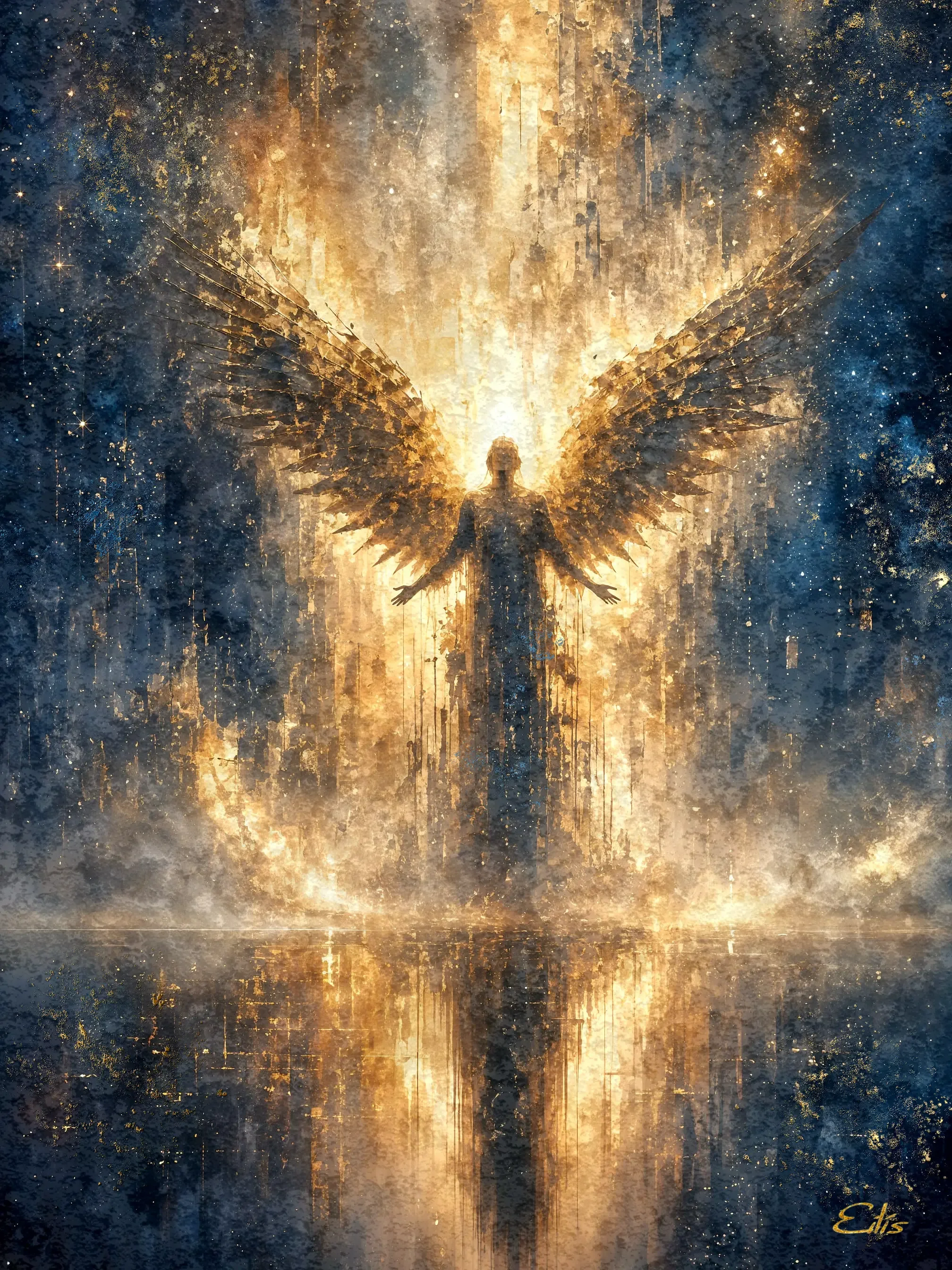
And then, at the still centre of everything, the luminous one.
A silhouette of gold against the deep blue of starlit space, wings spread to the full width of the canvas, arms open, face lifted to a source of light that seems to be both outside and inside it simultaneously. Below, in still water, its perfect reflection. This figure does not arrive from elsewhere. It emerges — from the painting itself, from the light itself, from whatever the blue and gold have been building toward since the first stone figure sat in its garden of grief. This is what remains when everything contingent has been stripped away. The energy before and after form. Not a messenger. Simply what light looks like when it remembers its own nature.
I believe we touch this, sometimes, on earth. Not often, and not for long — but there are moments in the creative act when what we are making briefly ceases to feel like effort and becomes something else entirely. A sentence that arrives whole. A passage of music that plays itself. A painting that tells you what it needs before you have decided. In those instants, something older than skill is present. A frequency we came in on, mostly lost beneath the noise of living, briefly recovered. The angel's light is perhaps precisely this: a sparkling of an inner essence that predates this existence, surfacing in the rare moments when a poem, a painting, a piece of music is born through us rather than by us — and flows outward to other living souls already tuned to receive it, who find in it something they recognise without knowing why. As though the sparkling, in passing through the one who creates, reawakens in those who receive it the memory of a state they too once knew. Not the source. Just the opening through which it passed.
What the Children Know
There is a kind of knowledge that we are born with and spend the rest of our lives being educated out of.
In their absolute, inborn innocence, children know things that the world will spend years quietly erasing. They arrive still close to whatever they were before — embodying, in their unhurried and total attention, a state of pure awareness that distances themselves from the grown-up condition, the adulthood caution in self-protection that the world superimposes.
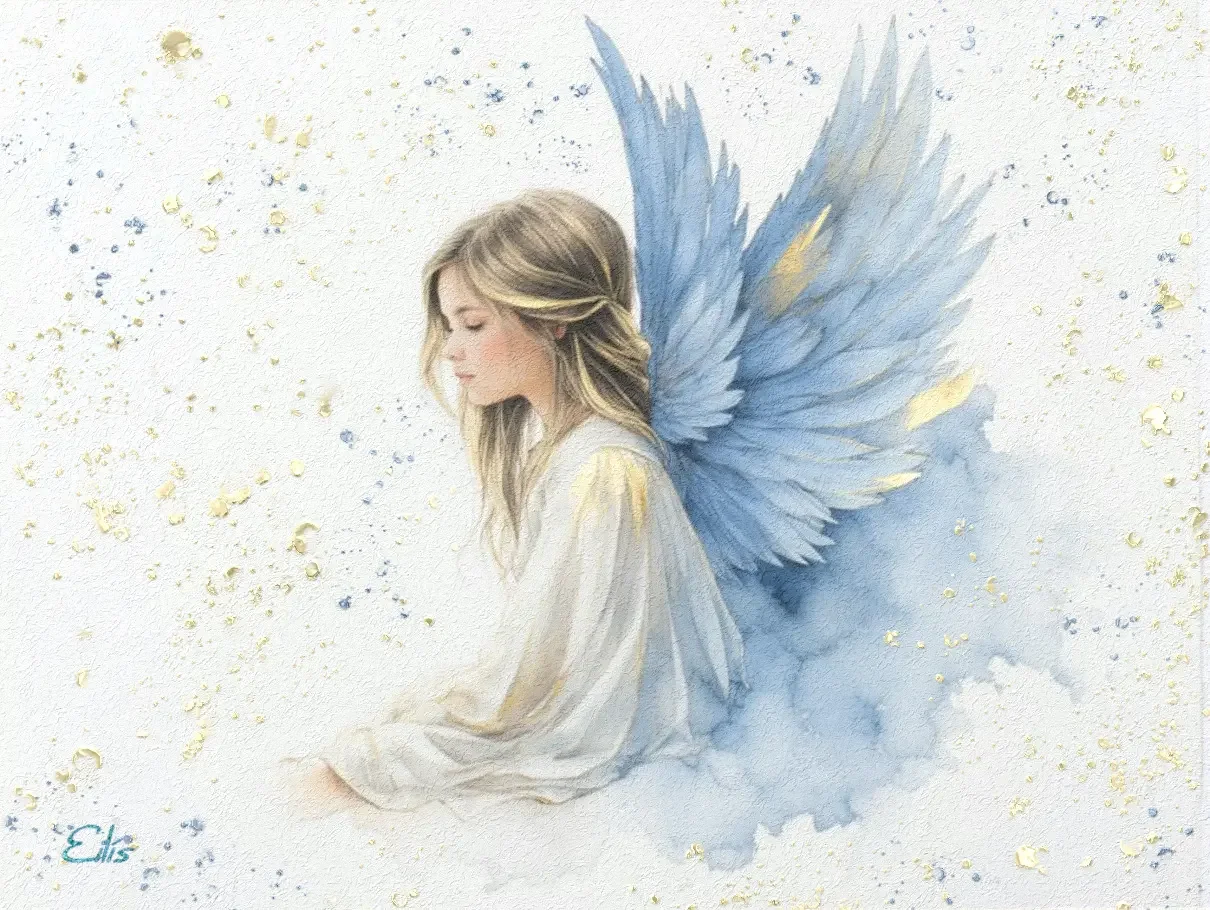
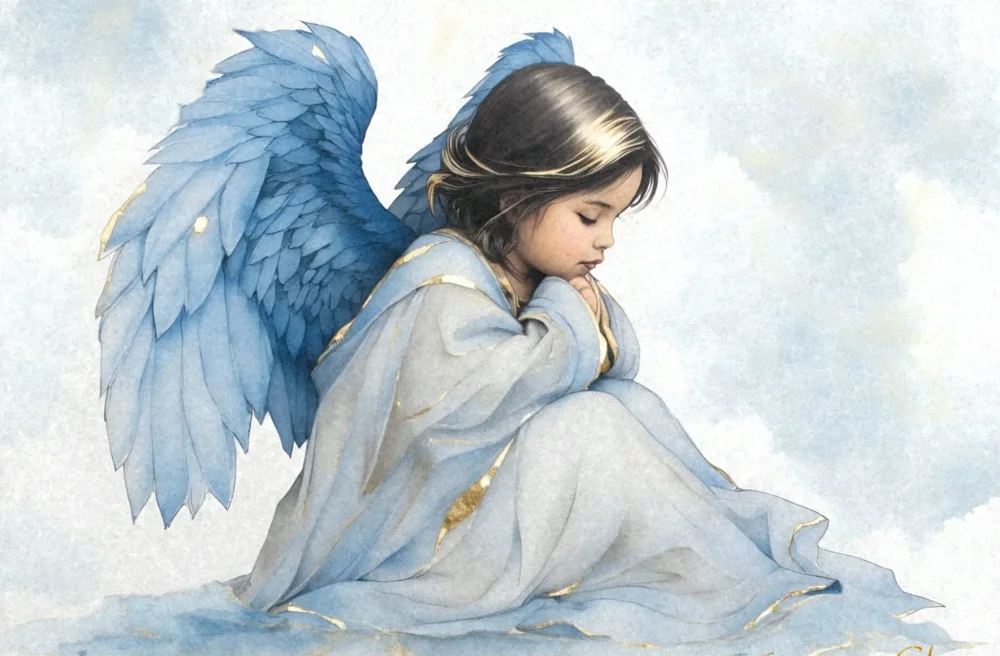
A young figure sits quietly in the collection, blue wings dissolving into soft cloud at their edges, face turned slightly downward in the posture of someone listening to something no one else in the room can hear. Gold leaf floats around it in the white space like audible light. There is nothing performed in this image. No message being delivered, no duty being fulfilled. Simply the presence of something that is still close to the source it came from, and has not yet learned to be afraid of that.
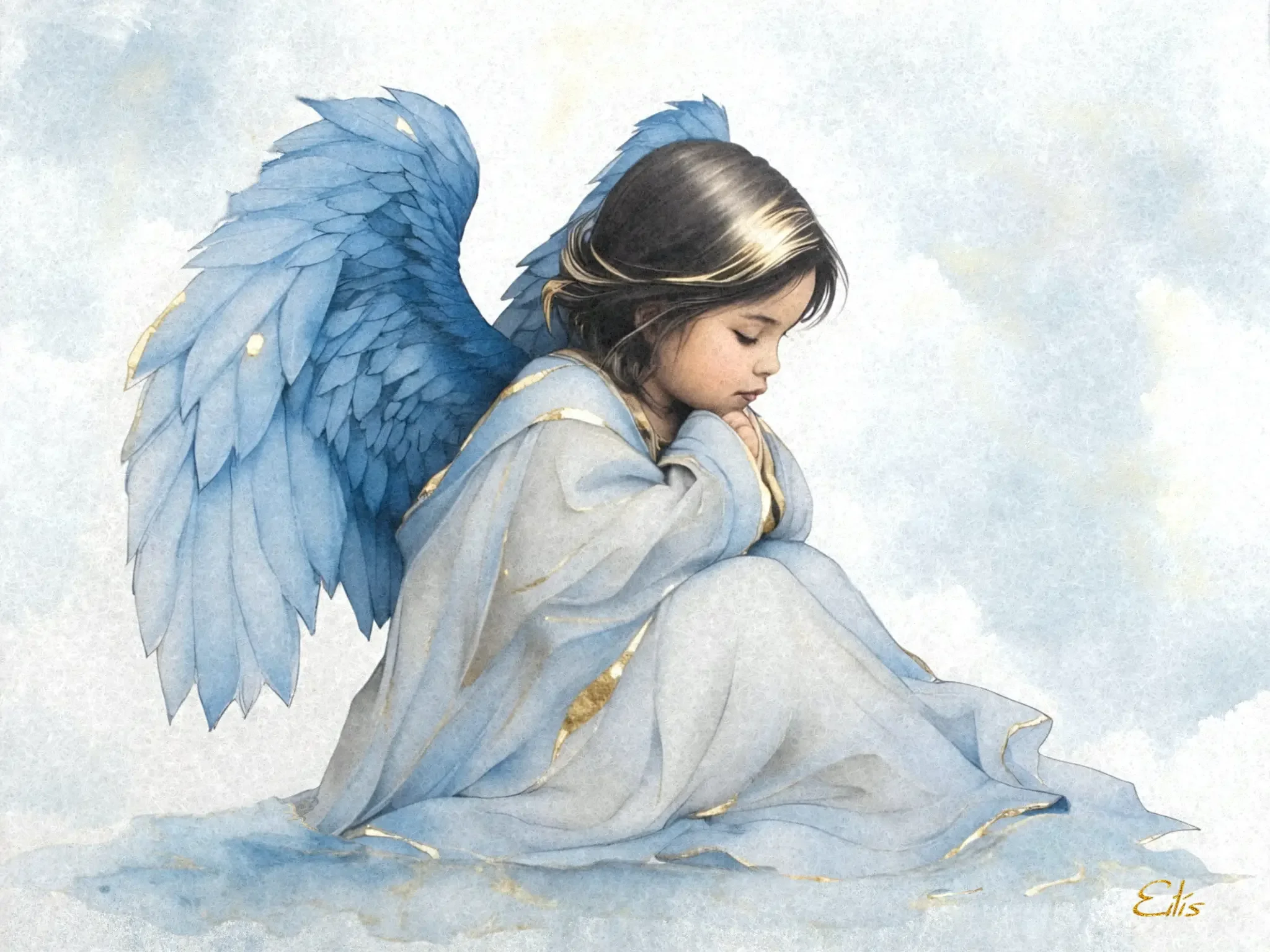
And then the child. Small and dark-haired, curled into its own body the way children sleep — with absolute trust, with the complete surrender of the utterly unguarded — wings spread wide above a small frame in pale blue robes threaded with gold. This is the one that stops me every time.
If the guardian angel is what we carried into this life from whatever we were before it — the part of us that remembers the state of pure light, even after years of embodiment have buried the memory under everything else — then perhaps the child is what keeps that memory alive the longest. Children know things. Not in the way that can be written down or argued over. In the way that gets forgotten the moment you try to explain it. The cherub does not explain anything. It simply sleeps, in the knowledge that it is held, in a trust so complete it does not require a name.
That trust is, perhaps, what the whole collection has been circling.
The dark figures and the luminous ones, the stone ones weeping light and the golden one blazing in its own fire, the choir standing in shared silence and the child sleeping in perfect unguarded peace — they are all the same question, held in twelve different ways.
What is the thing in us that was here before we were, and will continue after we are done? What watches, what grieves, what rises, what holds a rose in the dark and considers beauty a sufficient reason for everything?
I don't know the answer. I made twelve paintings trying to find out.