Carved by the Sea
A Fisherman's Tale
The village existed in that peculiar geography where land surrendered to sea without ceremony, where houses huddled against the wind like penitents. Thomas Carrick had lived there for sixty-seven years, though the sea had claimed so much of him that the years themselves seemed arbitrary—mere notations on a calendar that bore no relation to the true marking of time, which happened in the body: in the calcification of joints, the deepening of lines around eyes that had spent decades squinting against salt spray and oblique light.
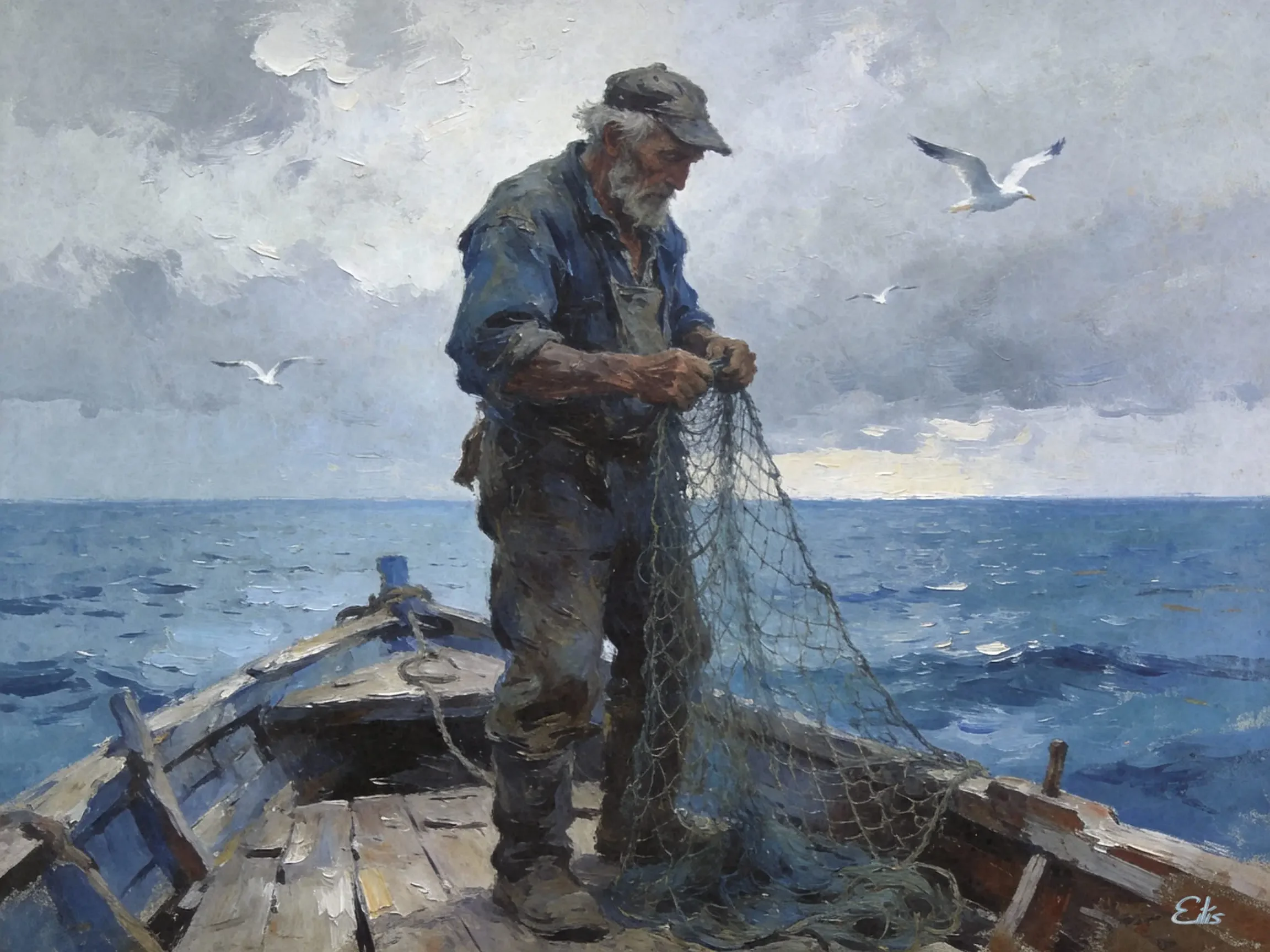
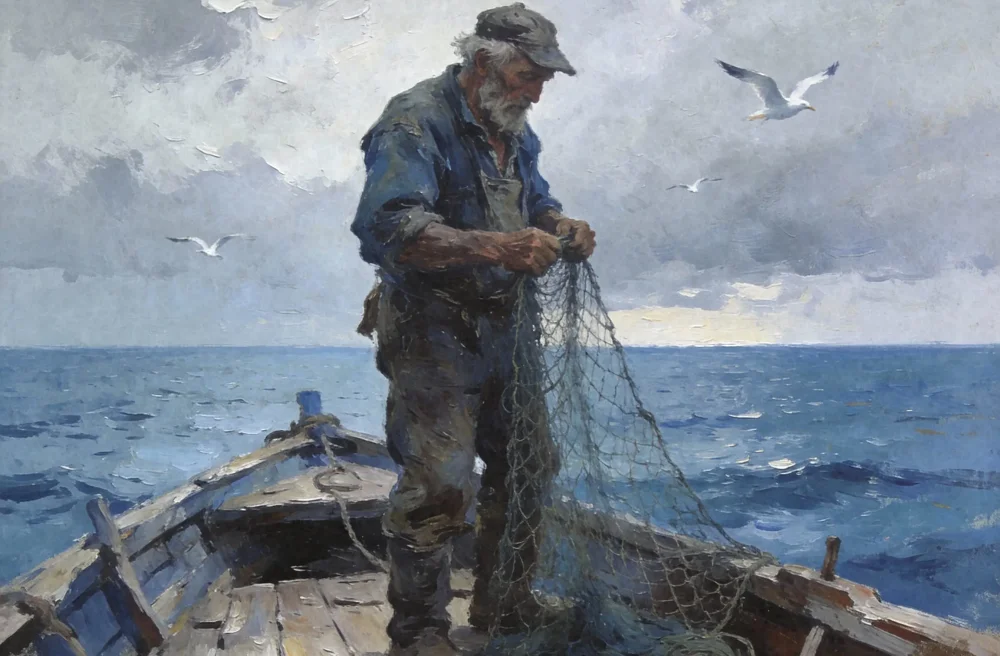
He sat now on the deck of the Constance, named for his wife who had been dead these twenty years, his hands working the nets with a mechanical precision that belied their arthritis. The morning had broken grey and diffident, the sun a pale disc behind cloud cover that turned the sea to pewter. His fingers moved through the mesh, feeling for tears, for weaknesses—this knowledge so deeply embedded in muscle memory that his mind was free to wander, to drift like the gulls that wheeled overhead, their cries sharp and accusatory.
The boy—though Charlie Brennan was nineteen now, hardly a boy—sat on the gunwale watching him. Thomas could feel the weight of that observation, the way the young man's gaze tracked his movements with an attention that was almost scholarly. Charlie had been coming out with him for three years now, since his own father had died of the cancer that had taken him too young—fifty-three, with a teenage son still at home and a whole life yet to live.
"You'll want to check the port side," Thomas said, not looking up. "Felt something snag yesterday, about halfway down."
Charlie moved with the careful economy of someone who had learned to respect the boat's moods, its tendency to pitch unexpectedly. Thomas watched from his peripheral vision as the boy—no, the young man—knelt and began his inspection. There was something touching in Charlie's earnestness, in the way he approached each task as though it contained some deeper significance. It reminded Thomas of himself at that age, before the sea had taught him that significance was a human invention, that the ocean itself was indifferent to meaning.
"Got it," Charlie called. "Nasty bit of tearing here. Must've caught on something sharp."
Thomas nodded, already reaching for the mending twine. His hands knew the work so intimately that he barely needed to look—the needle moving in and out, the knots forming with a deftness that seemed at odds with his gnarled fingers. He thought, not for the first time, how strange it was that his body could remember these movements when it had forgotten so much else: the exact timbre of Constance's laugh, the way his daughter Maggie had looked as a child, the taste of his mother's bread.
What remained was this: the texture of rope, the particular resistance of water against oar, the way the boat responded to the shifting of his weight. These things his body held with a fidelity that memory could not match.
"My da used to say," Charlie began, then stopped, uncertain.
Thomas glanced up, saw the hesitation in the younger man's face—that peculiar vulnerability that came from offering up fragments of the dead for examination. "Go on."
"He said you were the best fisherman in the village. Said you could read the water like other men read newspapers."
Thomas felt something tighten in his chest, not quite pain but its precursor. "Your father was a good man. A good fisherman too, better than he gave himself credit for."
This was true, though Thomas's relationship with Michael Brennan had been complicated by the particular awkwardness between generations—Michael had been twenty years younger, but they'd fished together for nearly fifteen years. They had worked in a companionable silence, but Thomas had never quite known how to bridge the distance between them, how to articulate the things that mattered beyond the practical considerations of catch and weather.
Now Michael was gone, and his son sat in his place, and Thomas felt the weight of inheritance—not of the work itself, but of all the unspoken things that passed between generations like genetic material, shaping destinies in ways neither party fully understood.
"Why did you name the boat after her?" Charlie asked, then immediately looked apologetic. "Sorry. That's—you don't have to answer that."
But Thomas found he wanted to answer, found that the question had unlocked something in him that had been dormant, waiting. "I named it after her because I was never with her," he said slowly, the words emerging with the careful deliberation of someone handling something fragile. "Always out here, always at sea. She was on land, waiting, and I was—" He gestured at the water surrounding them. "I was here. I thought if I named the boat for her, I could bring her with me somehow. Could carry her presence with me, even when I'd left her behind."
He paused, felt the old guilt surface—that familiar companion that had shaped so much of his interior landscape. "It didn't work, of course. A name's just a name. But by the time I understood that, she was gone, and the boat was hers anyway. Seemed wrong to change it."
Charlie was quiet for a long moment, his hands still on the net. Then: "Do you regret it? The fishing, I mean. All the time away?"
It was the kind of question only the young could ask—direct, unadorned by the elaborate courtesies that older men used to avoid actual intimacy. Thomas considered it seriously, felt his way around the edges of the answer.
"Regret's the wrong word," he said finally. "Regret implies choice, and I'm not sure I ever had that. The sea gets into you early here. It's not a calling exactly—nothing so grand. It's more like a current. You don't choose it so much as fail to resist it."
He set down the mended net, straightened with a wince that he tried to hide. His back had been troubling him more lately, a deep ache that settled in the lower vertebrae and radiated outward. "But if you're asking whether I'd do it differently, knowing what I know now—I honestly can't say. A different life would have made me a different person, and that person wouldn't be standing here able to answer your question."
Charlie absorbed this with the seriousness of someone committing it to memory. Thomas felt a sudden affection for the young man, for his earnestness and his willingness to probe at difficult truths. It was a quality that would either serve him well or cause him tremendous pain—possibly both.
"Right," Thomas said, breaking the moment before it could become uncomfortable. "Enough philosophy. We've got work to do."
They motored out past the harbour wall as the morning began its slow transformation into proper day, the sun burning through the cloud cover in fits and starts. Thomas stood at the wheel, his body absorbing the boat's movements with the unconscious skill of long practice. He could feel the sea's mood through the hull—not quite rough but unsettled, a restlessness in the water that suggested changing weather.
The fishing grounds lay three miles out, in deeper water where the continental shelf dropped away and the fish congregated in the upwellings. Thomas had been coming to this spot for five decades, had seen it in every season and weather condition, yet it never failed to move him—the way the land receded into abstraction, becoming a thin line on the horizon, and the sky opened up into that vast dome that made human concerns seem appropriately minuscule.
Charlie stood beside him, silent now, watching the water slide past. Thomas wondered what the young man saw when he looked at the sea—whether it still held mystery for him, or whether familiarity had reduced it to mere backdrop. For Thomas, the sea had only grown more mysterious with time, its patterns more complex, its moods more nuanced. He had learned, over the years, that true understanding didn't simplify—it revealed layers of complexity that had always been there, waiting to be perceived.
"What do you think about, out here?" Charlie asked, as though he had been following Thomas's train of thought.
Thomas considered the question. What did he think about? The truth was both simpler and more complicated than language could easily accommodate. He thought about everything and nothing—his mind ranging freely across memory and sensation, plans and regrets, settling nowhere for long. But there was also a quality to the thinking itself that was different out here, less linear, more associative. The sea did something to consciousness, expanded it somehow, or perhaps just revealed its natural state before the constraints of land-based living imposed their rigid structures.
"I think about the catch," he said, which was true but not the whole truth. "What we might bring up, where the fish might be running. But I also think about—" He paused, searching for the right words. "About how it all fits together. The tides and the moon, the temperature gradients, the migration patterns. It's all connected, you see. And once you start seeing those connections, you can't stop. Everything's related to everything else."
He gestured at the water, at the particular way the surface was moving—a chop that suggested crosscurrents, a confused sea state that would make the fishing more challenging. "That's what your father meant about reading the water. It's not magic. It's pattern recognition. Your brain learns to process all these small signs—the colour of the water, the behaviour of the birds, the smell of the air—and it puts them together into a picture. A prediction."
"Can you teach me that?" Charlie asked.
Thomas smiled, a small movement of his mouth that didn't quite reach his eyes. "I'm trying. But it's not something you can teach directly. It's like—you know how you can tell when someone's upset even if they're not saying anything? How you read their body language, their tone, all these tiny cues you're not even conscious of processing?"
Charlie nodded.
"It's like that. The sea has its body language, and you learn to read it. But it takes time. Years. And even then, it still surprises you. Still does things you didn't anticipate." He cut the engine, let the boat drift. "That's the other thing you learn. Humility. The sea doesn't care how much you think you know. It'll humble you every time you get too confident."
They set to work deploying the nets, the familiar choreography of their movements a dance they'd performed hundreds of times. Thomas felt his body slip into the rhythm of it, the pulling and the hauling, the careful management of weight and balance. His muscles complained—everything complained these days—but there was a satisfaction in pushing through the discomfort, in the knowledge that his body, despite its deterioration, could still perform these essential tasks.
The first haul was modest: a scattering of cod and haddock, a few flatfish, nothing exceptional. Thomas sorted through the catch with practiced efficiency, throwing back the undersized specimens, noting the overall health of the fish. There was an art to this too, a kind of diagnostic reading that told him about the state of the water, the food chain, the health of the ecosystem.
"Numbers are down," Charlie observed, and Thomas heard the worry in his voice.
"They are," Thomas confirmed. He didn't offer false comfort. The fishing had been declining for years now—overfishing, warming waters, pollution, all the various depredations of modern life taking their toll. "Your generation's going to have it harder than mine did. I won't lie to you about that."
"Then why keep doing it?" Charlie asked, and Thomas heard the real question underneath: Why should I keep doing it?
Thomas was quiet for a long moment, his hands continuing their work. Why indeed? The economics barely made sense anymore, the labour was brutal, the future uncertain. Yet here he was, sixty-seven years old, his body a catalogue of aches and pains, still coming out before dawn to pull nets from the cold Atlantic.
"Because it's what I know," he said finally. "Because there's dignity in the work, even when it's hard. Especially when it's hard." He looked at Charlie directly, holding the young man's gaze. "But you need to understand—that's my answer. It doesn't have to be yours. You're young. You've got options I never had. If there's something else you want to do, something else that calls to you, then you should do it. Don't let anyone tell you otherwise."
"What if nothing else calls to me?" Charlie asked, and Thomas heard beneath the question that particular confusion of young men who couldn't yet see the full map of their possible lives—the paralysis of too many paths obscured, too few certainties. Charlie was adrift in that liminal space where fishing felt inevitable not because he'd chosen it, but because he couldn't imagine what else there might be. The fear wasn't of making the wrong choice, but of having no sense of what the choices even were.
"Then you fish," Thomas said simply. "And you find meaning in the doing of it. But the meaning doesn't come automatic. You have to make it, every day. You have to decide that this matters, that it's worth the cost."
He turned back to the nets, giving Charlie space to process this. The sun had broken through properly now, illuminating the water in patches of diamond-bright reflection. Thomas felt its warmth on his face, closed his eyes for just a moment, letting the sensations wash over him: the sun and the wind and the rock of the boat beneath his feet, the cry of gulls and the smell of salt and fish, the particular quality of light that existed nowhere but on the water.
This was why he kept coming out. Not for the catch, not for the money, not even really for the tradition of it. But for these moments of pure sensory presence, when the boundary between self and world seemed to dissolve, when he was simply a point of consciousness existing in this particular configuration of light and water and time.
They worked through the morning, hauling and sorting, moving from spot to spot as Thomas followed instincts he couldn't fully articulate. The catch improved as the day wore on—a better haul of cod, some mackerel, a scattering of whiting. Enough to make the trip worthwhile, though not enough to be called exceptional.
Around midday they stopped for lunch, breaking out the thermoses of tea and the sandwiches they'd prepared that morning. Thomas sat on the gunwale, feeling the sun on his face, the pleasant exhaustion in his muscles. Charlie sat across from him, eating with the unconscious hunger of youth.
"Tell me about the big storm," Charlie said between bites. "The one in '97."
Thomas felt himself pulled back through time, the memory surfacing with visceral clarity. October 1997, a depression that had come racing in from the Atlantic with a ferocity that had caught everyone off guard. He'd been caught in it, five miles offshore, the Constance pitching in waves that rose like walls of dark water.
"What do you want to know?" he asked.
"What it was like. How you survived it."
Thomas sipped his tea, feeling its warmth spread through his chest. How did you describe something like that? The words available seemed inadequate to capture the reality of it—the terror and the awe, the way time had seemed to stretch and compress simultaneously, the absolute certainty of death followed by the shock of continued existence.
"It was—" He paused, searching. "It was like being inside chaos. The normal rules stopped applying. Up and down lost meaning. The waves weren't waves anymore—they were mountains, and they were moving, and you were moving with them whether you wanted to or not."
He could see it still, the precise shade of grey-green the water had been, the foam blowing horizontal in the wind, the way the boat had climbed each wave with agonising slowness before tipping over the crest into the trough beyond.
"I thought I was going to die," he said simply. "Not in a panic-stricken way, but as a kind of fact. The boat was taking on water, the engine was screaming, and I just thought: 'Well, this is it, then. This is how it ends.'"
"But it didn't," Charlie said.
"No." Thomas smiled slightly. "The thing about surviving something like that is it doesn't feel heroic at the time. Doesn't feel like you've done anything special. You just keep going through the motions—bailing water, trying to keep the bow into the waves, holding on. And then at some point you realise the waves are getting smaller, the wind's dropping, and you're still alive."
He was quiet for a moment, remembering the strange deflation that had followed, the way survival had felt almost anticlimactic after the intensity of the storm itself. "Your father came out to meet me as I limped back into harbour. Helped me secure the boat. We didn't talk much—just worked together getting everything sorted. But I remember he clapped me on the shoulder before he left, and there was something in that gesture—an acknowledgement, I suppose. Of what I'd been through, of the fact that I'd made it back."
"Did it change you?" Charlie asked. "The storm?"
Thomas considered this. Had it changed him? He was a different person now than he'd been before October 1997, but how much of that was the storm and how much was simply the accumulated effect of time and experience?
"It clarified things," he said finally. "Made me understand that I wasn't in control, had never been in control. All my skill, all my knowledge—in the end, it came down to luck. Being in the right place at the right time, the boat holding together just long enough, the waves breaking in my favour rather than against me." He paused. "There's a kind of freedom in accepting that. Once you know you're not in control, you stop trying to be. You just do what needs doing and accept the outcome."
Charlie absorbed this in silence, and Thomas wondered if the young man could truly understand what he was saying, or if some truths could only be grasped through direct experience. You could tell someone about fear, about transcendence, about the way extreme circumstances stripped away the inessential and left you face-to-face with something fundamental—but until they'd lived it themselves, the words remained abstractions.
"Right," Thomas said, standing with a grunt. "Break's over. Let's see what else the sea's willing to give us today."
The afternoon passed in steady labour, the rhythm of work creating a kind of meditation. Thomas found his mind drifting again, ranging across memory and thought like a bird skimming the water's surface. He thought about Constance, about the life they'd built together in the spaces between his trips to sea. She'd been patient with his absences, understanding that the fishing wasn't something he could simply choose to stop. But he knew now what he hadn't fully grasped then: that patience wasn't the same as acceptance, that understanding didn't eliminate loneliness.
She'd died in the winter, pneumonia progressing with shocking speed from mild illness to critical. Thomas had been offshore when it happened, unreachable in the days before mobile phones. By the time he'd returned, she was already in the ground, and his daughter Maggie's face had held a reproach she'd never quite voiced: You weren't there.
He hadn't been there for so many things. Maggie's school plays, her graduations, her first word, her first steps. Always offshore, always chasing fish, always believing there would be more time later to make up for the absences. But time didn't work that way. The missed moments didn't accumulate credit you could spend later—they were simply gone, leaving gaps in the narrative of the relationship that could never quite be filled in retrospectively.
Maggie lived in Edinburgh now, worked in finance, and came back to visit perhaps twice a year. They spoke on the phone weekly, conversations that were affectionate but slightly formal, as though they were relatives who'd met only recently and were still learning each other's rhythms. Thomas knew this distance was his fault, the price of all those absences, but knowing it didn't make it easier to bridge.
"You alright?" Charlie asked, and Thomas realised he'd been standing still, his hands motionless on the nets, lost in thought.
"Fine," he said, resuming his work. "Just woolgathering."
But Charlie was watching him with that particular attention again, and Thomas felt seen in a way that was both uncomfortable and oddly welcome. The young man had an emotional intelligence that Thomas had lacked at that age—a willingness to sit with complexity, to not shy away from difficult feelings.
"Do you ever—" Charlie started, then stopped.
"Go on."
"Do you ever wish you could go back? Do things differently?"
Thomas considered the question seriously. Did he wish he could go back? The honest answer was yes and no simultaneously—yes, he would make different choices, spend more time on land, be more present for the people he loved. But also no, because he couldn't imagine being anyone other than who he was, and that person had been shaped by exactly these choices, these absences, this particular relationship with the sea.
"I wish I'd understood sooner that time is the only resource that matters," he said slowly. "Money, you can always make more of. Opportunities come around again. But time—" He shook his head. "Once it's gone, it's gone. And we never know how much we have. We act as though we're immortal, as though there will always be another chance to say the important things, to show up for the important moments. But that's a lie we tell ourselves."
He looked at Charlie directly. "You're young. You've got time still. Don't waste it the way I did. Don't let the work—any work—become more important than the people you love. Because in the end, when you're sitting on a boat at sixty-seven, tired and aching and alone, it's not the fish you'll remember. It's the faces. The voices. The moments of connection you either had or didn't have."
Charlie nodded slowly, and Thomas hoped the young man was really hearing him, really taking it in. But he also knew that some lessons could only be learned through living, that warnings from the old rarely carried the weight of personal experience.
They headed back to the harbour in late afternoon, the hold reasonably full, the day's work done. Thomas stood at the wheel, guiding the Constance through the familiar waters, and felt the particular satisfaction that came from honest labour completed. His body ached—back and shoulders and knees, the whole catalogue of complaints—but it was a good ache, earned.
The village came into view gradually, the houses resolving from abstract shapes into specific structures he knew intimately. There was the pub where he drank his Friday pint, the church where Constance was buried, the primary school where Maggie had learned her letters. This was his geography, these landmarks the coordinates by which he oriented himself in the world.
The harbour wall rose up, weathered stone that had stood for two centuries, protecting the fishing boats from the worst of the Atlantic's moods. Thomas manoeuvred the Constance into her berth with practised precision, feeling the boat respond to the wheel like an extension of his own body. Charlie jumped onto the dock to secure the lines, his movements efficient and sure.
They worked in familiar rhythm, unloading the catch, hosing down the deck, stowing the gear. It was ritual by now, this end-of-day choreography, each movement prescribed by tradition and necessity. Thomas felt the weight of all the other men who'd performed these same actions, generations of fishermen going back centuries, and felt himself part of that continuum, a link in a chain that stretched backwards into history and forward into an uncertain future.
"Same time tomorrow?" Charlie asked, and Thomas nodded.
"If the weather holds."
Charlie headed off toward his mother's house, and Thomas watched him go, feeling a complex mixture of emotions he couldn't quite parse. Affection, certainly. Hope that the young man would find his way to a good life. But also a kind of grief for all the paths not taken, all the versions of himself he'd never become because he'd chosen this one—this particular relationship with work and sea and solitude.
He locked up the boat, performed his final checks with the automatic thoroughness of long habit, then made his way along the dock toward home. The sun was setting now, painting the sky in shades of orange and pink that reflected off the water in shimmering bands. It was the kind of evening that tourists would photograph, trying to capture something of its beauty to take home with them. But beauty was the wrong word, Thomas thought. What he felt looking at this sky wasn't aesthetic appreciation but something more fundamental—a kind of recognition, an acknowledgement of his place in the natural order of things.
His cottage sat at the edge of the village, a two-room stone structure that had been in his family for three generations. Inside, it was neat but sparse, the accumulation of a lifetime pared down to essentials. Thomas moved through the space in the gathering darkness, not bothering to turn on lights yet, letting his body memory guide him to the chair by the window.
He sat and looked out at the harbour, at the Constance bobbing gently at her mooring, and felt the day settle into his bones. This too was ritual—this moment of quiet reflection, of accounting. He thought about the catch, about Charlie's questions, about the way the light had looked on the water at noon. He thought about Constance and Maggie and Michael Brennan, all the people who'd shaped his life in ways large and small.
And he thought about the sea—about its constancy and its changeability, about how it had been the one relationship in his life that had never disappointed or surprised him, because he'd never expected it to be anything other than what it was. The sea wasn't kind or cruel, wasn't there to teach lessons or provide meaning. It simply was, in all its terrible indifference, and there was a strange comfort in that absoluteness.
The summer progressed in a rhythm of identical days—out before dawn, back in late afternoon, the variations so subtle that only someone attuned to the sea's moods would notice them. The catch remained modest but adequate, enough to keep the Constance running, to pay for fuel and maintenance and the other costs of fishing. Thomas continued teaching Charlie, though he was increasingly aware that teaching was perhaps the wrong word. What he was really doing was providing a context in which the young man could learn himself, could develop his own relationship with the work and the water.
"Tell me about the best catch you ever had," Charlie said one morning, as they were hauling nets in a thick fog that reduced visibility to a few metres.
Thomas smiled at the question. The best catch. How did you measure that? By weight, by value, by the effort required to secure it? Or by some more intangible quality—the conditions under which it was made, the meaning it held in the larger narrative of a life?
"Summer of '73," he said. "I was just twenty years old, still learning the trade from my father. We'd gone out early, just the two of us, to a spot he'd been fishing for forty years. He had this intuition—said he could feel that something big was running."
Thomas paused, the memory vivid despite the decades. "We hauled in more cod that day than I'd ever seen. Just nets full of fish, big healthy ones, more than the boat could really hold. We had to throw some back because we were sitting so low in the water."
He looked at Charlie, making sure the young man understood. "But that's not why it was the best catch. It was the best because of my father—the way he was that day. Usually he was quiet, kept things to himself. But that morning he was telling me stories about his own father, about learning to fish as a boy, about the war years when fish were scarce and every catch meant the difference between eating and going hungry."
Thomas felt a tightness in his throat, that particular ache that came from touching old grief. "He died that winter. Heart attack while he was mending nets in the shed. I found him when I came in from school. So that summer day—that was our last good day together, the last time I saw him truly happy in his work. That's what made it the best catch."
Charlie was quiet, absorbing this. Then: "What was he like? Your father?"
"Hard," Thomas said immediately. "The way most men were then. Didn't show emotion, didn't talk about feelings. But there was kindness underneath, even if he couldn't express it directly. He showed his love through teaching, through patience with my mistakes." He smiled slightly. "Sounds familiar, probably."
"You're not hard," Charlie said.
Thomas laughed, a brief bark of amusement. "I'm not? Tell that to my daughter. She might have a different perspective."
"That's different though, isn't it? Family's complicated in ways work isn't."
"True enough." Thomas secured the net they'd been hauling and began sorting the catch. "But the complication comes from caring too much, not too little. If I'd been better at showing that—at saying the important things instead of assuming they were understood—maybe the relationship would be less complicated now."
They worked in silence for a while, the fog pressing in around them, muffling sound, reducing the world to this small bubble of boat and water and grey air. Thomas found he liked fishing in fog—the way it forced attention inward, the way it made every sound more immediate and distinct. It was like being suspended between worlds, neither fully at sea nor quite on land.
"I'm thinking of asking Sarah to marry me," Charlie said suddenly, and Thomas heard the vulnerability in the confession.
Thomas looked up, studied the young man's face. Sarah McKenzie, the doctor's daughter, a teacher at the primary school. Thomas knew her slightly—a sensible woman, warm but with a practical streak that suggested she wouldn't tolerate nonsense. A good match for Charlie, if matches could be judged from the outside.
"What's stopping you?" he asked.
Charlie gestured at the boat, at the water, at everything the gesture encompassed. "This. The fishing. The uncertainty of it. I can't promise her a stable future, can't guarantee I'll make enough to support a family. And the hours—she'd be alone most of the time, just like—"
He stopped, but Thomas heard the rest of the sentence: just like your wife was.
"Like Constance," Thomas finished for him. "You can say it. It's true."
He set down the fish he'd been holding, turned to face Charlie fully. "Look. I can't tell you what to do. But I can tell you this—you're thinking about it wrong. You're not choosing between Sarah and the fishing. You're choosing what kind of life you want to build, and with whom. And if Sarah is the person you want to build that life with, then you have to trust that she can make her own decisions about what she's willing to accept."
"But what if I'm making the same mistake you did?" Charlie asked, and there was real anguish in his voice. "What if I put the work first and lose everything that matters?"
Thomas felt the question land like a punch, felt the truth of it reverberating. "Then you'll have made that mistake," he said quietly. "And you'll live with it, like I have. But Charlie—" He paused, making sure the young man was really listening. "The mistake wasn't the fishing. The mistake was not being present even when I was on land. Not saying the important things. Not making the choice, every day, to prioritise the people I loved."
He reached out, gripped Charlie's shoulder. "You can fish and be a good husband. They're not mutually exclusive. But you have to work at it. Have to make the intention conscious instead of just letting life happen to you. Ask yourself every day: Am I doing right by the people I love? And if the answer is no, change what you're doing."
Charlie nodded slowly, and Thomas could see him processing this, turning it over in his mind. "Did you love it?" the young man asked. "The fishing. Did you love it enough to make it worth the cost?"
It was perhaps the most penetrating question anyone had ever asked him, and Thomas felt himself reaching for an answer that would be both honest and helpful. Did he love it? The word felt simultaneously too small and too large for what he felt.
"I don't know if love is the right word," he said finally. "It's more like—this is who I am. The sea's in my bones, in the way I think and see and understand the world. I can't separate myself from it any more than I can separate myself from my own history. And yes, there was a cost. There's always a cost. But the alternative—being someone I wasn't, living a life that didn't fit—I don't know if that would have been any better. Different regrets, maybe. Different losses."
He released Charlie's shoulder and turned back to the work. "What I'm saying is: there's no right answer here. Just choices, and consequences, and the life you build from those. You make your choice, and you live with it, and you try to do it as well as you can. That's all any of us can do."
Late August brought a change in the weather—the first hints of autumn arriving in the quality of the light, in the morning chill that took longer to burn off. Thomas felt the shift in his body, the way his joints ached more in the cold, the way he tired more easily. Sixty-seven was old for a fisherman, especially one who'd spent his entire life on the water. He knew, with a clarity that brought no comfort, that he was approaching the end of his working life.
The question was what came after. Retirement felt like a death sentence, a surrender to irrelevance. But he also recognised that he couldn't keep going indefinitely, that there would come a day when his body simply refused to do what he demanded of it.
"You should come visit more," Maggie said during one of their phone calls. "Stay for more than a day or two. Actually spend time here, get to know the grandchildren properly."
Thomas felt the familiar guilt surface. Maggie had two children now—Emma, fourteen, and Jack, eleven—and he barely knew them. They were polite strangers who called him Grandad but had no real relationship with him, no shared memories or inside jokes. He saw them perhaps twice a year, brief visits that never quite bridged the distance.
"I'd like that," he said, meaning it. "Once I'm done with the fishing, I'll have more time."
"You've been saying that for years, Dad."
It was true, and they both knew it. He'd always found reasons to put it off, to stay in the village, to remain close to the sea even when he wasn't actively working. But now, facing actual retirement, he felt the urgency of it—the recognition that time was finite and running short.
"I mean it this time," he said quietly. "I'm finishing up end of October. Selling the boat. After that, I'll come. Properly. For a few weeks, maybe longer."
There was a pause, and he could hear the cautious hope in Maggie's voice when she spoke again.
"That's—" He found his voice catching, had to clear his throat. "That's good, love. Really good. I want that too."
"We'd like you to be involved," Maggie continued. "More involved than you have been. The children ask about you, you know. Wonder why Grandad doesn't come to visit."
It was both an invitation and an accusation, and Thomas felt the weight of both. "I'll do better, Mags. I promise."
Even as he said it, he knew promises were cheap, that what mattered was action. But he meant it nonetheless—meant to do better, to be present, to not make the same mistakes twice.
After they hung up, Thomas sat in his chair by the window, watching the harbour in the fading light. Emma and Jack. His grandchildren. Fourteen and eleven years old, and he barely knew their favourite subjects at school, what music they listened to, what dreams they had. He'd missed so much already—first steps, first words, school plays, birthday parties. All the small moments that built a relationship.
But there was still time. Not much, perhaps—he was sixty-seven, and who knew how many years he had left? But enough, maybe, to build something real. To be present in their lives in a way he'd never quite managed with Maggie.
He thought about the stories he could tell them—about the sea and fishing and the life he'd lived. But also, he hoped, he could show them something more important: that it was never too late to change, never too late to choose differently, never too late to show up for the people you loved.
The evening darkened into night, and Thomas remained at his window, thinking about time and legacy and the shape of a life. He had lived, he realised, in the conditional tense—always thinking about what he would do later, what he would say when he had more time, when conditions were better. But the conditional tense was a trap, a way of avoiding the present moment's demands.
No more, he thought. Whatever time he had left, he would live it in the present tense. Would make the choices consciously, would say the important things, would show up in the ways that mattered.
September brought storms, the autumn gales arriving with their usual mix of fury and beauty. Thomas and Charlie went out less frequently, choosing their days carefully, respecting the sea's moods. On the days when they couldn't fish, Thomas worked on the boat, performing the endless maintenance that kept the Constance seaworthy.
Charlie joined him often, the two of them working side by side in the boat shed, their conversation ranging freely across topics both practical and philosophical. The young man was changing, Thomas noticed—developing a confidence that went beyond technical skill, a kind of settledness that suggested he was making peace with his choices.
"I asked her," Charlie said one afternoon, as they were replacing a section of planking on the starboard side. "Sarah. She said yes."
Thomas straightened, felt genuine happiness expand in his chest. "Congratulations. When's the wedding?"
"Spring, we think. April, maybe. Before the busy season starts." Charlie was grinning, his whole face transformed by joy. "You'll come, won't you? I'd like you to be there."
"I wouldn't miss it," Thomas said, and meant it absolutely. He thought about weddings, about beginnings, about the optimism that let two people stand up in front of their community and promise forever despite all evidence of human fallibility.
"Will you—" Charlie hesitated. "Would you stand up with me? As a groomsman, I mean. I know it's usually friends, but you've been—you've meant a lot to me. Taught me a lot."
Thomas felt something catch in his throat, that particular tightness that came from unexpected emotion. "I'd be honoured," he managed.
They returned to their work, but something had shifted; some barrier had been crossed. Thomas felt the weight of the responsibility Charlie was giving him, the trust implicit in the invitation. To stand with someone on their wedding day was to witness their choice, to support them in the life they were building. It was not a role to be taken lightly.
"Have you thought about what comes after?" Thomas asked. "After the wedding, I mean. What do you want from life?"
Charlie nodded slowly. "We want kids. Probably three or four. Want to stay in the village, raise them here like we were raised. And I want to keep fishing—at least for now, while it's still viable. But I'm also thinking about diversification. Maybe starting a side business taking tourists out for sea fishing trips. Something that could provide income when the commercial fishing gets too unpredictable."
Thomas approved of this thinking—the pragmatism, the forward planning, the recognition that adaptation was survival. Charlie was going to be alright, he thought. Was going to build a good life for himself and his family.
"And you?" Charlie asked, turning the question around. "What do you want from the time you have left?"
It was asked without malice, just simple directness, but Thomas felt the reminder of his mortality nonetheless. What did he want? The answer came with surprising clarity.
"I want to be present," he said. "Want to know my grandchildren—really know them, not just see them occasionally. Want to repair what I can with Maggie, even if it's too late for some things. And I want—" He paused, surprised by what he was about to say. "I want to put it down. The fishing, I mean. Want to step away while I still can, on my own terms, rather than waiting until my body forces the decision."
Saying it aloud made it real, made it a decision rather than a vague future possibility. Thomas felt both fear and relief—fear at the prospect of identity dissolution, of not knowing who he was without the work, but also relief at the thought of rest, of mornings spent somewhere other than on the water.
"When?" Charlie asked quietly.
"End of the season," Thomas said, the decision crystallising as he spoke. "I'll fish through October, then sell the boat. Someone should have her who can put her to proper use."
"I could buy her," Charlie offered immediately. "If you're willing to sell to me."
Thomas considered this. The Constance going to Charlie—there was a rightness to it, a sense of continuity that appealed to him. The boat had been his, and before him his father's, and now it would be Charlie's, and perhaps someday Charlie's children's. The chain continuing, adapted to new circumstances but fundamentally unbroken.
"We'll talk about it," he said. "Work out terms that make sense for both of us."
They returned to their work, but Thomas felt the conversation settling into him, reshaping his understanding of his future. Three more months on the water, and then—what? He didn't know exactly, but for the first time in years, he felt something like anticipation for what came next.
October arrived with its particular quality of light—sharp and golden, painting everything in shades of amber and bronze. Thomas fished through the month with a heightened awareness, paying attention to details he might previously have overlooked, trying to memorise the way the morning light looked on the water, the smell of salt and fish, the precise feel of the wheel under his hands.
These were his last trips, and he wanted to hold them carefully, not to let them slip past unconsidered. Each morning felt weighted with significance, each task performed with the knowledge that he was doing it for the last time—or if not the last time, then as part of a finite sequence that was drawing to its close.
Charlie noticed, of course. "You're being nostalgic," he said one morning, not unkindly.
"I am," Thomas admitted. "Trying to fix it in memory. This—" He gestured at everything: the boat, the water, the distant line of coast. "All of this. It's been my whole life. Want to make sure I remember it properly."
"You'll still come out sometimes, won't you? Even after you sell the boat?"
"Maybe," Thomas said, though he suspected he wouldn't. Some things needed clean breaks, needed definitive endings rather than gradual fade-outs. He would visit the harbour, would stand on the dock and watch the boats come and go, but getting back on the water—that would be too hard, too much like haunting his own life.
The fishing that month was good—better than it had been in years, as though the sea was giving him a parting gift. They brought in full nets, healthy catches of cod and haddock and mackerel, enough that Thomas ended the month with the best profits he'd seen in a decade.
"Going out on a high," Charlie observed, and Thomas nodded.
"Better than the alternative."
The last day of October arrived grey and cold, the kind of morning that suggested winter's arrival. Thomas woke before dawn as he always did, made his tea, and sat by the window watching the harbour come to life. This was it, then. The last trip. The end of a life's work.
He felt surprisingly calm, no second-guessing, no desperate urge to reconsider. Just a quiet acceptance that this chapter was closing, that it was time.
Charlie was waiting at the dock, his face serious. He knew what today meant, had perhaps understood before Thomas himself had fully accepted it. They prepared the boat in their familiar silence, the ritual of departure performed one final time.
The morning was rough, a chop on the water that made the going slow and uncomfortable. Thomas stood at the wheel, feeling every pitch and roll, his body absorbing the punishment with the automatic adjustments of long practice. This, he thought. This was what he would miss—not any specific moment, but the accumulated experience of it, the way his body knew the sea's rhythms better than it knew anything else.
They fished hard through the day, pulling net after net, sorting catch with efficient focus. It was good work, honest work, and Thomas let himself sink into it completely, let everything else fall away until there was just the immediate present: the pull of rope, the smell of fish, the cry of gulls overhead.
As the afternoon began its slide toward evening, Thomas made the decision to head back. Charlie looked at him questioningly—they still had another hour of good fishing time—but Thomas shook his head.
"It's enough," he said simply.
The return journey was quiet, both of them wrapped in their own thoughts. Thomas stood at the wheel, guiding the Constance through the familiar waters one last time, and felt the weight of ending press on him. Not sad, exactly—he'd had his time, had lived this life fully—but aware of loss nonetheless, of all the mornings on the water that would now belong to other people, other lives.
The harbour appeared ahead, the village lights beginning to come on in the gathering dusk. Thomas brought the boat in with the precision of five decades' practice, the movements automatic, deeply embedded. Charlie secured the lines, and Thomas cut the engine, felt the sudden silence that always followed, that moment of transition between the engine's noise and the quieter sounds of harbour and village.
They unloaded the catch in silence, working with the smooth coordination of long partnership. The light was fading now, the sky turning that particular shade of purple-grey that came just before full dark. Thomas performed his final checks, moving around the boat with careful attention, touching familiar surfaces, saying goodbye in the only way he knew how.
"That's it, then," he said finally, more to himself than to Charlie.
The young man nodded, then surprised Thomas by pulling him into a brief, fierce embrace. "Thank you," Charlie said quietly. "For everything. For teaching me. For—for being here."
Thomas returned the embrace, felt the complicated knot of emotion in his chest loosen slightly. "You're going to be fine," he said. "Better than fine. You'll do well out here."
They separated, both slightly embarrassed by the display of feeling. Charlie headed off toward Sarah's house, and Thomas stood alone on the dock, looking at the Constance one last time. She sat low in the water, tired but sound, ready for her next life with her next owner.
"Well," Thomas said aloud, though there was no one to hear him. "That's done, then."
He walked home through the village, taking his time, looking at everything with fresh attention. The pub where he'd drunk his Friday pints, the church where Constance was buried, the primary school where Sarah taught and where, someday, Charlie's children would learn their letters. This was his world, these few square miles of coast and harbour and stone houses. He had lived his entire life within this circumscribed geography.
At home, he sat in his chair by the window, watching the harbour lights reflect off the dark water. He was tired—bone-deep, comprehensively tired in a way that went beyond physical exhaustion. But there was also a quiet satisfaction, a sense of work completed, of having seen something through to its proper end. The day settled into memory, this last trip adding itself to the vast catalogue of experiences that comprised his working life.
The phone rang, and Thomas answered to hear Maggie's voice. "Dad? Just wanted to check in. How are you?"
"I'm fine, love," he said, and realised he meant it. "Just finished my last day of fishing."
"How do you feel?"
Thomas considered the question. How did he feel? Tired, certainly. Sad, in a way. But also something else—something he couldn't quite name but that felt like peace, like acceptance, like coming to rest after a long journey.
"Ready," he said finally. "I feel ready."
They talked for a while, about the grandchildren and plans for Christmas, about his upcoming visit to Edinburgh, about ordinary things that felt newly significant. When they hung up, Thomas remained in his chair, looking out at the night. The sea would go on without him—the boats would still go out, the fish would still run, the tides would still turn. But he had been here, had lived this life, had passed on what he knew to Charlie, who would pass it on in turn. The cycle would continue.
Epilogue: Spring
Thomas sat on the harbour wall, watching Charlie bring the Constance into berth. The young man had owned the boat for five months now, and had already made subtle changes—new equipment, updated electronics, small improvements that showed both respect for the boat's history and willingness to adapt to changing conditions.
"How was it?" Thomas called as Charlie secured the lines.
"Good. Really good, actually. Brought in a nice haul of cod."
Thomas felt the familiar pull—the urge to step aboard, to check the catch, to offer advice. But he resisted it. This was Charlie's boat now, Charlie's life, Charlie's work. Thomas's role was to observe, to support, but not to interfere.
They walked together toward the village, Charlie giving him the day's details—where he'd fished, what he'd caught, conditions on the water. Thomas listened with the part of himself that would always be a fisherman, tracking patterns, noting variations, building mental maps of where the fish might be running.
"Wedding's in two weeks," Charlie said as they approached the church. "Everything's coming together. Sarah's in full planning mode—I just try to stay out of the way and agree with whatever she says."
Thomas smiled. "That's probably wise."
They parted at the church corner, Charlie heading home to Sarah, Thomas continuing toward his cottage. But he didn't go inside immediately—instead, he detoured to the churchyard, to the weathered stone that marked Constance's grave.
He came here every day now, without fail. Rain or shine, early morning or late afternoon, Thomas made his pilgrimage to this quiet corner of the churchyard. It had become essential to him, this daily conversation with the woman he'd left behind so many times during their years together.
The visits were his atonement, though he knew atonement was perhaps too grand a word for what he was doing. He simply came and told her things—small things, ordinary things. The things he should have told her when she was alive, but had been too busy, too preoccupied with tides and catches and the endless demands of the sea.
"I sold the Constance to Charlie Brennan," he said, settling into his familiar position beside the headstone. "Michael's boy. Remember Michael? You always said he had kind eyes. Charlie's got his father's eyes and his father's way with the boat. He's doing well with her, Con. Taking real good care."
The wind moved through the churchyard, stirring the grass, and Thomas felt the familiar ache in his chest—grief that hadn't diminished with time, only changed shape, become something he could carry.
"Maggie's coming for the wedding in two weeks. Bringing David and the children. Emma's fourteen now—can you believe it? And Jack's eleven. Growing up so fast, and I've missed so much of it." He paused, felt his throat tighten. "But I'm going to do better. I've got time now. No more excuses about the fishing, about the season, about the catch. I'm going to Edinburgh next month, staying for three weeks. Really getting to know them."
He told her about the last day's fishing, about the grey morning and the way Charlie had worked the nets, about the quiet satisfaction of finishing well. He told her about the weariness in his bones and the strange peace he'd found in stepping away. He told her everything, the way he wished he'd done when she was alive to hear it.
"I know I wasn't there enough," he said quietly. "I know I chose the sea over you more times than I can count. I told myself you understood, that you knew it wasn't personal, but—" He stopped, gathered himself. "But that wasn't fair to you, was it? You deserved better. Deserved someone who was actually present, not just a name on a boat that was always somewhere else."
A seagull landed on the churchyard wall, unusually close, and fixed him with its bright, unblinking eye. Thomas looked back at it, startled by its boldness.
The bird tilted its head, studying him with what seemed like recognition. Then it opened its beak and let out a single, clear cry—not the harsh screech gulls usually made, but something softer, almost musical. A sound that seemed to carry both acknowledgement and release.
Thomas felt something shift in his chest, some long-held tension loosening. He thought about Constance and how she'd always loved the gulls, had fed them scraps from the kitchen window, had laughed at their boldness and their absurd dignity. "The comedians of the sea," she'd called them.
The gull cried out once more, then spread its wings and lifted into the air, circling twice over the grave before heading toward the harbour. Thomas watched it go, watched it become a white speck against the darkening sky, and felt tears on his cheeks.
"I loved you," he said to the stone, to the wind, to whatever remained of Constance in this place or in the world. "I still love you. I was never good at saying it, never good at showing it the way I should have. But it was always true. You were always—" His voice broke. "You were always the one I came home to. Even when I came home too late, or not often enough. It was always you."
The evening had deepened into dusk, the churchyard filling with shadows. Thomas stood slowly, his knees protesting, and laid his hand on the cool stone of the headstone.
"I'll be back tomorrow," he said, as he always did. "I'll tell you how the wedding preparations are going. Whether Charlie's panicking yet." He managed a small smile. "You would have liked Sarah, I think. She's steady. Good for him."
He walked home through the gathering dark, and for the first time in twenty years, he felt something like forgiveness—not just Constance's, if the seagull had indeed been some sign of her presence and her grace, but his own forgiveness of himself. The acknowledgement that he had done his best with the understanding he'd had, even if his best hadn't been enough. That he had loved, even if he'd loved poorly. That there was still time—not to undo the past, but to build something better from what remained.
At home, he sat in his chair by the window and picked up his book. Outside, the harbour lights glimmered on the dark water, and somewhere in the distance, a gull cried out once more—a sound that seemed, to Thomas's ears, almost like benediction.