Celtic Mystic
The Standing Stones
The cottage smelled of damp stone and the pine tar her grandmother had used on the door frames, and underneath both of these the older smell of turf, which had not been burned in the grate for almost two years now and yet had soaked itself so deeply into the granite that Niamh suspected it would be there long after the cottage was gone, the way certain perfumes survived their wearers. She set her bag down on the kitchen flags. She did not turn on a light. The west-facing window held the last of the day, a blueing slow-going light that lay across the table in a long parallelogram, and she stood in the middle of the room for what might have been a minute or might have been several, feeling the house settle around her — the small clicks of cooling slate, the low hum of the empty fridge — as it had used to settle around her grandmother in the long blue evenings of Niamh’s childhood, when the woman would sit at this same table peeling something or mending something or simply watching the dusk arrive.
She had driven from Dublin in a little under four hours. She had stopped only to fill the car at Athlone, where she had stood in the petrol station forecourt with her hand still on the pump and had cried, briefly and without ceremony, the way a tap drips before being turned off properly. She had been doing this, on and off, for three weeks. The crying came when it came. It was, by now, almost without content — the body simply produced it, the way certain weather produced rain — and she had stopped trying to attach meaning to each occurrence. Patrick had moved his clothes out on the seventeenth of April. He had been very kind about it, which she had found, in some perverse part of herself, harder than cruelty would have been; cruelty would at least have given her a clean wall to push against.
The kindness had been real, once. She gave him that, even now. In the early years he had brought her tea in the mornings and listened to her account of her day with the small attentive lean that had made her, at twenty-seven, feel for the first time properly seen. But kindness, she had come to understand, was a perishable thing if it was not regularly exercised on its actual object. Patrick’s had hardened, by very slow degrees, into a habit, and the habit had calcified by some quiet geology of its own into something that wore the shape of kindness but no longer carried its substance — a politeness so reliable in its observances that one could live alongside it for years without noticing that the man inside it had, by inches, gone elsewhere. He had not left her for someone else. He had left, she now thought, because he had run out of reasons to stay. His leaving had been kind because his staying had also been kind, in the same exhausted way, and there had at the end been nothing in him invested enough to make the difference. The kindness had left her holding the marriage in her hands like something whose handle had come away, with no clear sense of where to set it down.
Her grandmother had said, if it ever goes wrong, a leanbh, you go to the field. You sit with the Seven and you let them have a look at you, and you’ll come away knowing what you didn’t know going in.
Niamh, twenty at the time and reading geology at Trinity, had laughed. Mamó, she had said, they’re stones. They are extremely old metamorphic stones, and they don’t have anything to look at me with. And her grandmother, who had been seventy-one then and still strong, with most of another decade of her own to walk through, had reached across the table and pressed Niamh’s hand once, lightly, and said, that is what the stones are for the people who don’t need them yet, and had said no more about it.
The thing was that Niamh had not, for a long time, needed them. She had built a life along straightforward lines. She had finished her degree and her doctorate and had found work she liked at a consultancy that surveyed the geological underpinnings of proposed wind farms, and she had married Patrick, who was an architect and who had not minded that she went out in the rain to look at rocks, and they had bought a flat in Stoneybatter, and the years had passed without the particular kinds of rupture for which her grandmother’s advice would have applied. Until — quietly, with no one event Niamh could point to as origin — the marriage had begun to thin from within, the way certain rocks thinned at their bedding planes, invisibly and irreversibly, until the day they cleaved cleanly along a line that had been there all along.
So she had come west. She had told herself, in Dublin, that she was coming to look over the cottage, perhaps to begin to think about selling it, and the lie had got her into the car, which the truth would not have. The truth was harder to look at. The truth was that she had remembered her grandmother’s advice in the small hours of a Tuesday, lying in a flat that no longer fit, and had risen and packed a bag, and had been driving towards Connemara before her rational mind had had time to file an objection.
Now her rational mind was filing one. It had been filing one for the whole of the four-hour drive. It filed another now, quietly, as she stood in the kitchen and looked out at the small back field where the path led down towards the stones. They are mica schist, her mind said, with the particular pedantry of professional knowledge. Caledonian metamorphics, dragged into this valley by the ice some twelve thousand years ago and stood upright by the men of the late neolithic some five thousand years after that. They have been standing in this field for the better part of seven millennia, and they have done so by means of geometry and gravity and the accumulated weight of their own settling. That is all that they are. That is everything that they are.
She put the kettle on. She did not, in the end, drink the tea. She had come to the cottage to sit with herself, but the cottage was full of her grandmother and was not, tonight, a place where sitting with herself was going to be possible. She took the small torch from the dresser drawer where her grandmother had always kept it. She put on her grandmother’s old waxed jacket, which had been hanging on the back of the door for two years and still smelled faintly of the woman’s hair. She went out.
The field was reached by a path she knew without thinking. Her feet remembered the small dip where the rain pooled in winter, the loose flag that rocked under the tread, the hawthorn she had to duck beneath. Above her the sky had gone the deep cold blue of late dusk, with a band of mauve along the western ridge where the sun had been an hour before, and the first of the stars had come out over the Maamturks. The air was cold and clean and tasted of bog water. A snipe drummed somewhere out over the lower ground, the strange wooden vibrato of it travelling cleanly through the dusk, and Niamh felt the sound find a small lodged place in her chest and loosen something there.
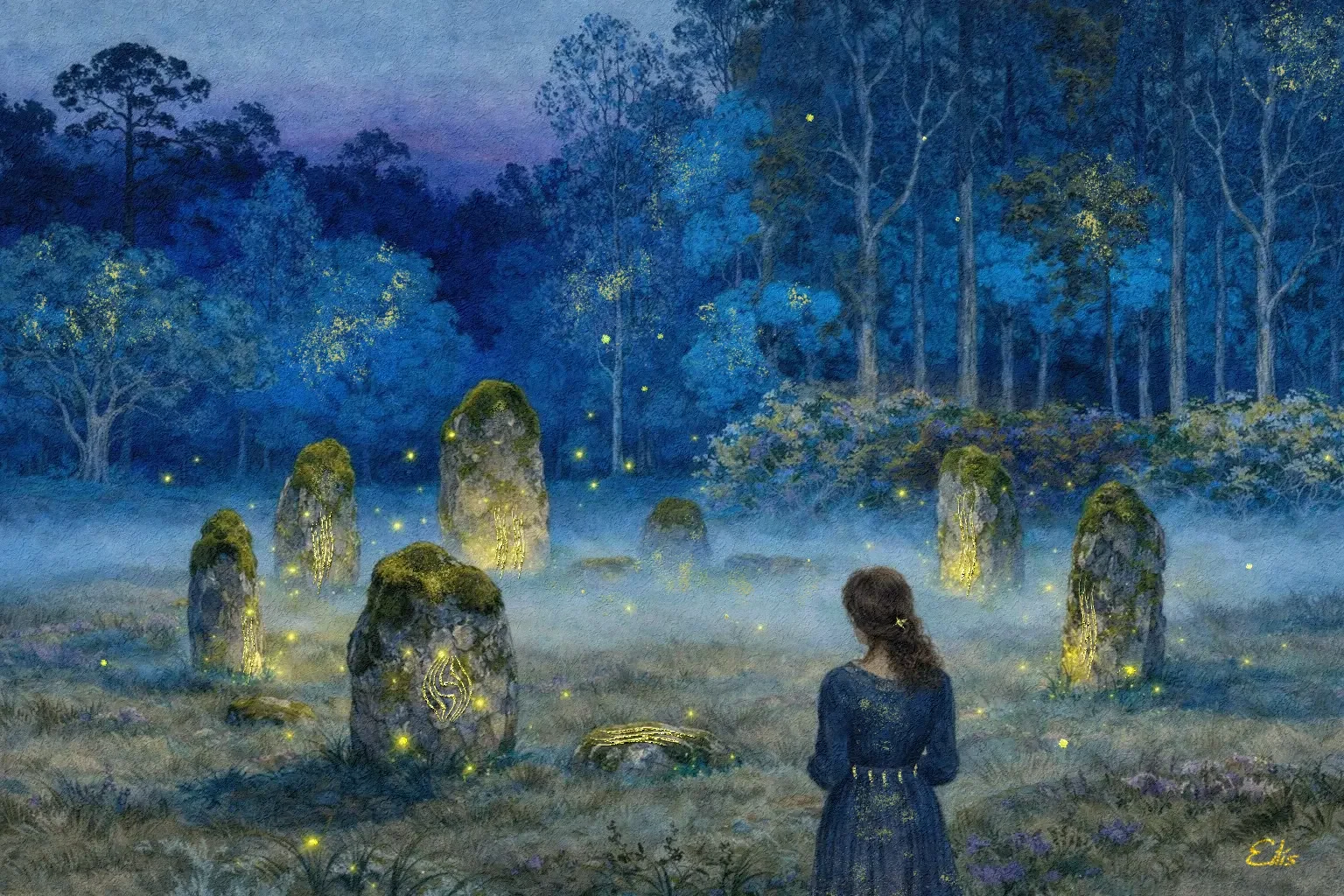
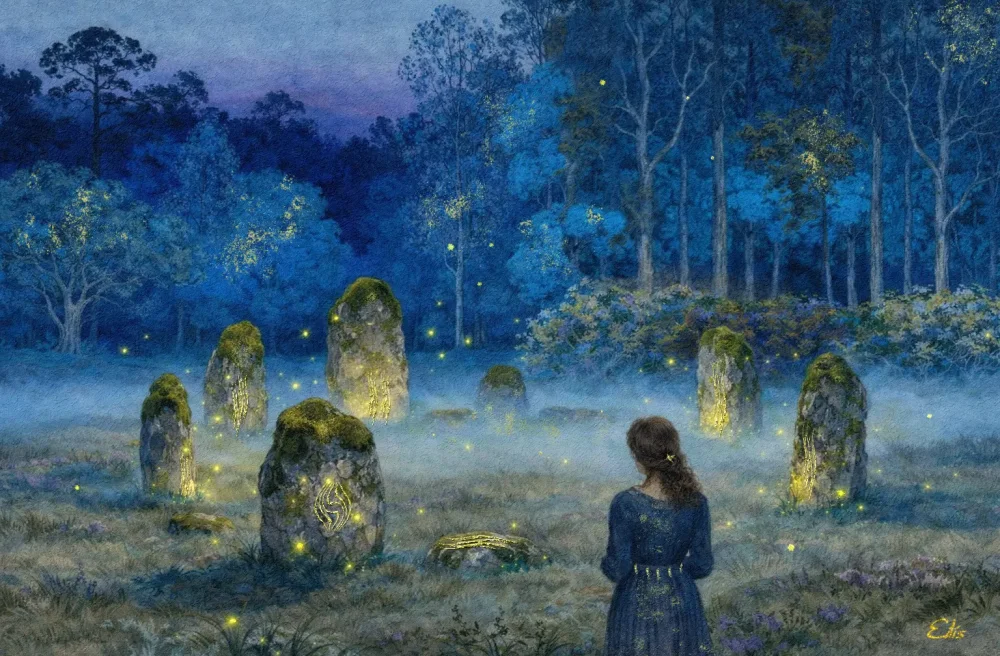
She came over the rise and stopped. The Seven stood in the field as they had always stood, in the slack circle her grandmother had walked her round at the age of five and at the age of six and at every age until the last, the small ceremony of introduction performed each time as though for the first. Now this is the eldest, her grandmother had said, laying Niamh's small hand on the largest stone, and she is patient, you must be patient back. This one keeps secrets — anything you tell her she will hold for you and not give back until you are ready to receive it. This one is for laughing, but mind, you must bring her something funny, she does not laugh on her own. This one — touching the slender stone on the eastern side — this one listens. She will sit with you when no one else can. This is the youngest, and she is shy, do not press her. This one is for endings. And this one, — her grandmother had paused at the seventh — this one is for what comes after.
Niamh, at five, had been delighted by this, and had taken it for granted, the way children took for granted the magic that adults extended to them; only later, at fifteen and at twenty, had the delight curdled into a small embarrassment for her grandmother, that the woman had peopled a field of stones with personalities like so many china dolls. Niamh had not, she realised now, ever quite forgiven the woman for being a person who would do such a thing. She felt the small unforgiving tightness in her shoulders and let it go, or attempted to, and the cold of the meadow rose up the length of her grandmother’s old jacket to greet what was no longer guarded.
She walked into the circle. She did not, now, intend to. Her feet did it. She had been standing at the edge with her hand on the gate-post and her professional vocabulary marshalled, and her feet had decided otherwise, and she had let them. She stopped at the eldest of the stones — the patient one — and stood with her hands at her sides and waited.
The first light lifted from the grass. It was small, and gold, and it rose to the height of her hand and waited there as though it were considering her. Bioluminescence, her mind offered, with weakening conviction, certain species of dipteran, but the mind was already losing its grip on the thread of its own argument; the light was simply there, warm and unhurried, and it was joined a moment later by another, and another, until the field around her was full of slow rising lights at every height between her ankle and her head. They were not fireflies. There were, she knew perfectly well, no fireflies in Ireland; the climate would not have them. The lights moved in a way no insect moved. They had a courtesy.
She reached, without meaning to, towards the eldest stone. Her hand met moss, and then, beneath it, the stone itself, and the stone was warmer than the air. She registered this with the small precise jolt of her professional mind: stones absorbed solar radiation during the day and released it slowly at night, this was elementary, but the air had been cold for three days and the stone, by all rights, ought to have been colder than the air around it, not warmer. She stood with her palm flat against the warm stone and waited for an explanation to arrive, and none did. She found, after a moment, that she had stopped waiting for one. The mind that had been filing objections all afternoon had simply, somewhere along the path, stopped filing them, and had taken a chair instead, and was sitting now at the edge of her attention with its hands folded, watching.
The warmth, she realised, was not residual. It was active. She could feel it move beneath her palm in the way warmth moved in a body, a quiet circulation, as though the stone were not radiating heat outwards but rather drawing her hand inwards, into something she had been trained, all her professional life, to think of as inert. Patient, her grandmother had said. The stone was patient. The stone was patient with her, particularly, with her body of carefully accumulated objection, with the small armoured place in her chest she had not known she had been keeping clenched. The patience was not impersonal. It was the patience of someone, not the patience of something. She could not — would not, professionally, ever — say so aloud. But standing here in the field with her hand on the warm stone, she could feel the difference, and the difference was the whole of what her grandmother had been trying, all those years, to communicate.
She moved along the circle. She did not plan to. Her feet moved her, the way they had moved her into the circle at the start. She came to the second stone — this one keeps secrets — and stood before it. The mossed face of it took the gathering dusk in a way that made the moss itself seem lit from within. She did not, this time, touch it. She thought, instead, of the secrets she had been keeping; the small ones from Patrick over the long years of the marriage’s thinning, the smaller ones she had been keeping from herself, the smallest ones she had been keeping — incoherently, miserably — from her own grandmother in the woman’s last year, when Niamh had been too busy with her work to come west and had told herself this was acceptable. She thought of these and felt, distinctly, the stone receive them. There was no transaction. The stone simply held them, in the way her grandmother had said it would, and the holding was a small specific relief, the relief of putting down a bag one had been carrying for so long that one had forgotten one was carrying it.
She came to the third stone — the laughing stone — and could not laugh, but smiled a little, which felt close enough; the stone, she sensed, was generous with what it would accept. She came to the listening stone. She stopped here for a long time. She did not know that she was going to speak. He was kind, Mamó, she said, after a while, and the saying of it was the first time she had said it aloud since the day Patrick had left, and the saying of it broke something in her properly, the way a long-iced river broke at the first warm wind. He was kind for so long that he forgot what the kindness was for. And one day he had no reason to stay, and a little while later he was leaving, and he was kind about the leaving the way he had been kind about everything for years, and I do not know what is wrong with me that I let it become that. That I did not call it by its name when I still could have.
The listening stone listened. There was nothing else to call it. The stone did not have ears, or attention as Niamh had been trained to recognise attention, but it had something — a quality of held silence, a shape of receptivity — and Niamh felt her words go into it the way water went into dry earth, accepted, absorbed, no longer hers alone. Something came back. It was not words. It was, she thought afterwards, a kind of fellow-feeling, a sense that the stone had heard many griefs of this shape over its seven millennia and recognised this one, and was — there was no other word for it — sorry with her, in the patient, undramatic way of a thing that had a great deal of time and no urgency about its use.
She wept then, properly, the kind of weeping that had a beginning and a middle, the body letting go of something it had been holding through every motorway service station and every difficult conversation with her sister and every bright unbearable morning of the last month. The lights came closer. They did not crowd her. They held a respectful distance, the way mourners at a graveside held a respectful distance, and they waited. Some of them, she noticed, hovered nearer to the listening stone than to her — as though they were not only attending her but attending it, the stone itself, in its work of receiving what she had brought.
A spiral kindled on the listening stone, low down, near her knee. She did not see it kindle; she became aware that it had been glowing for some moments, a triple curl in soft gold, the kind of motif she had seen incised on the chamber stones at Newgrange and had assumed, in her professional capacity, to be the patient flintwork of people for whom such symbols had carried meaning her culture had largely forgotten. It means what your own heart means by it, her grandmother had said, once, of a similar spiral cut into the lintel above the cottage door. Niamh had, at the time, found the answer infuriatingly imprecise. She found it, now, exact.
The spiral meant her marriage. She did not know how she knew this; she only knew. The spiral meant the slow turning of a thing that had begun in one place and had come back to almost the same place but not quite, and would do so again, and again, and that this was not failure, only motion, only the shape that certain lives took, only the geometry of return. The stone, by some courtesy she could not have explained, was offering her this knowing. She felt it as gift, distinctly — felt the careful giving of it, the considered presentation, as though the stone had known she would need the kind of meaning that wore the shape of geometry, the kind of meaning her trained mind could half-recognise even as the rest of her knew it for something older.
She felt her grandmother, then. Not as an apparition; she did not see her. There were no figures in the field, only the stones and the lights and the mist climbing the hem of her jacket. But she felt the woman’s particular presence in the way one feels a familiar hand on the small of one’s back, the precise pressure of it, the precise warmth — her grandmother’s hand had always been small and dry and surprisingly strong, the hand of a woman who had pulled lambs out of ewes and weeded a quarter-acre of vegetables every spring of her adult life. Niamh felt that hand now, exactly there, and let her weight rest into it as she had used to do as a child without knowing she was doing it. The stones, she understood, had not displaced her grandmother; they had — somehow, in the way of the place — let her come through. They were not in competition with the woman’s love. They were the ground in which it had grown, and from which, apparently, it could still be drawn.
I do not know what to do, Mamó, she said.
The answer that came was not in her grandmother’s voice alone. It was in something larger — a chorus, almost, the stones speaking with the grandmother and the grandmother speaking with the stones, indistinguishable, a single felt knowing that came up through the moss and through her palm and into her chest. You are not required, tonight, to know what to do. The Seven have been standing in this field for seven thousand years without doing anything in particular, and the doing was never the point. The marriage is over. This is true. Being true is the worst of what it can do to you, and the worst is — survivable. Set it down here. We will keep what you cannot carry. We have the time for it.
She put her forehead against the listening stone. The moss was cool against her skin, but the stone beneath was warm, warm as the side of a teapot under its cosy, and she stayed there with her eyes closed for a long time, and the warmth went down through the bone of her face into her jaw, which had been clenched for some weeks now without her knowing, and from her jaw down into her throat, which loosened, and from her throat down into her chest, which loosened too. The spiral burned a little brighter, and then began, by very slow degrees, to dim. The lights settled. Some fell back into the grass. Others dispersed against the dark mass of the wood. One small one, no larger than a hazelnut, hovered for a moment near her hair, and then drifted down to the base of the stone and went into the moss there, and Niamh felt, distinctly, that something had been concluded with grace.
She did not, before going, complete the circle. The seventh stone — the one for what comes after — she did not approach. There would be time. She knew this, with a certainty she had no intention of trying to defend. She would come back at midsummer, when the light held longest, and she would walk the rest of the circle, and she would ask the seventh stone what it had to tell her. For tonight it was enough that she had been received.
She walked back to the cottage in near darkness. The torch in her pocket she did not use. Her feet, again, knew the path. The hem of her grandmother’s old waxed jacket was wet to the knee, and her hair had loosened from its clip, and a piece of it lay against her cheek the way her grandmother’s had lain at the kitchen table on long evenings, and she did not push it back. She let herself in. She lit the lamp on the dresser. She put the kettle on, and this time she drank the tea, sitting at her grandmother’s table in the lamplight, with the door propped open onto the cool rising mist of the field, and the Seven standing out there in the dark behind her, and the small spirals on the stones — there had been others, she thought; she had not noticed at the time, but in retrospect the field had been quietly luminous with them — turning slowly in the dark, holding what she had set down for her until she was ready to come back for what was hers and to leave what was not.