
Where the Angel Kneels
Broken Wings
She had not consulted a map. Maps implied return.
Maren had driven through the small hours with the particular deliberateness of someone who has made a decision and is moving inside it, not toward it. Past the last service station. Past the turn-off for the town she had grown up in. Past the dark shoulder of the headland where the road narrowed and the sea became audible before it was visible — that low, pressurised sound, not quite wave and not quite wind, more like the edge of a frequency the body registers before the ears do. She had left the car at an angle that meant nothing now, because she had not been thinking about the car or what angle it was at, only about the sand and the distance to the water and whether the tide was in.
It was almost in. That was something. She would not have to walk far.
January on this stretch of Atlantic coast had a quality of erasure that she had always, in other lives, found melancholy. Tonight it seemed simply accurate. The sky and sea existed in the same register of blue-black, the horizon dissolved, so that standing on the sand felt like standing at the edge of a depthless thing with no clear boundary between it and the air. Snow had fallen in the night, enough to crust the dry sand near the dunes and settle in the hollows between stones. It softened the world without improving it. That, at least, was honest.
She had her coat on. She had remembered her coat. This small absurdity had almost made her laugh in the car park, and the fact that it nearly made her laugh had made her feel the loss of her mother so acutely that the laughter had nowhere to go and simply dissolved back into the larger silence she had been carrying inside her ribcage since October.
She was perhaps twenty metres from the water when she saw the figure.
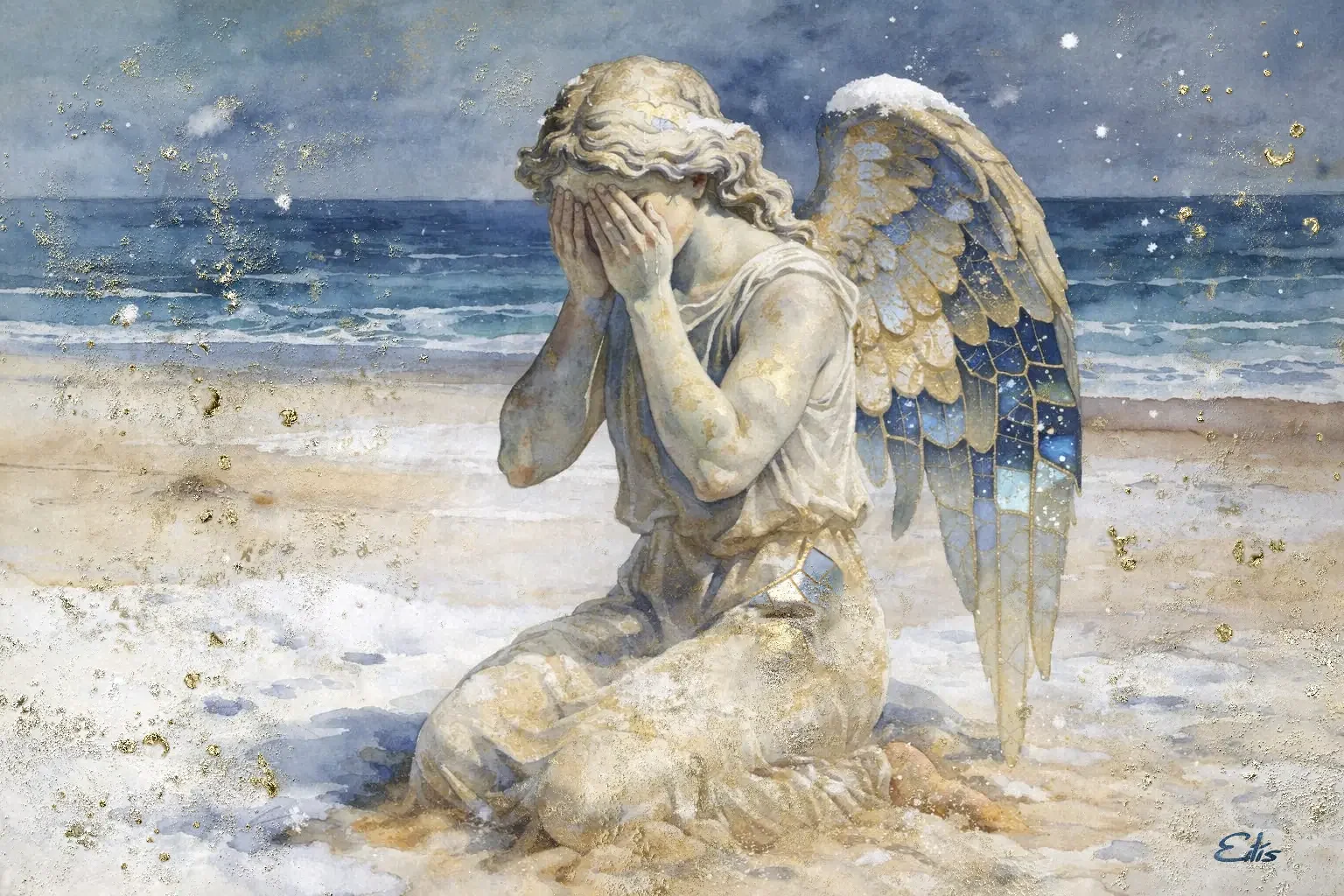
It was low to the ground — kneeling, or perhaps beyond kneeling, at the furthest reach of the waves, where the sea left its faint skim of foam on the wet sand before pulling back. The figure was pale, the colour of old marble or winter-bleached wood, and the snow had settled on it too, as though it had been there long enough to become part of the landscape's grammar. Maren stopped. The figure had wings — that was the fact she processed last, because the posture arrived first, the particular architecture of it: shoulders curved inward, face buried in both hands, the body's entire arrangement expressing something that had no interest in being witnessed but was being witnessed nonetheless.
She stood very still. The cold pressed at her face and the backs of her hands.
The wings were extraordinary. Not in any theatrical sense — not gleaming or luminous in the way of stained glass illuminated from behind — but extraordinary in the way of things that have existed across a very long time and carry that duration in their surface. The inner feathers were pale gold at the shaft and ivory at the vane. The outer primaries gave way to panels of deep cobalt blue, structured like antique leading, webbed with fine lines of gold that might have been decoration or might have been something more structural, the way bones are structural. They were pressed close to the body, folded low, weighted down with snow along their upper surfaces. The way wings go when flight is not under consideration.
The figure's shoulders moved, just slightly. The trembling of a body that has been at grief a long time, that has moved past the acute phase into the sustained one, which is both quieter and more total.
Maren should have felt afraid. She noted the absence of fear with the same flat register in which she had been noting most things since October — as information without particular implication.
She took three steps forward before she examined the impulse. The figure had not moved. Its shoulders carried that particular stillness of a body that has been at grief so long it has stopped anticipating relief.
"Are you all right?" she said.
The wind took most of it. But not all.
The angel had been with Maren at the very beginning.
Not in any way Maren could have known or would remember — the earliest self has no apparatus for such knowing — but she had been present in that first bewildered hour, when Maren was all breath and undifferentiated sensation, when the world was simply a pressure of light and sound and the overwhelming animal fact of existing. She had watched the child's face in those first weeks, learning its arrangements: the way surprise crossed it before the word for surprise existed in Maren's mind, the way grief arrived first in the lower lip, a trembling outpost of it, before the whole face followed. She had learned the child the way one learns a landscape — not all at once, but through repeated exposure across changing conditions, accumulating a knowledge that is partly factual and partly something else, something without a clean name.
She had been there for the first sustained grief Maren had ever felt — a small thing by later measures, a cat that did not come home, that could not be explained away or replaced, but enormous in proportion to the self that felt it. She had watched Maren discover that grief was something the body housed as well as the mind, had watched her press her hand to her sternum as though testing for damage. She had been present for the particular unhappiness of adolescence, which had a quality distinct from adult pain, sharper at the edges but with less tensile strength, more likely to break and less likely to understand itself breaking. She had watched Maren fall in love with the wrong person and partly know it and choose it anyway, and had been present for the quiet aftermath of that: the reconstruction of a self after its own choices.
She had watched her sit at her mother's bedside in the last weeks, and had watched the strange composure Maren had maintained there — the composure of someone who already knows the thing they are dreading and is living in the dread's shadow before the event itself. She had been present for the Tuesday morning in October when the composure had finally and completely given way, in a hospital car park, and Maren had sat on the kerb with her hands on her knees and her head down, and made a sound she would never make in company.
She had been present for the four months that followed. The particular quality of that winter's grief — its oceanness, the way it had no single direction, the way it returned in systems and swells rather than progressing in any linear manner toward resolution. She had watched Maren stop eating properly. She had watched her sit for three hours one Sunday with a book open on her lap, reading the same paragraph without the words acquiring any meaning. She had watched the light go out of Maren in small increments, the way a room's warmth leaves it after the heating fails — not dramatically, but conclusively, so that you notice not the moment of change but the fact of the changed state.
She had failed to hold the line.
That was the shape of it, laid bare and without mitigation, and it was this she was sitting inside on the January shore: the knowledge of her own failure. She had been Maren's witness across the entire length of that one human life, had been present for every threshold and crisis and small domestic ordinary, and when the largest test came she had not been enough to hold the thread of hope intact. Maren was on this beach. Maren was on this beach for a reason. And the angel had felt it — not as information relayed from outside, but as something interior, a tearing at the fabric of what she was — and had arrived before her, and fallen to her knees at the waterline, and covered her face, and could not move.
The figure stiffened almost imperceptibly — the faintest adjustment of the spine, the posture of something that has registered a presence without yet deciding what to do with it. Then, slowly, it raised its head.
The face stopped Maren in the specific way that genuinely unexpected things do — not with drama, but with a sort of full-stop quality, a halting of internal momentum. She had expected something theatrical, something that announced itself. What she saw instead was a face of considerable age that wore its age in the eyes rather than the skin, a kind of geological depth to them, the grey of water that has run over stone long enough to take on the stone's patience. The curling hair was sand-coloured and snow-dusted. The skin had the quality of a surface from which many layers had been gradually stripped, revealing not damage but essence, something older and more primary. It had been weeping. Not recently, perhaps, but comprehensively — the kind of weeping that rearranges the face.
What Maren felt, looking at it, was not fear and not comfort. It was recognition, arriving without explanation, the way certain music does.
"You can see me," the figure said. Low voice, with a quality of pressure behind it, like sound in a sealed room.
"Yes," Maren said.
A pause in which the sea completed several of its patient iterations. "It is not common," the figure said. "Particularly not—" and here something moved across its expression that was not quite an end to the sentence but was a decision to let the sentence stop there.
Maren sat down on the sand beside her. Not because she had decided to but because her legs were very tired and had been tired for four months and the figure's presence generated something in the air around it that felt — not warm, not safe exactly, but like a reduction in the cost of simply being upright.
"What happened?" she asked.
The figure looked at her. That total, performance-free regard — the look of something that has no investment in being perceived a particular way.
"I lost someone," it said. "Or rather — I could not hold what they needed to be held." It laid the distinction down carefully, with precision. "There is a difference. One is circumstance. The other is a kind of failure."
Maren felt the sentence arrive in her sternum rather than her head. She pressed her thumbnail into her palm.
"I had been with her since the very beginning," the figure continued, its gaze returning to the water. "Before she had words for anything. I watched her learn to walk — that extraordinary negotiation with gravity, the knees wide, the arms held out, the absolute seriousness of a body discovering its own uprightness." Something shifted in the grey eyes — not quite a smile, more the trace of where one had been. "I was present for the first sustained grief she ever felt. Small by later measures, but enormous in proportion to the self that felt it — a cat that did not come home, that could not be explained away or replaced. I watched her discover that grief was something the body housed as well as the mind. Watched her press her hand to her sternum as though testing for damage." The figure paused, and the pause had weight. "I watched her move through girlhood and into the more complicated country beyond it. She always approached new things obliquely — from the side, never directly — as though she needed to understand a thing's edges before she could trust its centre. I was there for her first love, which she chose partly badly and knew it and chose it anyway, because she was always more interested in understanding an experience than in being safe inside it. She fell in love twice. She recovered from it once.
"I was there when her mother was dying — and I watched her hold herself together in that room with such care, such extraordinary self-containment, as though she were a vessel she was afraid of breaking in the wrong place."
The figure's hands, resting open in the wet sand with their palms upward, contracted once and went still again.
"And I was there for the aftermath. The months of it. I watched the tide come in and not go out. And I could not—" A long pause, in which the waves completed several of their patient returns. "I could not hold the thread."
Maren was not cold. She noted this as strange, and then stopped noting it.
She understood, in the way that bypasses analysis and arrives directly in the body, that she was listening to herself being described. Not as explanation — she had not assembled the pieces yet into a coherent account of what this figure was — but as a felt knowledge, operating below the level of language. She was listening to the story of her own life being told by something that had been inside it, alongside it, a presence she had never been able to see or name but which had perhaps always constituted a kind of warmth she had attributed to other sources.
She thought of October. The car park. The kerb. Her hands on her knees.
She thought of the drive here tonight, the quality of that decision — the flatness of it, the absence of fear, which she had taken for resolution but which she understood now, hearing it from the outside, had been the sound of a thread pulled to its absolute limit.
"You have been watching me," she said. Not a question.
The figure turned and looked at her fully. The grey eyes held something Maren had seen once before — in her mother's face, in the last weeks, when the two of them had sat in the afternoon light and simply looked at each other, saying nothing, because they were both already standing at the edge of the goodbye and were still, remarkably, present.
"From the beginning," the figure said. "Every ordinary morning. The way you stand at a window before you're properly awake, not looking at anything, just — arriving. The way you move your lips on the first page of a new book and stop once you're absorbed." A pause. "I know you."
Something broke open in Maren's chest. Not violently — nothing so dramatic. More as a tidal thing, the pressure equalising between two spaces that had been sealed off from each other.
"You came here because of me," Maren said. "You knew—"
"Yes."
The word fell into the air between them with the weight and simplicity of a stone dropped into deep water.
They sat for a long while after that. Not speaking. The snow on the figure's wings was melting at the outer feathers, and the drops fell without sound into the wet sand. The light was changing — not warmer, but differently distributed, the cloud thinning in layers so that the water shifted through degrees of darkness, and a faint line began to declare itself at the horizon, the sea becoming distinguishable from the sky.
Maren looked at the figure's hands and felt the extraordinary sadness of them — not her sadness, or not only hers, but the figure's, which was in some sense also hers, being the sadness of something that had watched her across the whole length of a life and arrived too late and too small at the moment that mattered most. She thought: it came here and sat down in the cold and could not stop weeping because it could not reach me.
And she had reached it.
She had walked down the beach toward what she had intended and had stopped because something was sitting in her path, destroyed by grief over her, and she had sat down beside it and asked what was wrong.
She stayed until the line of the horizon was defined enough to call a line. Then she stood, and her knees ached and her coat was damp at the hem and her feet were very cold. She brushed the sand from her palms.
"I don't know what comes next," she said. "I want to be clear about that."
The figure looked up at her with those grey, storied eyes. "I know," it said. "That's different to what you knew an hour ago."
Maren looked at the water. The tide had turned without her noticing — it was, almost imperceptibly, pulling back. Exposing the shore by small degrees.
She turned and walked back toward the dunes. She did not look at the car or think about the angle it was parked at. At the top of the marram grass she paused with her hand on the cold metal of the door and looked back. The figure was still there, kneeling at the retreating waterline, its face lifted now toward the horizon. Not flying. Not standing. But lifted.
Maren got in the car. She sat for a long time with her hands in her lap and the engine off, looking at the rectangle of dark sea visible between the dunes. She was thinking about a cat that had not come home. About a stone wall in the rain. About a woman's hands resting on a hospital blanket, and the particular quality of afternoon light in that room, and how she had held her composure there so carefully, like something she was afraid of breaking in the wrong place.
She understood now that the composure had not been indifference. It had been love in its most demanding form — the love that stays upright so that the other person does not have to witness the falling.
Her mother had done that for her, in the end. And she had done it for her mother.
She turned the key and let the engine run without moving. The heater began, slowly, to recover the interior from the cold. After a while she took out her phone and found a number she had seen once on a poster in a waiting room and written into her contacts without quite acknowledging to herself why. Her thumb rested on it. She pressed dial.
It rang twice.
"Hello," said a voice. A woman's voice, low and unhurried, with that same quality of pressure held gently behind it — the quality of a room in which all the windows have been closed not to exclude but to contain, to make the interior survivable. Maren recognised it before she could name what she was recognising. Not the voice itself, which was entirely human, entirely particular, with a slight softness at the edges of its vowels. But something beneath it, or within it — the way a piece of music can carry inside its structure the ghost of an older melody, present not as quotation but as inheritance. The unhurriedness. The absence of performance. The sense of a presence that had no need to be anywhere other than exactly here.
"You've reached the line," the voice said. "Take all the time you need."
Maren's hand tightened around the phone. Outside, the tide continued its quiet withdrawal, exposing the shore by small cold degrees. She could not see the figure from here, but she knew without looking that it was still there, at the waterline, its face lifted. She thought of grey eyes. Of hands lying open in the wet sand, palms upward. Of wings releasing their weight of snow, feather by feather, into the dark.
Then the operator spoke again — and it was the operator's voice, plainly, a woman doing difficult and necessary work on a January night — and yet underneath it, woven into the particular grain of its patience, Maren heard something she recognised the way the body recognises warmth before the mind has registered the source.
"I'm here," that voice said. And then, as the angel had not said but might have: "I've always been here."
Maren breathed out — a long, unsteady exhale, the kind the body produces when something has been held far past its natural duration. And then, in a voice she barely recognised as her own, she began to speak.