Bran's Vigil
Sharing Grief
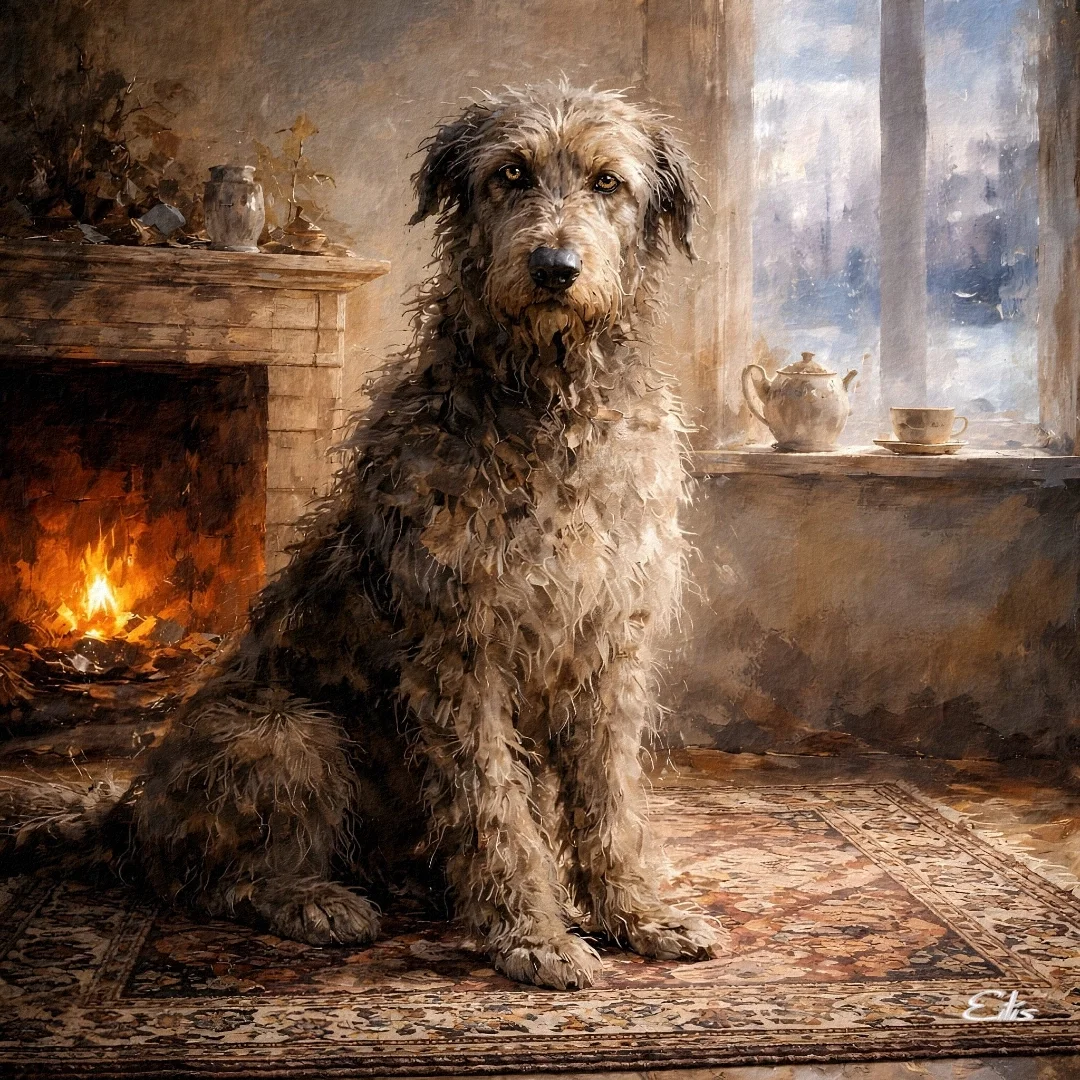
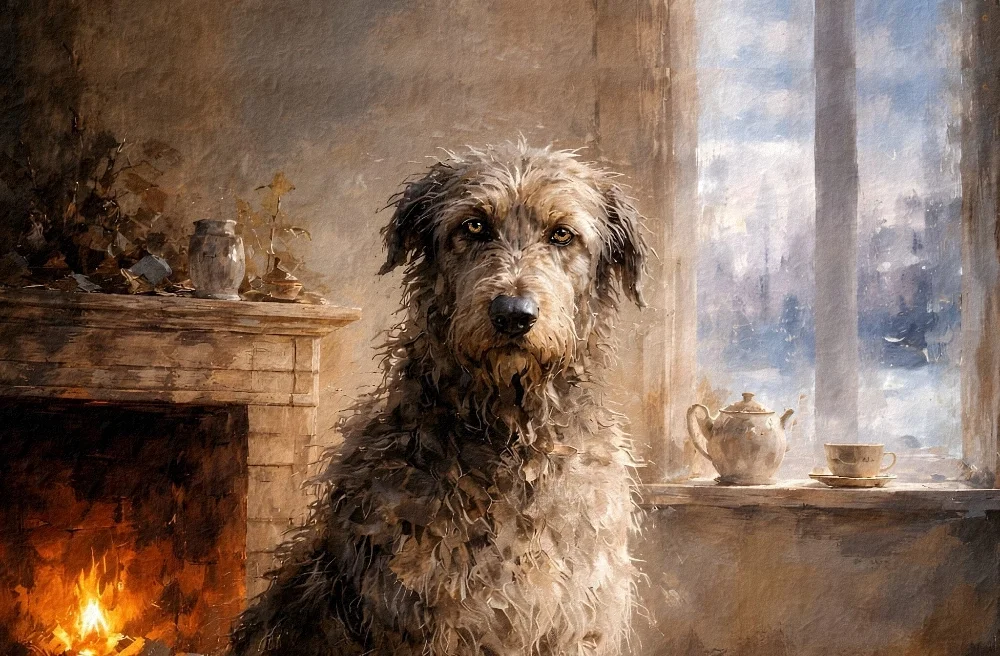
The fire in the front room burned hot and steady, throwing its colour halfway across the worn pattern of the rug before the cold reasserted itself near the window. Snow had been falling against the glass since early afternoon, soundless, gathering along the sill in a way that made the room behind it feel doubly enclosed, doubly chosen against the white indifference outside. On the hearthrug, between the fire and her chair, the wolfhound sat upright with the stillness of something carved rather than breathing, his great shaggy head turned not toward the flames but toward the door.
Brigid had stopped noticing, some years back, the exact moment each evening when Bran took up that position. It had become simply a feature of the room, like the hairline crack in the glaze of the jug above the mantel, or the particular slant of light through the window in high summer. But she noticed it tonight, watching him from her chair with the teapot warm beneath her palm, because she had just done something she hadn't done in longer than she could easily account for: she had reached, without thinking, for two cups.
Her hand had gone to the dresser shelf on its own authority, fingers closing round the second cup's handle before the rest of her caught up with what the gesture meant. She stood a moment in the kitchen with it, feeling the particular hollowness that comes of a habit outliving its reason — the body still fluent in a language the mind had stopped needing to speak. Then she set the cup back on its hook and carried through only the one, and the tea, and her own memories.
The wolfhound had been Eamon's, in the beginning, though only for the last two winters of his life. He came home one wet October as a pup from a litter belonging to a man three farms over — all paws and ribs and a coat the colour of unbleached wool — curled into the footwell of the tractor cab, wrapped in Eamon's spare coat against the weather, with no discussion of the matter beforehand at all. He'll grow into himself, Eamon had said, of the dog and, Brigid had always suspected, a little of himself as well, for he was seventy-one that year and had just given up the last of the cattle, and a pup about the place seemed a way of admitting he meant to slow down without quite using the word for it. The hound had grown enormous, as wolfhounds do, filling doorways and the foot of the bed within the year, and far too quickly afterward, the particular shape of grief that settles into a house once one of its occupants is gone.
Eamon had kept to the same hour coming in from work for the better part of thirty-one years, since the morning he'd first taken on the land as a young man, stamping the yard off his boots on the flagstone outside before the door ever opened. The hound knew none of those earlier decades. Across two winters only, he had learned the sound of Eamon — the scrape of boot leather on stone, his own small rush to the threshold a half second before the latch lifted, tail low and serious, as though receiving him were a duty rather than a pleasure, though plainly it had been both. It had been enough. Four more winters now since the byre had stood empty and the boots had stopped scraping anything, and still, at the same hour, the dog rose from where he lay and sat upright on the rug, turning the whole of his attention to the door, ears lifted toward whatever sound the wind might be persuaded to carry up the lane.
Brigid poured her tea and did not drink it at once, watching him instead, the way the firelight moved along the grey of his coat and pooled in the deep sockets above his eyes. She had read once that dogs experienced time differently to people — that an afternoon alone could feel, to a dog's reckoning, like something closer to a season — and she had wondered, not unkindly, whether four years meant to Bran what it meant to her, or whether each evening's vigil arrived fresh and unburdened by the three hundred-odd days behind it in this past year alone, never mind the three years more behind that, all of which had ended the same way. She rather hoped it was the former. There was a mercy in forgetting that grief never seemed to extend to the living.
The wind found some new angle against the window and rattled it faintly in its frame, and Bran's ears came up at once, swivelling with a precision that made her chest tighten before her own ears had finished registering the sound for what it was. She watched the readiness travel the length of him — the haunches gathering slightly, the great head lifting an inch off true level — and then watched it drain away again just as quickly, the ears settling, the head lowering by that same small inch, the whole long body resuming its patient architecture before the door. It happened so fast that a person glancing in from the lane might have missed it. Brigid had not missed it in four years.
She had told herself, in the earlier and rawer version of this particular grief, that the dog was waiting for Eamon still — that some animal faculty in him had simply failed to register the absence as permanent, and that this was the saddest fact in a house already crowded with sad facts. She had said as much, almost in passing, to Doctor Hannigan, who had taken to calling out to her once a fortnight that first year the way he did with the newly widowed in those parts, ostensibly to check her blood pressure and quietly to check everything else besides. She had expected to be corrected — gently informed that dogs did not reason in any such terms, that this was only a story she was telling herself about him. He had said nothing of the kind. He had only nodded, packing his stethoscope away, and said that loyalty rarely needed an explanation in order to be true.
What struck her now, with the tea cooling forgotten in her hands and the snow going on past the glass, was a thought she had not let herself arrive at properly until this exact evening. The hour had never moved. Four winters on, Bran still rose at precisely the hour the byre door would once have opened, to the minute, as far as she could tell, though no clock in the house could have told her so with any certainty and none was needed. What had changed, she understood now, watching the readiness travel through him and drain away again, was not the hour but the manner of the waiting. In that first terrible year there had been a rawness to it — a thin, almost human whine caught in his throat each time the latch failed to lift, and his head would drop low afterward in a way she found hard to watch, because it looked too much like her own grief. That sound was gone now, and had been gone some time. What remained was this: ears up, head up, a held breath of a body, and then, gently, without complaint, the settling back down. He was not confused. He understood, as well as she did, that the door would not open for Eamon again. He kept the hour anyway.
She set the cup down at last on the small table beside her chair, only half drunk and gone cold at the edges, and crossed the rug to where the dog sat. He did not turn his head from the door even as she came to kneel beside him, one hand finding the rough grey wool at his neck, and for a moment she let herself simply be there in the firelight with him, two old creatures keeping watch for the same absence in their own different ways.
"He's not coming, love," she said, not for the dog's benefit particularly, since she'd said as much to him a hundred times across four winters without it altering his habits in the slightest. She said it the way one says a true thing aloud simply to hear how it sits in a room once spoken. "But I'm here."
Bran's tail moved once against the floorboards. Then, for the first time in any of the four winters she had watched him do this, he turned his head from the door.
He turned it slowly, the way an old dog turns anything, and set it down against her knee with the full unhurried weight of him, his amber eyes finding hers rather than the latch, and held there. The door, for once, could keep its own watch. It struck her, with her hand resting on the broad plane of his skull and his breath warm and steady against her sleeve, that whatever else might be said about a dog having a soul, no one watching this would have thought of an absence. He had grieved Eamon for four winters in the only language available to him, faithfully and without complaint, and he was sharing, tonight, in this room, the grieving of Eamon with her.
Inside, the fire settled lower in the grate, and under her hand she felt something in him let go that had not let go in four winters — the long muscles of his shoulder loosening by degrees, his amber eyes releasing their watchfulness at last and easing shut into a slow, serene doze. It was not much. It would not mend either of them outright, not that night nor any night soon after. But grief carried by two was already, somehow, lighter in the carrying than grief carried alone, and for the first time in a long while, Brigid felt the beginning of that small mercy settle quietly into the room alongside them. Outside, the snow went on falling into the lane, indifferent to all of it.