The Castle that was Sand
Sand, Stone, Tide
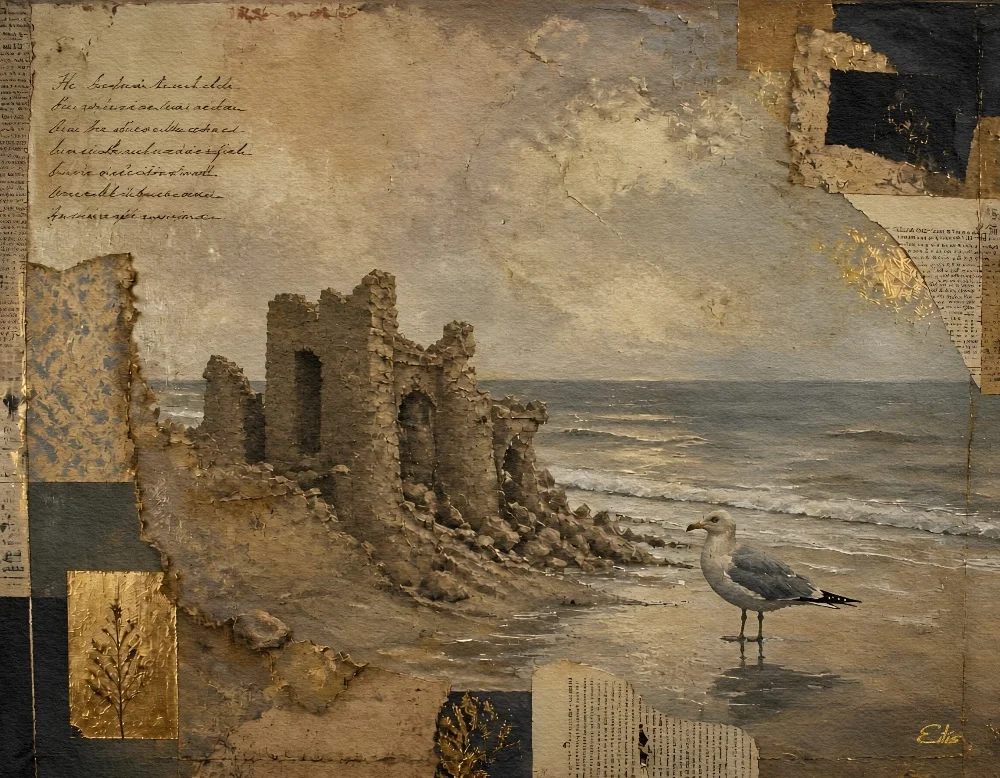
The tide had not yet decided to come for it, and so the castle stood, for now, with the particular dignity of a thing that does not know its hour.
Maire had built it the way she built everything in those days — with her hands too quick for her thoughts, packing the wet sand into towers before she had properly considered where the towers ought to go. Four of them, uneven, the tallest leaning very slightly seaward as if it had already made its peace with falling. Between them she had pressed the sand into walls, smoothing them with the flat of her palm, and where the walls had crumbled she had patched them with handfuls scooped from deeper down, the cold sand, the sand that held its shape because the sea had only just let go of it. She did not think of any of this as architecture. She thought of it as the only thing she could do with her hands that did not require her to think of anything else.
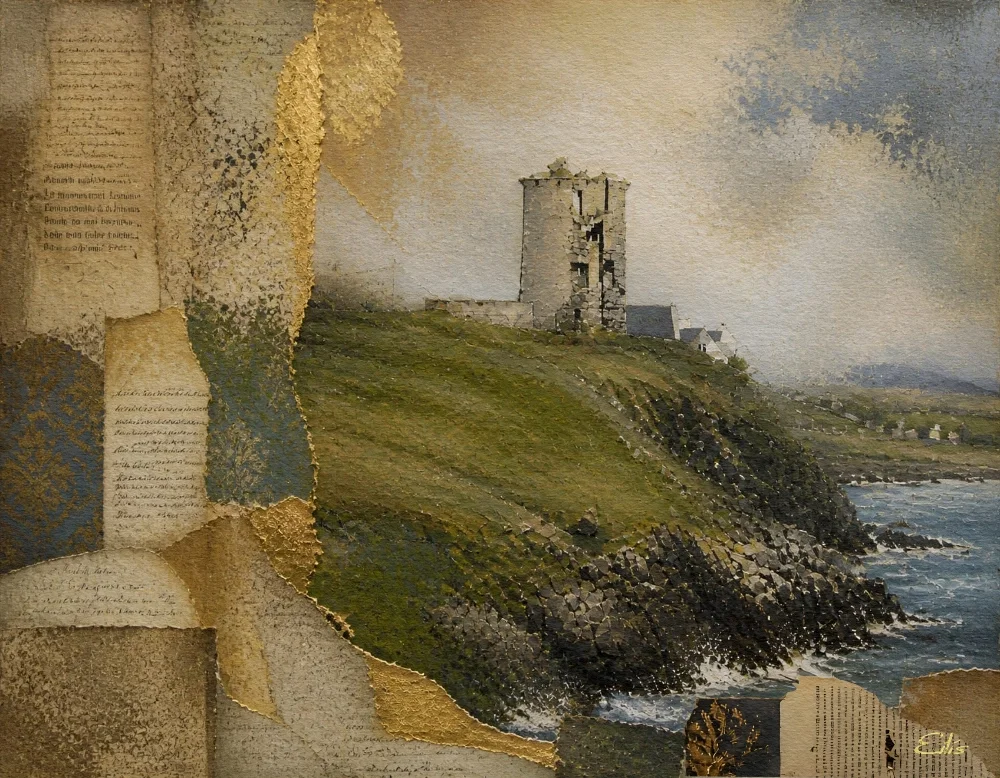
Behind her, somewhere up the strand, her grandmother sat on a folding chair with a paperback she was not reading, and behind her grandmother the old tower stood against the sky the way it had stood for centuries — stripped to its bones now, its window-arches holding nothing but air and the occasional gull, its walls the colour of wet bread. The O'Flahertys had built it, her grandmother sometimes said, when the telling took her, up there on the green shoulder of the promontory where it could watch every boat that came or went from this stretch of Connemara coast, and it had been a castle too, once, with a roof and men in it and a purpose. The sea had not taken it. The weather had, and time, and the slow indifference of stone giving way to wind one grain at a length of years too long for any person to witness in full. Maire did not know the history in any detail that would have satisfied a textbook. She knew only that the ruin was old, that it belonged to the headland the way the headland belonged to the sea, and that her own castle, the one rising under her reddened fingers, was new, and that there was something in the gap between the two of them — the old tower half a mile up the coast, the wet sand castle six inches high at her knees — that she felt without being able to name it.
A seagull had come to watch.
It stood some four feet off, on the firm sand where the last wave had smoothed everything flat, and it watched her with the particular stillness of a creature that has long since stopped being surprised by anything. Its eye was pale and round and entirely without sentiment. It was not waiting for food, not exactly — there was no food here, no chip papers, no abandoned sandwich crusts — and yet it did not leave, and Maire, glancing up between handfuls of sand, found herself addressing it the way children address anything that holds still long enough.
"It's going to be the biggest castle on the beach," she told it.
The gull said nothing, because gulls do not, but it tilted its head a fraction, and something about the gesture seemed less like agreement than like patience — the patience of a thing that has seen a great many biggest castles on this particular beach and has watched the sea undo every one of them without hurry and without malice, simply because that is what the sea does, the way breathing is what a person does, the way growing old is what a person does.
She built on. The fifth tower went up crooked and she straightened it. She dug a moat that filled, unbidden, from below — the water table rising to meet her work without her asking it to — and she was delighted by this, by the way the sand grew dark and slick at the moat's edge and the small channel filled itself as if the beach had decided to participate. She did not think to wonder why the sand held water so close beneath its dry surface. She only thought that the moat was working, that the castle now had a moat the way castles in books had moats, and she sat back on her heels to admire it.
The light had begun, by then, to change. It does this on that coast without announcement — the sun does not so much set as withdraw, the sky thickening from white to the colour of old paper, gold bleeding along the undersides of cloud the way it bleeds along the edge of a leaf turning. The sea took on a darker cast, pewter where it had been silver, and the line where it met the sky grew soft, uncertain, a place where neither element seemed entirely committed to being itself.
Her grandmother had not moved from the folding chair. She was watching, in the unfocused way of the old, not Maire exactly and not the sea exactly but some middle distance that held them both, and the ruined keep behind her, and the gull, all in the same loose field of attention. She had built castles too, on this beach, sixty-three years gone, with hands that had not yet learned what hers knew now — that the sea always returned, that the patient erosion of things was not a tragedy so much as a fact, neutral as weather, and that to grieve it each time would be to grieve continuously, which no life could sustain. She had built castles and watched them taken and built more, and at some point in that long unremarkable accumulation of afternoons she had stopped expecting otherwise, and what had felt, at seven, like heartbreak had become, by seventy, something closer to rhythm.
She did not call out a warning to the child. She had decided, without quite deciding, that this was not a thing to be warned about.
The gull, for its part, shifted its weight from one foot to the other and resettled, and in that small movement there was something Maire would not have been able to articulate but would, perhaps, remember — not as a thought but as a feeling lodged somewhere beneath thought, the way the cold of the sand had lodged itself in her knees. The bird did not pace. It did not fuss at the tide line the way the smaller birds did, darting in and out ahead of each wave in their anxious choreography. It simply stood, facing the sea, as if it had already done its accounting and found the sum unremarkable. Things came in. Things went out. The castle would stand and then it would not, and the gull's hunger, when it came, would be answered or it would not, and neither outcome required comment.
There is a kind of wisdom that looks, from outside, exactly like indifference, and it is only from very close, or after a great deal of time, that the difference becomes visible — that what reads as not caring is in fact a caring stretched so wide and so far back that it has lost the shape of urgency. The gull had watched ten thousand tides come in. It had watched castles and the people who built them and the people who wept over them and the people who laughed and built another one twenty feet up the strand, out of reach, only to watch the sea arrive there too, eventually, on some tide it had not accounted for. None of this had taught the gull contempt. It had taught it only proportion.
Maire finished the last tower as the first long fingers of foam reached the base of the moat.
She felt it before she understood it — a coolness around her ankles where she knelt, a give in the sand beneath her hands. The moat, which she had built and delighted in, had stopped being a feature of her castle and become an extension of the sea itself, and the sea did not distinguish between the two. It came in the way it always came in, without speed and without hesitation, a thin sheet of water sliding up the flat sand and finding the base of the nearest tower and pausing there, briefly, as if considering, before it began, very quietly, to undo what four hours of concentration had made.
The lowest wall went first, dissolving rather than collapsing, its careful edge softening into the general slope of the beach until there was no edge at all, only sand the same colour as the sand around it. Maire watched this with her hands still wet, still curled in the shape of the work they had just finished, and she did not, at first, move to stop it. There was nothing, really, that could be done — she understood this with the swift unsentimental clarity that children sometimes have and adults spend years relearning — and so she only watched, the way the gull was watching, the two of them facing the same disappearing thing from two very different distances of feeling.
The tallest tower, the one that had leaned seaward from the start, held longest. It stood alone for a moment on its narrowing plinth of sand, a single dark spire against the pewter water, and there was something almost theatrical in its persistence, as though it had decided, in whatever way sand can decide anything, to make a performance of its own ending rather than simply submit to it. Then the next wave came a fraction higher than the ones before, the way one wave in a sequence always does, for reasons that have to do with the moon and not with mercy, and the tower folded into the water without a sound, and where the castle had been there was only the wet sheen of disturbed sand, already smoothing itself flat again, already forgetting.
Maire did not cry. She had expected to, slightly, in the abstract way one expects a known thing — she had built castles before and watched them go before, and each time some small ceremony of grief had attended the ending. This time there was instead a kind of widening in her chest, not sorrow exactly, something nearer to recognition, as if she had been let in on a fact too large to be sad about, the way one is not sad about the tide itself, only about the particular thing the tide happens to take.
She turned to look at the gull. It had not moved, except to lift one wing and resettle it, a small private adjustment, indifferent to the small drowned kingdom six feet from its pale feet. It met her eye — or seemed to, in the way birds seem to do anything, their attention always slightly oblique, always angled past the thing it appears to be fixed on — and held it for a moment longer than chance would account for.
Then it lifted into the thickening light, unhurried, and was gone up the strand toward the tower, where it would land, perhaps, on the broken sill of a window that had once looked out on ships, and stand there as it had stood by the castle, facing the sea with the same wide unbothered patience, because the tower too was sand, in its way, only sand given centuries instead of an afternoon, and the sea was no less faithful to it for the difference.
Behind her, her grandmother folded the unread book and rose from the chair, her joints announcing themselves the way they always did now, a small chorus of small protests, and she came down the beach toward the smoothed place where the castle had been and said nothing about it, only put her hand, briefly, on the crown of Maire's head, the gesture older than either of them, older than the keep, nearly as old, in its way, as the tide itself — a thing offered and then withdrawn, leaving no mark, and yet somehow, in its passing, leaving everything.