
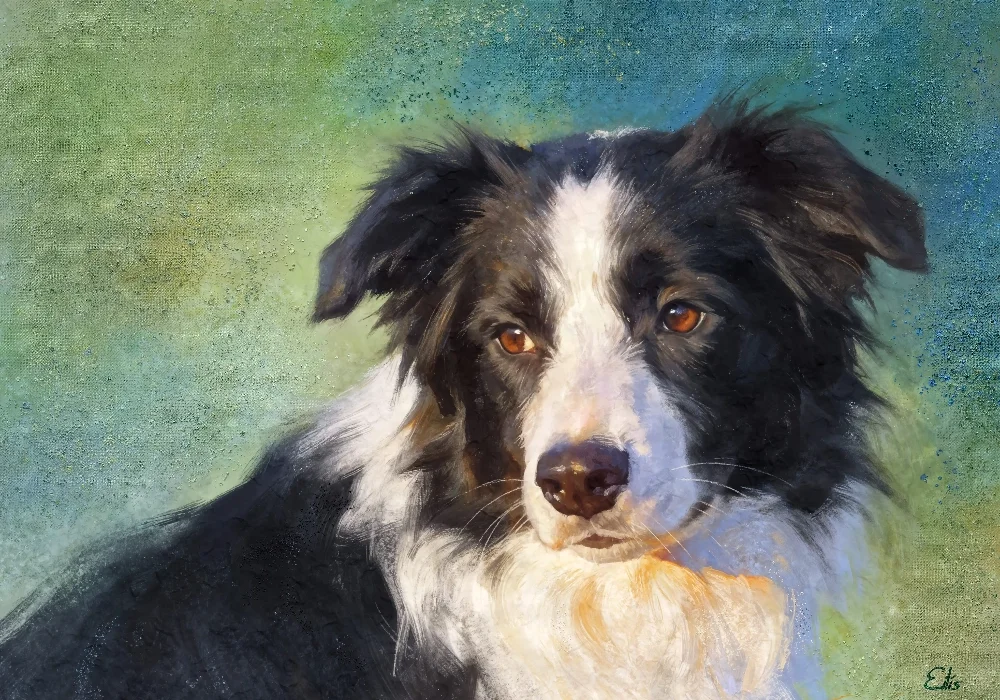
A Day in the Life of a Border Collie
A Connemara Pastoral
I. Dawn
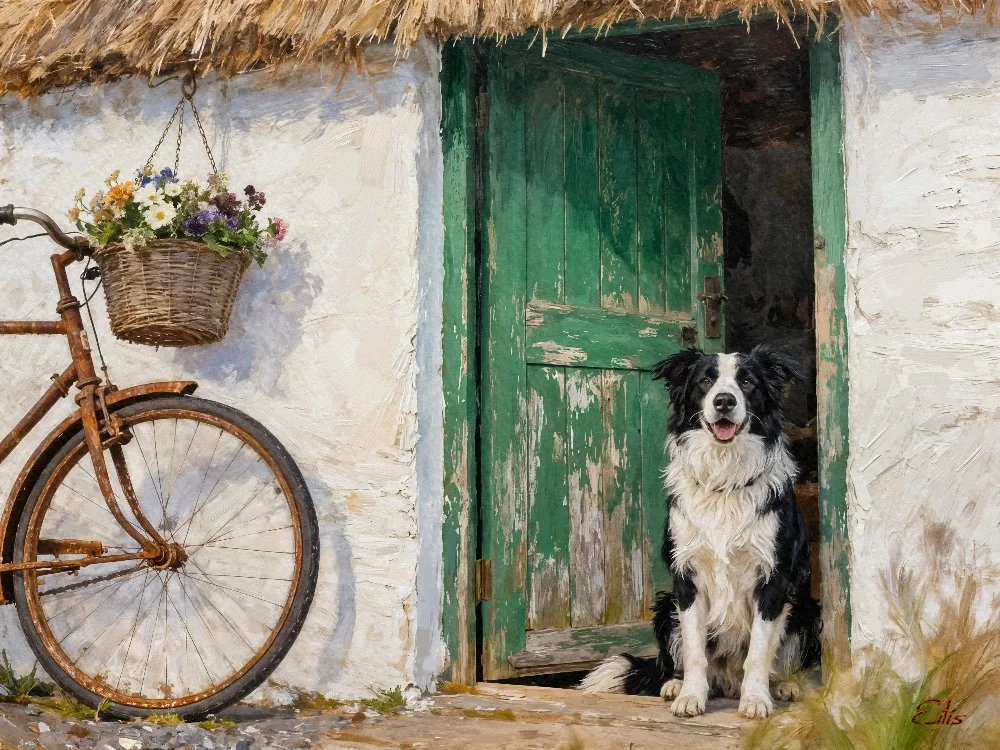
The green door opened before the sun had fully committed itself to the day, and Moss was through it in the same breath, as though the door and the dog were parts of a single mechanism, oiled by years of repetition.
She sat on the worn threshold stone and let the morning arrive at her. This was her practice, older than memory: the sitting, the receiving. The cold of the stone travelled up through her haunches and settled somewhere behind her breastbone, where it became something else — readiness, perhaps, or the particular alertness that lives in a working dog the way tide lives in water. Her ears made their small independent surveys of the yard. The bicycle leaned against the whitewash where it had leaned since before she was born, its rust deepening by seasons, the wicker basket above it spilling flowers that the woman of the house renewed and the weather unmade in a slow, patient argument neither would ever win.
Inside, behind her, the kettle ticked on the range. She knew the order of sounds by heart. Kettle, then cup, then the scrape of the chair, then boots — and it was the boots that mattered, the boots that turned morning from a condition into an intention. The tea itself she regarded as a design flaw in humans generally. An entire species that woke each day to a world crammed with sheep in need of moving, and elected to begin by sitting down with hot leaf-water. If she had thumbs, she often reflected, things around here would run very differently.
The thatch above the door still held the night's rain, releasing it drop by drop onto the flagstone with a sound like a clock that had abandoned regularity for honesty. Moss watched the lane. Beyond the gate, the fields ran pale gold and grey-green towards the water, and somewhere in that dimness the flock was scattered like dropped wool, dreaming whatever sheep dream, which she suspected was grass, and the absence of dogs.
The boots, when they came, were unhurried.
"Well," said the old man, standing in the doorway with his cup, looking at the sky the way farmers do, reading it for grievances. "It'll hold."
Moss's tail moved once against the stone. Astonishing, said the tail. A weather report. Meanwhile the entire east field is unsupervised.
"Give me a minute, so." A swallow of tea. The cup set down on the windowsill with a small ceramic finality.
The woman came to the door behind him with the canvas satchel, its strap gone soft as cloth from the years of his shoulder. She had packed it in the dark of the kitchen the way she packed it every morning now: the bread, the cold bacon wrapped in paper, the flask. It was presented as convenience. Both of them knew it for what it was — the long round out to the shore field and back was a journey he made once a day now where he had once made it twice, and she would sooner fill a bag each dawn than watch him climb the hill home at noon and pretend his breath came easy.
"Mind you eat it sitting down," she said, settling the strap across him, "and not standing in a ditch like a heron."
"I will, I will." He had said I will, I will to this woman across five decades, and meant it roughly half the time, and she knew the percentage to the decimal.
Moss watched the satchel take its place on the man's hip with an attention she reserved for very few objects in this world. The satchel contained bacon. The satchel had always contained bacon. In the dog's private cosmology it ranked somewhere just below the flock itself, and considerably above the bicycle.
"Right."
The word went through the dog like current through wire.
II. At Work
They found the ewes above the shore field, where the land tilts its face to the sea and the grass grows salted and sweet. The morning had opened fully now, the water beyond turned that improbable turquoise that visitors never believe until they see it, and against all that colour the sheep stood grey-gold and unbothered, heads down in the manner of creatures who have decided the world contains nothing new.
Ladies, Moss announced, in the language of a body appearing suddenly at the edge of a field. Your carriage awaits. Everyone moving. Yes, you as well, madam. This grass will still be here tomorrow.
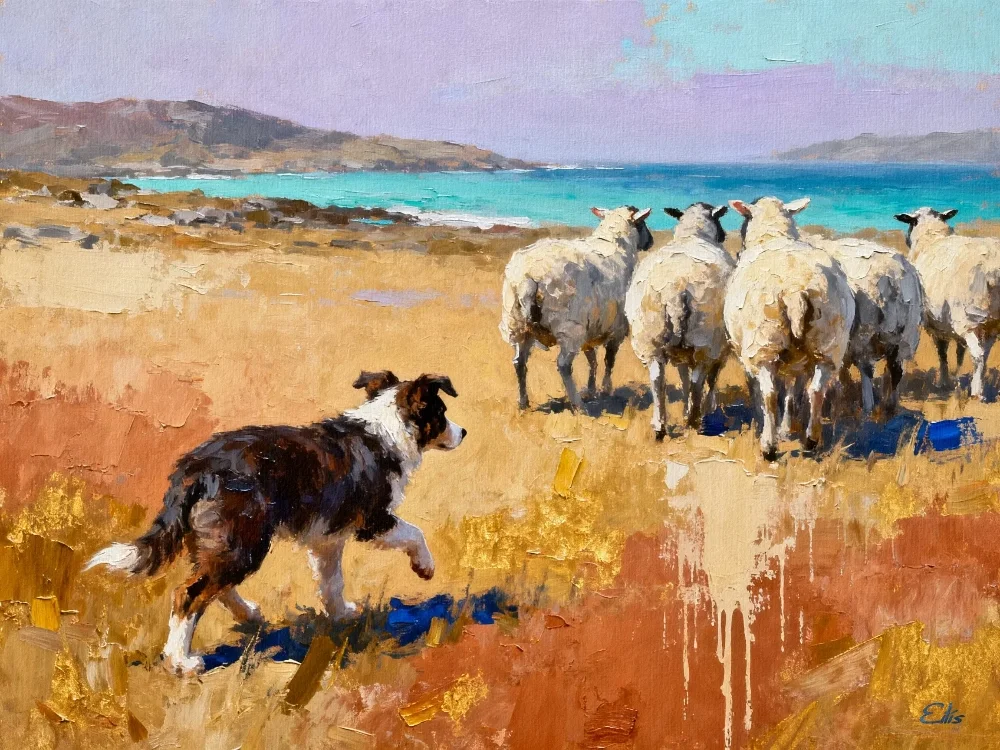
She came down the slope at a trot that lengthened, without any visible decision, into the low travelling run that was her true gait — the one she had been assembling since puppyhood, spine level as a spirit-line, head carried below her shoulders, paws finding the ground in near silence. She did not run at the sheep. She ran to a point in the field that existed only in her mind, a point calculated from wind and slope and the invisible arithmetic of flight and pressure, and when she reached it the sheep lifted their heads as one animal.
They turned. They moved.
This was the part no one had taught her and no one could. The man had given her the words — come by, away, steady, lie down — but the words were only handles on something that had been in her before she could see: the old inheritance, the wolf's design with the hunger bred clean out of it and the patience made infinite, so that all the ancient stalking craft survived in her with its purpose transformed — a shepherd's instrument now, incapable by its very making of turning on the flock it gathered. She pressed, and the flock flowed away from her pressure like water finding a channel. She eased, and they slowed. Between her and them ran a thread that was pure attention, and her work was the tension of that thread — never slack, never snapped.
"Away to me," came the man's voice from the wall, thin across the distance, and Moss bent her line to the right, swinging wide, gathering the stragglers into the current of the rest.
The oldest ewe trotted at the rear with an air of magnificent condescension, as though the entire procession were her own idea and the dog merely an untidy coincidence.
I can hear you thinking, Moss told her, wheeling past at a courteous distance.
A dog that eavesdrops, the ewe returned, through the eloquence of one slowly rotating ear. Standards have collapsed entirely.
III. Focus
At the crest of the field the flock checked and swung about, and the morning arrived at its still point.
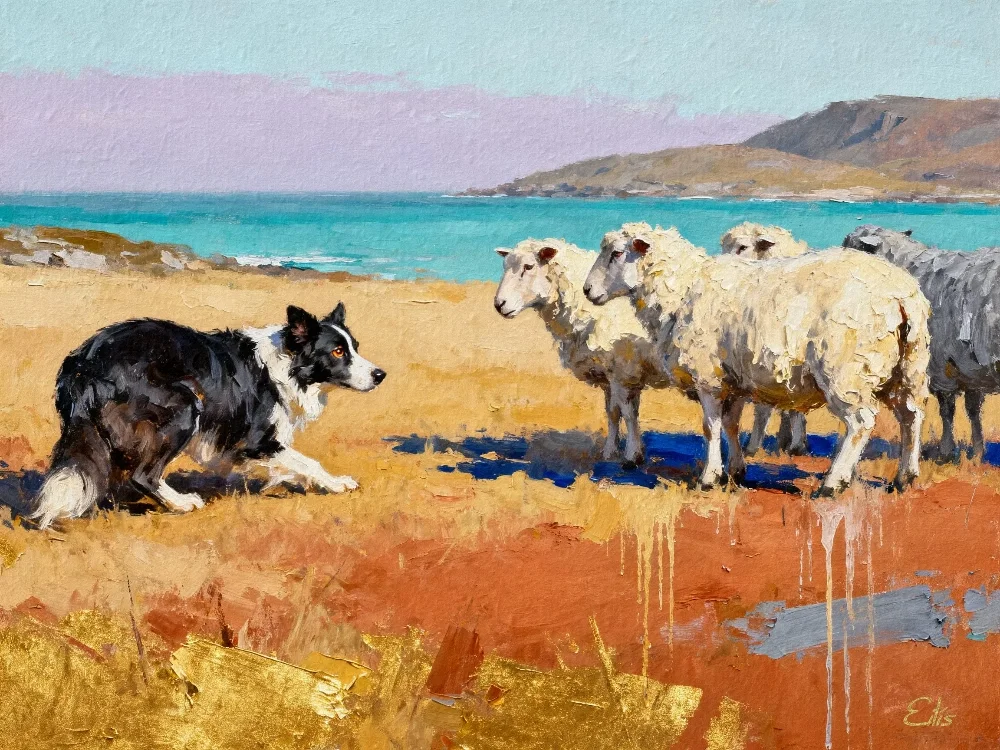
The old ewe turned first, and the others turned with her, and suddenly there were faces where there had been tails, a row of dark eyes ranged against the dog's own. The flock had decided, in the sudden parliamentary way of sheep, to dispute the matter.
Moss stopped. She dropped her head. She let the stillness come up through her from the ground.
The wind moved the grass between them. Nothing else moved at all.
She fixed the old ewe with her eyes and gave her the full weight of her attention, which was the only force she possessed and the only one she needed. The eye of a collie is a strange inheritance — a hunter's stare with the hunt bred away, leaving only the pressure of it, the ancient message with the teeth removed. She poured herself into that gaze until she could feel the ewe wavering at the far end of it.
We were here before you were whelped, the ewe's stare said, plain as speech across the ten yards of shivering grass. We have outlasted better dogs than you, small one. We will be here when you are a name the man says to the fire.
Lovely speech, said Moss's eyes, unblinking. Very moving. The pen is that way.
Insolence.
Punctuality, Moss corrected. You'll thank me at shearing.
The ewe stamped one forefoot. It was theatre, and they both knew it. In the long grammar of field and flock, the stamp was already a form of surrender, the gesture of a creature preparing its own dignity for retreat. Moss did not blink. A gull went over, dragging its cry behind it, and she did not blink at that either. Her raised forepaw hung in the air, mid-step, patient as a held note.
The ewe turned. The flock turned with her, the dispute dissolved as though it had never been raised, and the current resumed its course towards the pens — the old ewe leading now at a pace that said, to anyone watching, that leaving had been her intention all along.
Naturally, all your own idea, Moss agreed graciously, falling in behind. I merely seconded the motion.
Behind her, softly, the man laughed. "You have her measure," he said. "You always had."
IV. Full Flight
The work, once done, released her.
The gate latched, the count made, the man's hand describing its slow satisfied arc over the penned wool — and then the word, the great word, the word that unmade all duty:
"Go on, then."
Moss went.
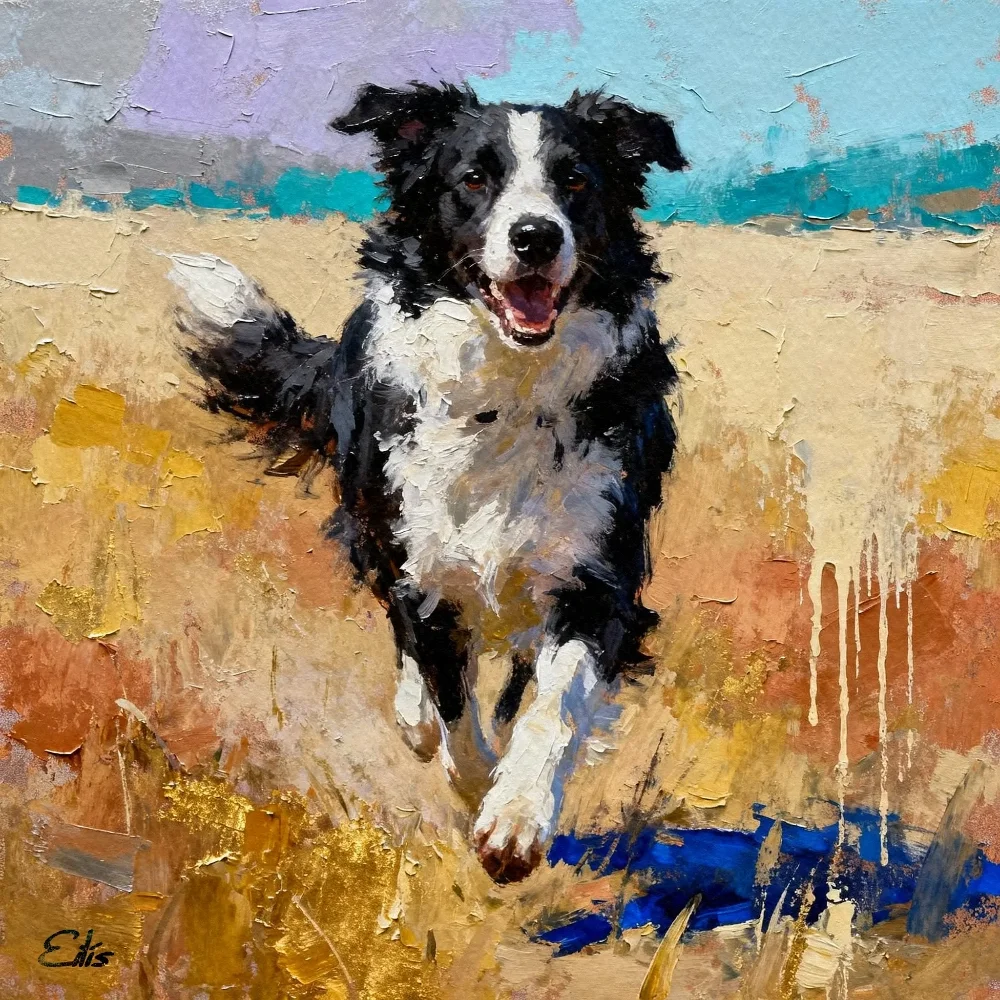
She went across the open field with everything the morning had asked her to hold back, the checked speed and the swallowed joy, all of it spent now in one long extravagance of running. There was no line to hold, no thread to keep taut, no arithmetic. There was only the ground unrolling beneath her and the air parting at her chest and her own body doing, at last, the single thing it most purely was. Her ears streamed. Her tongue flew sideways like a banner of no country. Where the grass stood tall she did not go around it; she went up, launching over the pale seedheads for the plain animal pleasure of the small flight and the softness of landing.
The man watched her from the gate, his chin resting on the hands folded over his crook, and something in the old face loosened its weathered discipline. It is a particular thing to watch a creature be entirely itself. Men are seldom granted it in one another; they find it in dogs and in children and, rarely, in music. He watched the black-and-white shape stitch its wild seam across the field, out and back and out again, running for the pure sake of running, and he felt the day settle in him like sediment in still water.
"Eejit," he said, with a tenderness that would have embarrassed him in company.
Moss heard it, wheeled, and answered the only way the word deserved: she dropped her chest to the grass, hindquarters aloft, tail going like a metronome set by a madman, and barked once — a bright, ridiculous sound, entirely without professional dignity.
Your eejit, the whole posture said. Catch me if you can, grumpy old three-legged man.
"I will in me hat," said the man, who had run after nothing since 1994.
She came back at last in a wide, slowing circle, ribs heaving, eyes lit, and pushed her wet nose once into his cupped hand — a full stop at the end of a long sentence — and fell in beside the boots for the walk home, matching her pace to theirs as though she had never in her life moved faster than an old man's stroll.
V. Evening
They took the last of the light on the wall above the house, as they did most evenings when the weather allowed, the man sitting with his satchel and crook set by, the dog at his knee, the sun going down over the hills in its slow ceremony of amber and rose.
The cottage below them had lit its window. Smoke stood up from the chimney and then thought better of it and leaned away east. In the distance the day's flock grazed the darkening field, restored to their conviction that the world contains nothing new, the whole morning's drama already composted into wool and cud. Somewhere among them, Moss knew, the old ewe was telling the others how she had faced down the dog again and won. She wished her joy of it. A good opponent was worth the keeping.
The man's hands found the dog's face and held it, thumbs working slowly into the fur below the ears, and Moss lifted her muzzle into the touch and gave the man her eyes.
There are gazes that ask and gazes that give, and this one gave. Whatever moved in the dog at such moments had no need of a name. It was continuous with the morning's threshold stone and the noon's held stare and the afternoon's long flight — a single unbroken attention that had, at its centre, this one man, his voice, his boots, the smell of tea and rain and lanolin on his hands. The scientists, had they been consulted on that wall, might have spoken of oxytocin and of ten thousand years of parallel selection. The man would have said, if pressed past all his reticence, something shorter.
"Good day's work," is what he actually said. His thumb traced the white blaze up the dog's forehead, once, the way a man smooths a page he has finished reading. "Good girl."
Then he reached for the satchel, and Moss's ears went up like two flags at the news.
There was a rind of bacon in the paper, kept back from the midday bread with the deliberateness of a man who has been keeping back the last of the bacon for a dog since before this dog was born. He broke it in two, unequally, and ate the smaller piece himself, and held the larger out on his open palm. Moss took it with a delicacy that would have astonished the old ewe — lips only, barely a touch, the manners of a creature accepting communion rather than food. Then she licked the palm once, thoroughly, in case the palm had further opinions to offer.
"That's the lot," he said, showing her the empty paper, and she inspected it with the thoroughness of a customs officer before conceding the point.
The sun let go of the hills. The cold came up off the stones the way it had come at dawn, closing the circle, and neither of them moved yet. The dog leaned the whole slight weight of herself against the man's leg. Far below, the window glowed. In a minute — in just a minute — there would be the walk down, and the door, and the fire, and the bowl by the range. But this, too, was her practice, learned from the man across all their shared seasons: the sitting, the receiving.
"That'll do, Moss," the old man said quietly, to the dog, to the day. "That'll do."
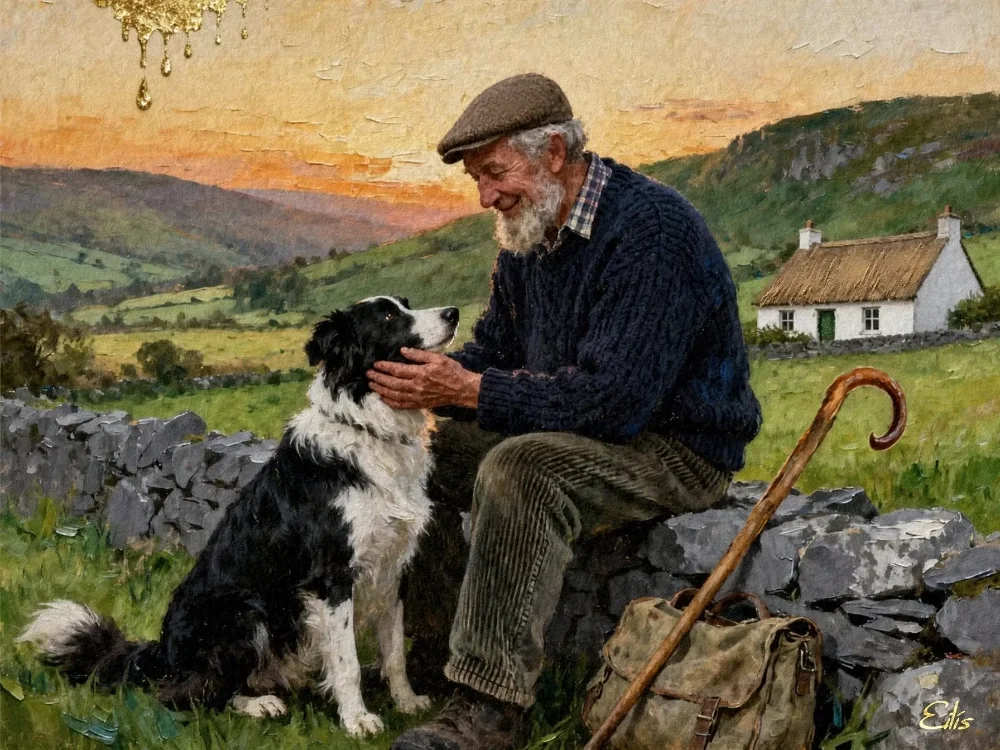
All artworks accompanying this post are original mixed-media pieces from my studio, exploring the working life of the border collie in the Connemara landscape.