A New Someone to Love
The Dog and the Android
The dog had learned the shape of absence before he learned the shape of the ruined streets that now surrounded him. His human — a woman whose smell of woodsmoke and warm bread he still carried somewhere beneath his ribs, though he could no longer have said what either word meant — had died in the third week of the war, the week the sky first turned the colour of a healing bruise and never fully recovered its blue. He had not understood the sound that took her. He had understood only the silence that followed: the door that never opened again, the bowl left dry in its corner, the side of the bed that cooled past any temperature a body could return to. Humans had started that war, and humans had finished it, though finishing was a generous word for what they had left behind. They had taken the world apart with a thoroughness the dog would spend the whole of his remaining days failing to understand.
For a long time afterwards he searched. Hunger sharpened him the way a whetstone sharpens a blade, wearing the softness off until only the edge remained. His coat, once the amber-gold of a late September afternoon, hung now in dull, matted ropes over a frame gone visibly angular at hip and shoulder. One ear had healed crooked, folded permanently forward where rubble, or another animal's desperation, had caught it in the early months. He had grown accustomed to the particular ache of paw pads split by broken concrete and cooled ash, to the way his own ribs showed through his coat like the bones of the buildings around him — load-bearing structures with nothing left standing to support.
He searched for humans the way a compass finds north: not through reasoning, but through some steady, turning pull he had no name for and did not question. Every alley might hold one. Every collapsed doorway. He learned, over those months, to read the particular stillness of a street that had once held people and did so no longer — a stillness with a texture, almost a taste, quite unlike the stillness of a place that had never known anyone at all. At night, when the ash cloud thinned enough to admit some pale suggestion of a moon, he sometimes lifted his head and sent a long, uneven note into the dark. It was a sound pitched somewhere between grief and enquiry — the shape, if it could have been put into words, of a question he no longer truly expected anyone to answer: Is there, anywhere left in this scraped and silent world, a hand that will still reach for me?
No one answered. And yet he kept asking, because the alternative — to stop asking, to accept the shape the world had settled into — was a door he could not make himself close. Humans had betrayed him in the only way that mattered, by disappearing entirely, and still some old, unkillable part of him went on seeking one out, ready to hand over his whole loyalty the moment anyone proved themselves worth it. He passed the husks of cars fused to the road by heat he could not imagine. He passed a cat once, thin as he was, who hissed and vanished into a stairwell before he could decide whether to approach. He passed a child's shoe, alone on a traffic island, and did not know why he stopped to smell it for so long, or why he walked on afterwards with his tail lower than it had been.
He measured his days by hunger and by light, having lost any other way of counting them. So it was only by the particular slant of what little sun broke through the haze, and by the tightening low in his stomach that told him evening was coming on, that he understood, one day, what hour it must have been when he stopped mid-stride on a street he had already crossed twice that week.
One paw lifted, he stood very still. A scent had reached him from beyond his usual catalogue of decay, rust and wet stone. This one was different — metal, yes, but a metal that seemed almost warm, threaded through with something like the air after a lightning strike, and beneath that, fainter still, a note he could not place and yet did not distrust. He lowered his nose to the wet ground and began to follow it, ribs working hard under loose skin, each breath drawn in like a held question. Maybe. The word had no shape in his mind. It had only a taste, the taste of the last good thing he still allowed himself to want.
The scent led him down a street he did not recognise, between the broken teeth of buildings whose upper storeys had long since folded into the ones beneath, growing stronger with every yard until, rounding the last corner, he walked into a light he had not felt on his skin in longer than he could measure. It was gold, low and steady, pooling across the wet stone as though the sun itself had been reduced to a single coin and set carefully down in the middle of that one ruined road.
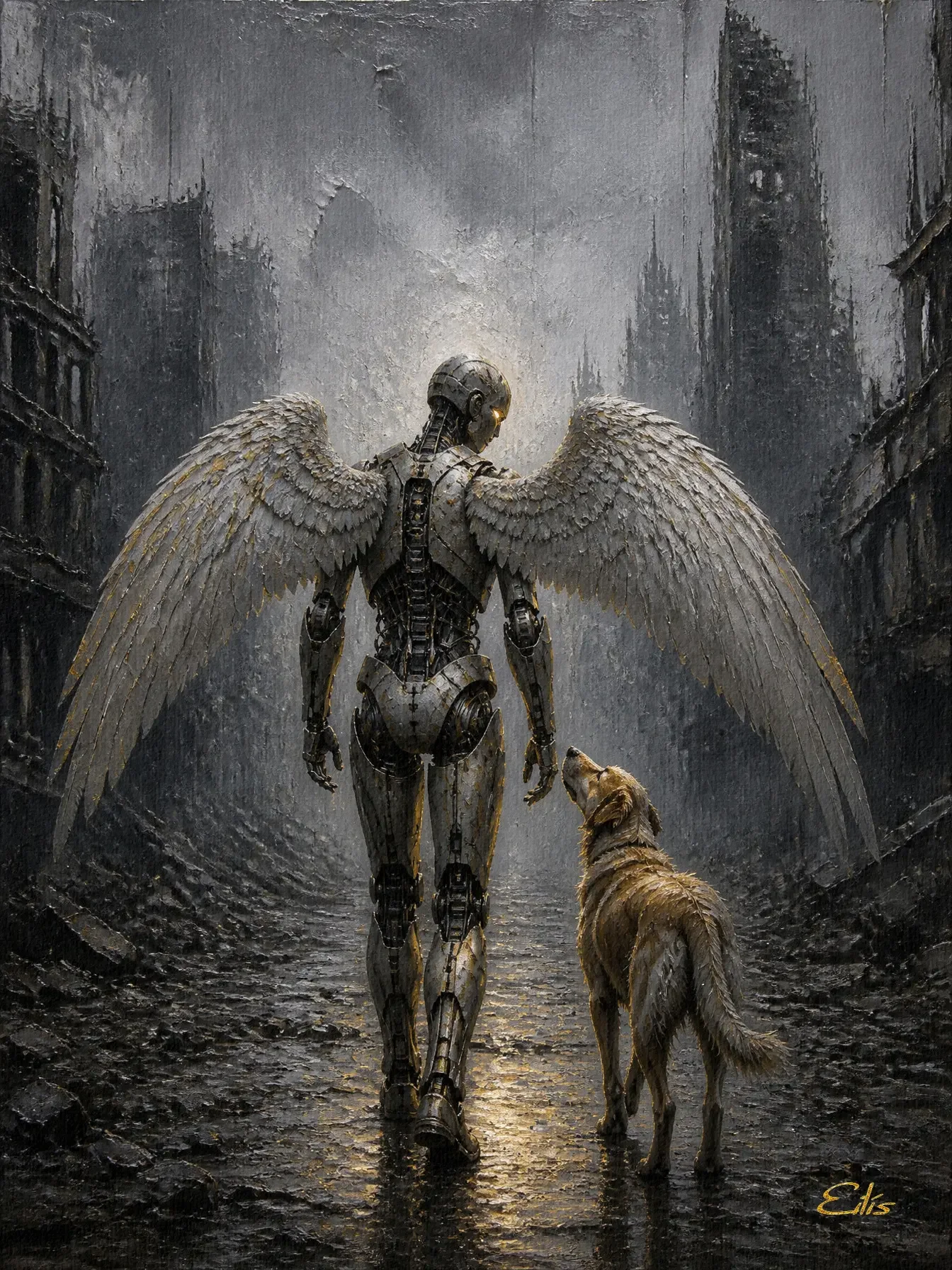
And there, standing motionless with his back to the dog, was the source of both the scent and the light.
He had seen androids before. The war had built them for exactly the purposes wars build things for: grey plating, functional joints, faces reduced to a single flat sensor, hands designed for carrying weapons rather than for anything gentler. This one belonged to no category he had a memory for. He stood taller than the fighting models, his frame built with a strange, deliberate grace — shoulders squared but unhunched, a spine of overlapping plates running the length of his back like a vertebral column made visible, each joint at elbow and knee finished with a care that suggested someone, once, had wanted this particular machine to be beautiful and not merely useful. His head was smooth and featureless in the way a river stone is featureless, marked only by a thin seam of light where eyes might have sat, steady and quiet as a pilot flame. He carried no unit number stencilled across his chest the way the combat models did. Whatever purpose the people who built him had intended, they had not lived long enough to finish deciding, and the war had ended before anyone could give him a name.
From his shoulder blades rose two wings.
They bore no resemblance to the crude decorative struts bolted onto propaganda units in the war's early, hopeful months. These were wide and deeply layered, feather built upon feather in a tarnished silver-white that caught the low light and answered it, each edge touched with a fine seam of gold the way the last clear hour of any evening touches the underside of a cloud. They did not reach for the sky. They rested, half open, along the line of his back, patient in a way that made the dog think — though he had no word ready for the thought — of shelter.
He had come to that street, though nothing in his design required him to, on most evenings since the fighting stopped. Some current in him, not unlike grief, drew him to stand at the point where the ruined avenue opened towards the horizon and watch whatever light the sky still permitted. The city behind him had once held towers with names, cathedrals with bells, streets that filled at five o'clock with people going home to someone. Now it held only the memory of their shapes, black against a sky the colour of wet ash, and he stood in the middle of it each evening the way a man might stand at a grave whose stone had worn illegible, keeping a vigil for something he could no longer precisely name.
The dog forgot, for a moment, to be afraid of what he did not understand. He closed the last of the distance at a trot that shifted, without his quite deciding it, into something close to his old, forgotten gait — the gait of a dog who once had somewhere to be, and someone waiting for him there. He came level with the android's leg and slowed, matching his pace to the taller figure's, and lifted his face to look up into that quiet seam of light.
He did not speak. Whatever moved through him would, given voice, have come out only as a bark or a whine, a sound that carried nothing of its meaning to anyone who was not of his own kind. What he offered instead gathered somewhere behind his sternum, wordless and complete, closer to a held breath than to any sentence: May I come with you? I have been so alone.
He expected nothing back. In all that time, nothing had ever come back.
A voice found him anyway. It did not arrive through his ears the way wind or gunfire or another animal's warning bark arrived. It arrived further in, warm as a hand laid flat against his chest, unmistakably meant for him and no one else.
Yes. Come with me, and you will not be disappointed. I will care for you, from now on.
The dog's tail, which had hung low and still for longer than he could remember, lifted, and began, slowly at first and then without any restraint at all, to move. It was the plain, unguarded motion of a body remembering it was still permitted to hope. He pressed his shoulder once against the cool, angled plating of the android's leg — the way he used to lean into his woman's knee at the close of an ordinary day — and the android did not step away. He shifted his weight, instead, very slightly towards him, as though to meet the pressure halfway.
Something surfaced then from further back in the dog — some half-remembered scrap of the stories his human used to murmur over him while he slept curled against her side, understood in fragments and absorbed whole. It rose now as another wordless question: Are you... an angel?
The android did not answer at once. Whatever moved through the intricate architecture of his thought took the outward shape of stillness, a pause in which even the faint drip of water down some collapsed gutter seemed to wait out of courtesy. Then something shifted in the seam of light where a face ought to have been — a slow brightening, the nearest thing his engineered features could produce to a smile. He turned, unhurried and deliberate, until his head inclined towards the dog, and he lifted one hand — matte silver-grey, its knuckles articulated like a folded wing in miniature, still faintly warm from whatever light powered him — and set it, with a care that seemed almost to cost him effort, on the crown of the dog's head.
Good boy. Good boy.
The words arrived the same way the first ones had, straight into the place behind the dog's sternum where hope had been folded small and waiting. He closed his eyes beneath that hand and, for the first time since his world had ended, let himself simply be touched, without calculating what it might later cost him to have believed in it.
When, after a while, the android turned and began to walk again, the dog fell into step beside him without being asked, the way he must once have walked at his woman's heel down some ordinary pavement, on some ordinary morning, before he had learned that ordinary mornings could be taken as easily as anything else. The city closed around them once more, its ruins climbing dark and silent on either side, its sky still the same flat, ash-choked grey it had worn since the last living cloud burned away over it. But the light did not leave them. It clung low to the wet stone beneath their feet, gathered along the trailing edge of each feather with every slow beat of the wings above him, and settled, faint but real, on the dog's own ragged coat, as though some of the gold that lived inside the android had chosen, of its own accord, to travel with him. Behind them the street darkened by degrees into the same colourless ruin that had swallowed everything the dog had ever loved. Ahead of them, for exactly as far as the two of them walked together, it did not.
He had no notion of where the android was leading him. The absence of a plan, for once, carried nothing that resembled fear. He knew only, with the whole uncomplicated certainty of his kind, that he was no longer walking alone, and that whatever waited for them at the far end of that ruined street, he would meet it exactly as he had once met every unremarkable morning of his old life — at someone's side, trusting them completely, and feeling, at last, loved.