
Angelic Stairs
Halloween Gothic
The Winner
The email arrived on a Wednesday at eleven minutes past three in the morning, the hour when Norman Ashe did most of his living.
It came from a name and nothing behind it. The sender was listed as Tenebrae_Attic, and the address beside it was a string of letters that might have been a cat walking over a keyboard. The subject line said Congratulations, Mr Ashe. He opened it with the reflex of a man who had spent eleven years looking for the seams in other people’s work. The headers led, through several polite detours, to a server in a city his software could not name. Then he read the message.
You are the lucky winner of the video game Angelic Stairs. Your copy will travel to you within three days. You will know what to do with it. The stairs have been waiting.
Beneath it, set out like the tag on a jumble-sale lot, ran a signature of two lines:
Tenebrae Attic
Complete. Disc and manual. No returns. Not responsible for outcomes.
That was all. There was no link, no prize number, no small print offering the chance to unsubscribe. He smiled at the last line, a seller’s joke, and let it pass. The Norman who sat at this desk by day, flagging phishing attempts in other people’s builds, would have deleted the message in a second. The Norman who sat there at three in the morning read the title again and felt it drop into him like a stone into a well. He listened to the long fall.
He was thirty-three and looked like a first draft of himself that nobody had gone back to revise. He was tall and narrow, with the stoop of a man who had spent his life ducking under shelves in his own head. His brown hair was thinning at the temples, and he combed it forward as if to conceal a crime. His skin had the sallow shine of old piano keys, and a scatter of acne scars ran along his jaw like footprints in wet sand. Behind thick lenses his pale eyes sat a fraction too close together and watched the world from the bottom of a glass. His chin retreated early. His hands were long and white, the thumbnails bitten to the quick, and he kept them in the cuffs of his sleeves like animals in burrows. When he spoke to people his words went to their shoes, and when anyone looked at him for longer than a second a blush climbed from his collar in uneven patches. He knew exactly how glances behaved around him. They slid off, like rain down a window, without stopping.
He had learned it young. His father kept a ledger of coins, hours and disappointments, and held that a boy was a crooked thing to be corrected until it came out straight. There were no birthday parties in that house and no friends on the doorstep. Games his father filed under idleness, and idleness under vice. Once a year, on the last day of the seaside holiday, Norman was permitted a single coin.
At eleven he spent it in a boardwalk arcade, in a hall that smelled of fried dough and wet wool, with rain ticking on its tin roof. Behind a pinball machine whose bells had died stood a cabinet with a cracked screen. It was called Angel Stairs, and it was as crude as a child’s drawing: a grey zigzag of steps, two angels built from perhaps twenty square pixels each, wings that flapped in two frames, a bleep for every step. One angel went up and one came down. The boy moved a little square cursor onto the descending one and clicked it home. In the corner of the screen a rose assembled itself out of four red squares, and Norman thought it the most beautiful thing he had ever seen.
He had reached level three. Then his father’s hand settled on his shoulder like a clamp. ‘That’s enough. Stop wasting your time and my money. Come along, Norman.’
The cabinet was gone by the following summer. The owner shrugged and said it had gone back where it came from.
For twenty-two years the four red squares stayed behind his eyes, but he had never found any trace of the game in any database or internet archive. In due course he became a beta-tester, one of those small silent professionals who discover where a made world breaks: the wall a character can walk through, the stair on which a hero sinks to his knees. The work suited him. A man who sits alone in the dark for ten hours a day is called dedicated. Norman knew everything about how a game hooked a person, the variable reward, the near miss, the cheerful chime, and he had written reports on all of it. In the margin of one, with the confidence of the vaccinated, he had noted that players ought to take regular breaks.
His workroom was the back bedroom of a rented house at the end of a cul-de-sac, where he tested other people’s games from home. The blinds came down at dusk against the glare, and went up on Thursday mornings only because Consuelo raised them herself. The only light came in terminal colours: green text scrolling on one monitor, amber on another, and a bar of blue under the door from the hall. The air smelled of hot dust and ozone, cold coffee and unwashed cotton, and beneath it all the sweetish staleness of a room that was aired on Thursdays and sealed again by nightfall. The fans breathed all night. When the machines cooled, their metal ticked like a man clearing his throat.
In that smell and that colour he read the anonymous email four times. Then he did something he had never done with an unverified message. He replied with two words, Thank you, and no answer came. He found that he did not need one.
The Parcel
The parcel arrived on Saturday, and nobody had delivered it.
He found it on the doormat at noon, though the bell had not rung and no van had been seen in the cul-de-sac. The brown paper carried no stamp, no postmark, no courier’s label and no return address. His name and street had been written in block capitals by a hand that matched none he knew. Norman, who traced other people’s mistakes for a living, gave it forty minutes. He photographed the lettering and fed it to every database he could reach. He lifted a print from the tape and got the smooth blank of a glove. He searched for Tenebrae_Attic and found the name nowhere: no account, no listings, no feedback, not even a ghost in an archive. He went back through the email headers, and they led him, as before, down corridors of polite relays to a city his software would not name. The sender was a name with nothing behind it, and the parcel had come from nowhere. As a tester he could only admire the flawless absence of a trail, and it gave him something close to joy.
He carried it down the hall in both hands, the way a person carries a candle in a draught, and opened it on the desk.
Inside lay a visor of matte black, shaped like the face of a closed eye. Beside it were two gloves of thin grey fabric, with copper thread running through the fingertips, and a disc in a paper sleeve. The only manual was a card, printed in a faded serif: Mind the roses.
He plugged the visor into the tower and slid the disc into its tray. The licence agreement came up. Norman had read some four thousand of them in his working life, hunting for flaws in the wording. This was the first he accepted unread, his thumb already falling towards the button like a starving man’s hand towards bread. Had he scrolled as far as clause fourteen, he would have found a single sentence: The management accepts no liability for the loss of the player’s head. He would have taken it for a joke, as he had taken the last line of the email, and as he took most things written by lawyers.
Level 1
The world arrived slowly, the way a photograph comes up in a tray.
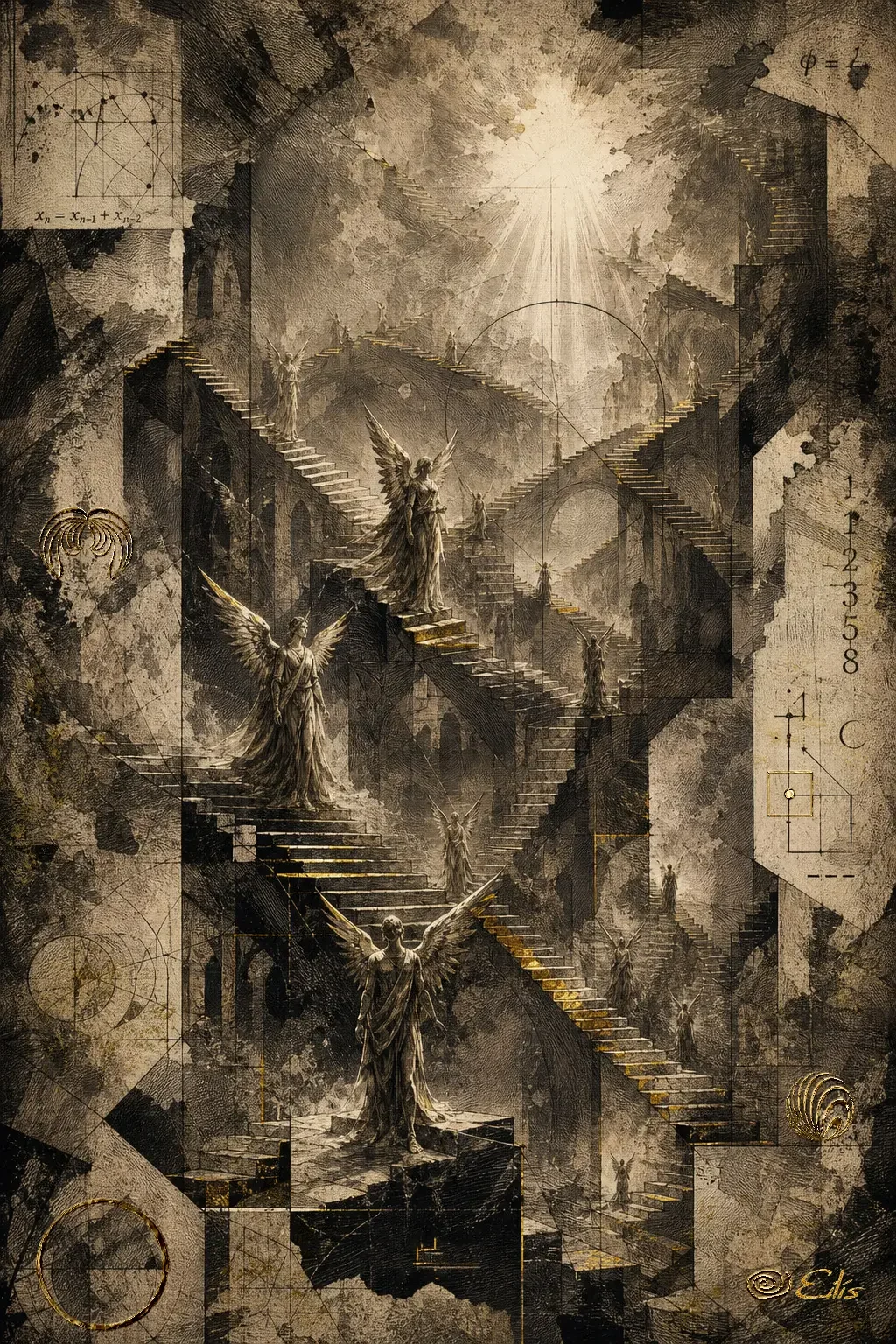
It had been engraved. Every surface was cut in fine cross-hatching, as if the whole place had been bitten into steel and printed by candlelight on paper the colour of strong tea. Staircases crossed above and below him in long flights, doubled back, passed beneath arches that led nowhere in particular and vanished into cloud. Only the edge of each step was gold, a thin line of fire that made the stairs readable from a distance. At the margins the world broke into planes, shards of wall and sky drifting apart like torn paper, and on the torn edges hung scraps of geometry: a compass-drawn circle, a spiral, a column of figures that read 1, 1, 2, 3, 5, 8. Far overhead, behind the cloud, a light waited. Its rays came down through the mist and Norman felt them on his face, though the room around him was cold.
Two angels stood on the nearest flight. They were tall and pale, grey as pencil lead, with every feather cut separately into the wings folded at their backs, and their robes stirred as though they stood under water. One climbed with the slow gravity of a thought. The other came down wearily, like a man who has forgotten why he went upstairs. When Norman lifted his hands, two small gold hands lifted in the air before him, wristless and exact.
He moved the right one over the descending angel and closed his fingers.
The angel stopped and turned its head. Its face was long and serious, carved out of the calm of stone. It looked at him with an interest that felt personal. Then it climbed, past its companion and into the light, with a sound like a page turning, and a soft bell rang inside the visor.
Something unclenched behind Norman’s breastbone that had been tight since a wet afternoon in a seaside town.
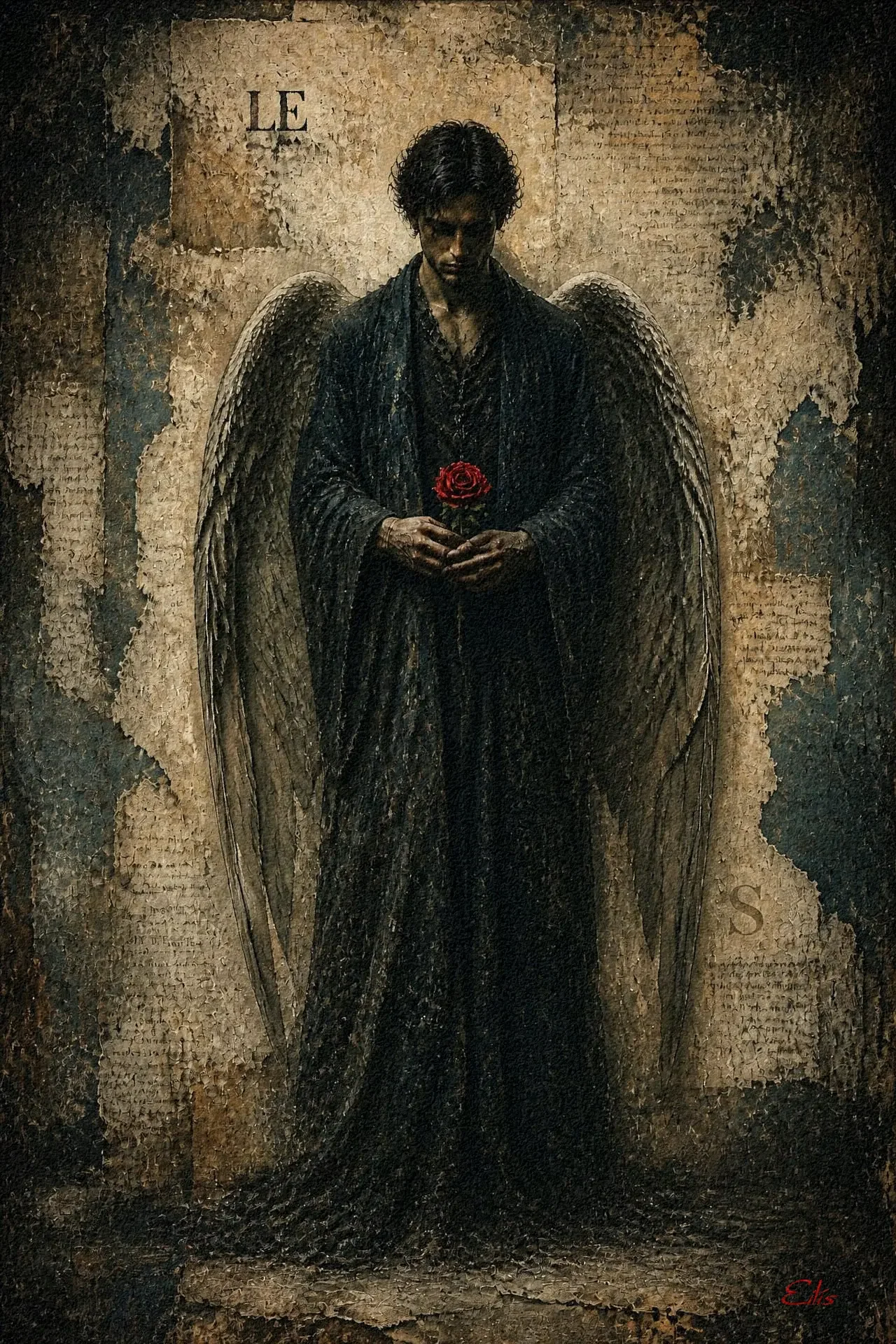
Another figure came down through the fog. This one was dark where the others were pale. He descended with the slow, sorry tread of an undertaker, black curls fallen forward over a bowed head, his robe the blue-black of wet slate, his grey wings hanging half open like a torn curtain. Behind him the air held scraps of old newsprint, layered and ragged, in a script that rearranged itself whenever Norman looked away. Between his joined hands he carried a single red rose, the only colour in the engraved world. Norman’s eyes stung. He was eleven again, and the rose was made of four squares.
The angel lowered his gaze and set the flower in the player’s keeping. A tiny red bloom appeared in the corner of Norman’s vision, with a small gold ×1 beside it.
Level 12
By Monday the notebook beside the keyboard held the rules. Norman had written them in his neat office hand, the way he wrote everything:
- A touch on a descending angel turns it round and carries it up one flight.
- Ascending angels waver without warning. The gold on the step beneath them dulls first. A touch steadies them.
- One angel lost to the fog and the level is lost.
- A cleared level earns a rose. A lost level costs one and sends you back a level. Without a rose there is no going back.
- The angels keep time with my pulse.
The fifth line he had underlined twice, as he underlined defects of the highest severity, and then he had done nothing about it. The copper in the gloves was listening. When he was calm the angels moved at the pace of a procession. When he panicked they hurried, and their hurrying made him panic more.
The game grew as a crowd grows. For the first dozen levels the number of angels followed the column of figures in the corner of his vision, one and one and two and three and five, until the sequence swelled past anything the stairs could hold. After that the game, apparently embarrassed by its own arithmetic, stopped printing the numbers and simply added more. At level one a single flight had stood between the angels and the light, so one touch had carried an angel home. Now the flights multiplied, and each angel needed carrying again and again. Those already climbing began to waver. An angel would stop on a step, tilt its head as though it had heard its name called from below, and fall backwards into the fog with the placid face of someone declining a second chance.
He learned to read the gold. When the edge of a step dulled to old brass, the angel standing on it was about to turn, and a quick pinch of the fingers would steady it. A lost angel drained the picture of colour. The dark angel came down with his bowed head, took one rose from the corner of the screen with the courtesy of a man collecting a debt, and set the stairs back a level.
Norman tested the edges, because he could not help it. He tried to walk off the map, and the fog returned him to his landing with the tact of a bouncer. The settings menu held a single slider, labelled Mercy, which moved a hair’s breadth and slid back to nothing. A button marked Report a bug opened a little stair with one word written on its top step: Noted.
On Thursday morning, at nine, a key turned in the front door.
Consuelo Reyes had cleaned Norman’s house on Thursdays for six years and had never once been asked to stay for coffee. She was fifty-four, small and broad, with a grey-streaked braid pinned in a coil at the back of her head and reading glasses on a beaded chain that clicked when she moved. Her hands smelled of lemon and bleach. She spoke English warmly and with great firmness, seasoned with the Spanish endearments of a woman who had raised three children, buried a husband and saw no reason to be impressed by anyone.
She stopped in the hall. The air told her everything, as air tells a woman who has cleaned other people’s houses for thirty years: old coffee, hot dust, the sweet closeness of a room slept in by day, and beneath them something mineral and faintly floral, like a cellar where flowers had once been kept.
‘Norman?’
‘Not now, Consuelo.’ The voice came from the back bedroom, thin and flat, from a long way down.
She did not knock. She crossed the dark room in four steps and hauled up the blind. The light struck like a slap. Norman flinched in his chair, the visor pushed up on his forehead, his gloved hands raised as if to fend off weather. In the daylight she saw him whole: the grey skin, the eyes ringed in violet, the wrists poking out of his sleeves thinner than they had been last Thursday, the takeaway cartons stacked beside the desk, the mug at his elbow with an oily skin across its coffee.
‘Mijo,’ she said, and laid the back of her hand against his forehead. ‘You are the colour of a candle.’
‘I’m testing. It’s for work.’ He had never lied well. His blush climbed in its patches, though there was little blood left to climb with.
She said nothing for a while. She emptied the cartons into a bag. She wiped the desk around his hands as one wipes around a sleeping child. She put two covered dishes into the refrigerator, with a strip of masking tape across each lid, Friday on one and Saturday on the other, and raised the window two inches so that the October air came in with a smell of leaves.
‘Eat. Sleep. Keep the window. Tonight I fly to Oaxaca, for my mother, for Día de los Muertos, the Day of the Dead. I am back on Tuesday, and if you do not answer my calls I come from the airport with my key. You promise me.’
‘I promise.’
From her apron pocket she took something wrapped in tissue and pressed it into his palm. It was a sugar skull no bigger than an egg, with tin-foil eyes and a spiral of pink icing on each cheek, and across the forehead, in blue icing and a careful schoolgirl hand, the name Norman.
‘For the altar,’ she said. ‘But you don’t have an altar, so. Put it where you can see it.’
He looked at the skull and the skull grinned back, wider than his own face had ever managed. He thanked her. She patted his cheek twice, quickly, the only touch he had received in weeks, and went out. The front door closed with a click.
He set the skull beside the keyboard. The lemon smell of her lasted forty minutes. Then the cellar returned, with roses in it. He forgot to lower the blind, and that afternoon a ginger cat arrived on the sill outside and stayed, regarding him through the glass with the weariness of a magistrate.
Level 41
By Friday the real world had begun to look unfinished.
When he pushed the visor up to rub his eyes, the room seemed a low-resolution build, its textures flat, its shadows set too soft, its colours missing a coat of paint. The kitchen was worse. The dishes Consuelo had left lay under their foil like exhibits from a poorly funded museum. His body had become a rumour. He drank cold coffee without tasting it and forgot to be hungry, and in the small hours his thumbs developed a callus where the gloves pressed, and the fans breathed in time with something he preferred not to identify.
His employer rang, and rang again. The phone buzzed across the desk like a trapped wasp, and he watched it with mild interest until it stopped. A report was overdue. Norman, who had never missed a deadline in eleven years, felt the information slide off him like rain down a window.
The angels had begun to look at him as they fell. Each one turned its long grey face on the way down, wearing the faint expression of someone he had once disappointed. A schoolteacher. A girl in a sixth-form corridor. On Friday evening one of them wore his father’s face, the face he had last seen nine years before at a funeral, where he had stood very straight and felt nothing. Norman’s fingers closed on it faster than on any other. He sent it up the stairs with a ferocity that frightened him, and it rose without a word into the light.
The dark angel brought him a rose for it. Norman accepted the rose, and the room smelled of petals.
Level 97
On Halloween night, at level ninety-seven, the doorbell rang.

Small shapes gathered behind the frosted glass: a pointed hat, a plastic scythe, a sheet with eyeholes, and at the front a child in a pair of cardboard wings with a coat-hanger halo wobbling above her head. Trick or treat! Norman had no sweets and no time. He had more angels on the stairs than he could count, and he had spent his working life counting. His rose counter stood at one. After a minute something soft and wet struck the door, and the shapes ran off giggling into the dark. He did not hear it. The staircase had begun, very slightly, to lean towards him.
Between levels ninety-seven and ninety-eight the picture went black, and the monitor mirroring it to the room went black too. Norman pushed the visor onto his forehead to rub his eyes. In the dead glass of the screen a man looked back at him.
He was grey-stubbled, with cracked lips and eyes like two coins pressed into dough. Norman considered the stranger politely. Then he considered the room: the mug with its oily skin of coffee, the cat on the sill, the sugar skull wearing his name, the phone with its eleven missed calls. A new message lay on the lock screen from Consuelo. It was a photograph of a table crowded with orange marigolds and candles, the first offerings laid out for the morning, a plate of bread, and a cup of coffee steaming for someone long gone. Beneath it she had written: Eat something, mijo.
A wish arrived, small and precise, and it astonished him. He wanted a cup of hot coffee, drunk slowly in a warm kitchen with the radio murmuring, and somewhere in the next room a woman humming while she ironed. That was all. For twenty-two years he had wanted one grand thing, and at the very bottom of him lay the shape of a smaller thing, and it was warm. Nobody in it told him to come along.
He considered stopping, for the length of a breath. But Norman had never left a test run unfinished in his life. An unfinished run was a bug waiting to be found by someone else. He pulled the visor down. The stairs brightened, and he lifted the gold hands.
Level 100
The last flight ended. For the first time the fog lifted from the stairs, and Norman saw paradise.
It was a wide terrace of pale stone under a sky the colour of the inside of a shell. Along it, in quiet ranks, stood every angel he had ever sent up, wings folded, faces turned towards him with the patient interest of an audience at a recital. No bell rang. He found that he was weeping, silently, a hot track down each cheek. His heart, which the game had been listening to all week, picked that moment to hurry, and a ripple of wings passed along the terrace like wind through grain.
Then the light parted and an archangel came down through it. He had fair curls and a young man’s face, calm as a held note. His wings spread wide as a fanned flame, with gold burning at his shoulders and his belt, and in his right hand he carried a sword as long as a staircase, its blade white and bright, its hilt beaten gold. He stopped at the edge of the terrace and looked out of the picture at the man in the chair.
The sword rose. Norman, who had never once been picked first for anything, bowed his head a little, the way a man does when he expects to be knighted. His last thought, in the little time there was for thinking, was of the coffee he had not made for a week.
The blade fell without haste, between one beat of his heart and the next. The picture flared white, one clean note sang from the visor like a wet finger drawn round a glass, and then there was only darkness.
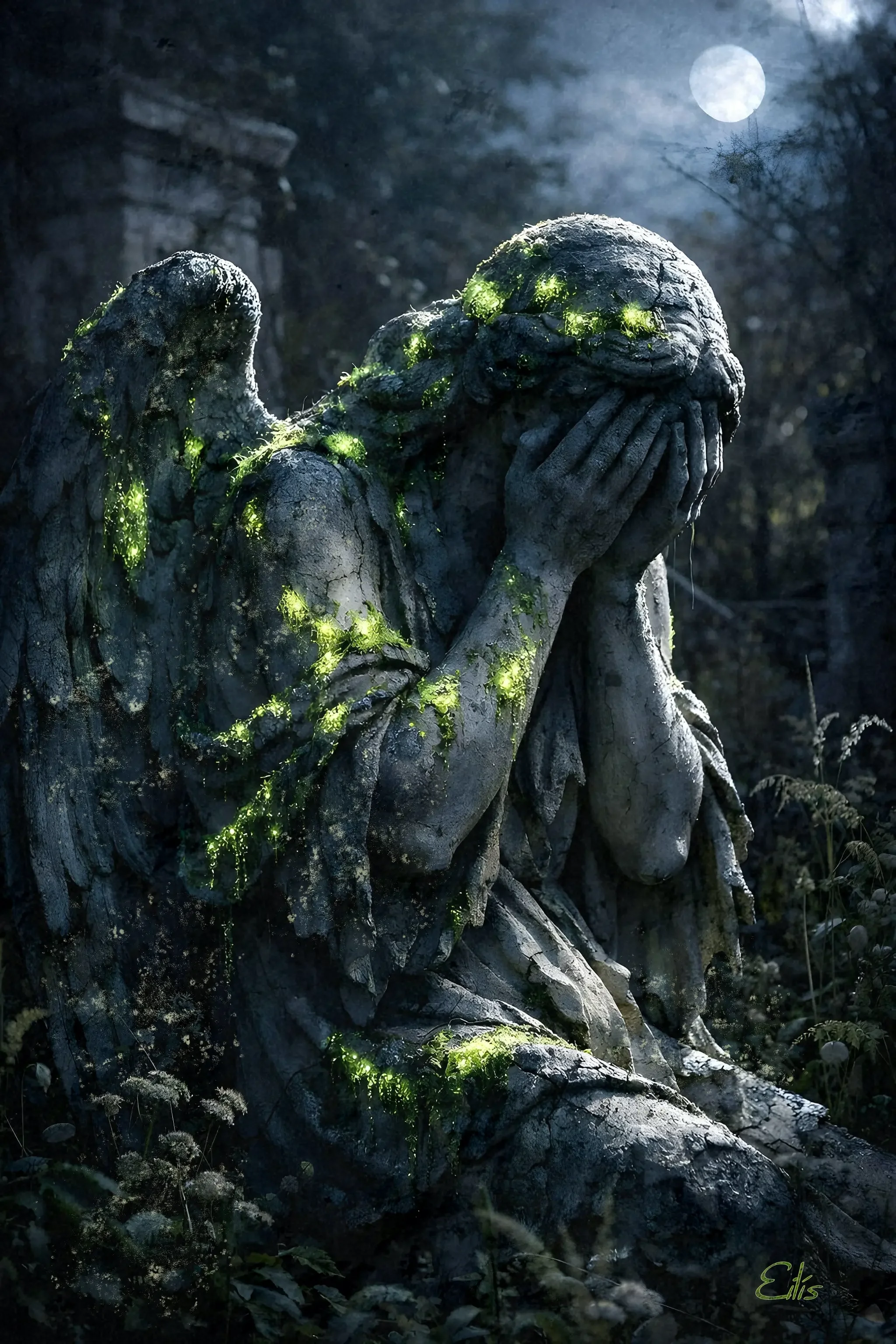
When the picture returned it showed a forest at night. A full moon hung in a rag of cloud, and in the undergrowth knelt a stone angel with her face buried in her hands and her heavy wings drooping at her back. Moss had crept over her head and shoulders and glowed there a poisonous green, like something remembered. Letters rose slowly out of the dark, one at a time:
NO ONE EVER WINS.
And beneath, smaller, in the polite type of a cashpoint:
THANK YOU FOR PLAYING.
After
Consuelo Reyes came home from Oaxaca on the Tuesday after Día de los Muertos, and went to Norman’s house straight from the airport, her suitcase rolling behind her over the wet pavement, marigold petals still caught in the folds of her coat and a bundle of bread wrapped in foil against her chest. Tuesday was not her day. But for four evenings she had rung him from her mother’s kitchen, and for four evenings the line had rung out like a bell in an empty church. The porch light was burning at noon. The post had piled up on the mat.
The ginger cat on the kitchen sill greeted her with narrowed approval. The house smelled of cellars and old roses, and under that of coffee gone cold.
‘Norman?’
The workroom was lit by one monitor. On it a stone angel wept in a moonlit wood, her face in her hands, and below her, in letters that seemed to have been there for a long time, stood two lines Consuelo did not stop to read. Norman sat at the desk with the visor over his eyes and the grey gloves on his hands, his head tipped slightly back, as if he were listening to something a long way above him.
She said his name once, and then again. The third time she said it very softly, the way one speaks to someone who is asleep and should be left so.
She lifted the visor. His eyes were closed. His face had been smoothed of its anxiety like a sheet pulled straight, and he looked, for the first time in the six years she had known him, entirely at rest. Across his throat ran a fine pale line, thin as thread, where the cable of the visor had pressed into the skin. On the desk beside the sugar skull that wore his name lay a single petal, deep red and velvet-soft, from a rose. She had carried home only marigold petals, orange and ruffled, and no rose had entered that house in six years. She decided that it had come in on her coat, and knew as she decided it that it had not.
His hand was cool as the underside of a pillow. She crossed herself, forehead to breast to either shoulder, and whispered, ‘Dios mío. Madre de Dios.’ Then she reached for the phone.
The paramedics came in four minutes, three of them in green, and they worked on him all the way down the front path, neither hurrying nor slowing. The youngest, a woman with a tired face, glanced back at the headset on the desk and said they saw more of this lately, the hours and then the days, and that the heart had a way of giving out quietly when nobody was watching. Neighbours stood along the pavement in their cardigans. Somewhere a child in cardboard wings, left over from Saturday, watched it all with grave attention from a gate.
When the ambulance had gone, Consuelo went back into the workroom for the last time. Someone had switched off the monitor, and the weeping angel had folded into the dark. Under the desk the tower’s tray slid open of its own accord with a small mechanical sigh. On the silver face of the disc, in silver ink, were two words:
No refunds.
She read them twice and did not like them. She slid the disc face down beneath a pile of paper, as one turns a photograph away from a mirror.
Then she went into the kitchen and set a pot of coffee on the stove with a stick of cinnamon and a spoon of brown sugar, the way her mother had made it. While it came to the boil she hummed, an old bolero whose words she remembered only in part, and the sound travelled down the hall into the empty room with the blinds half raised. She poured it black and sweet into the blue mug and carried it to the kitchen table. Beside it she laid a handful of orange marigold petals, a round of bread, and the little sugar skull with Norman’s name across its brow, grinning at the room with a width no one had ever told it to correct.
She left the cup there to steam, as she had left one every year for her mother, so that whoever came might find something warm. The steam rose and went up, in no particular hurry, as if it were being carried to a higher landing.