
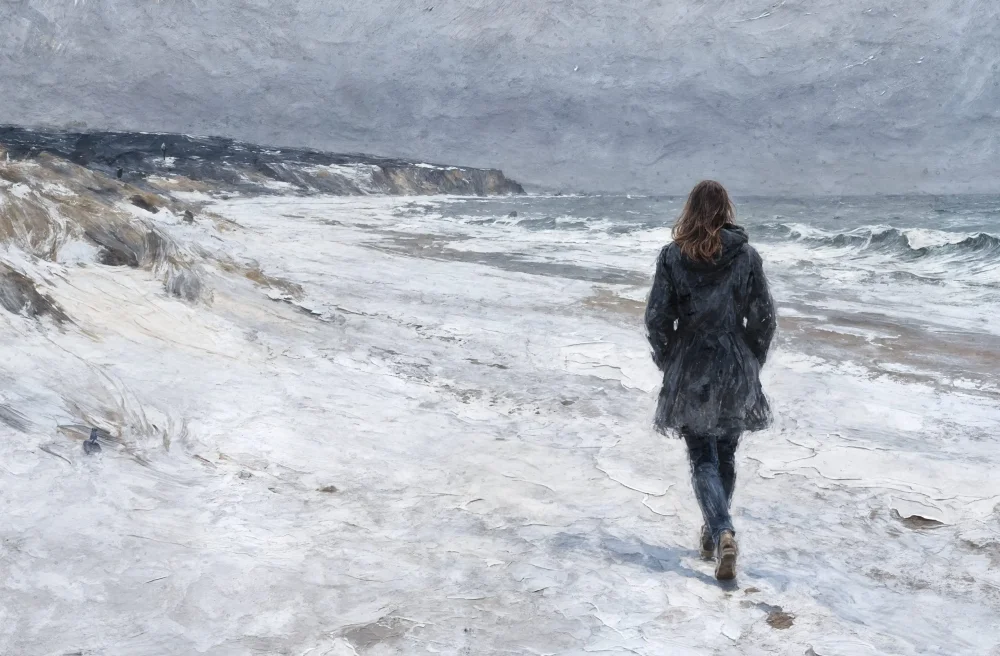
The Wintry Sea
Grey Seawaters
There is something about the sea in winter that strips away pretence. In summer, it offers itself generously—a playground for children, a postcard backdrop for tourists, all sparkle and invitation. But in the grey months, when the wind comes howling off the Atlantic and the light fails by four o'clock, the sea reveals its truer nature. It becomes what it has always been: indifferent, ancient, impossibly vast.
I come here when I need to remember my own smallness. Not in a way that diminishes, but in a way that settles things into proportion. The relentless press of daily concerns—the unanswered emails, the disappointing conversation, the persistent worry about whether I've chosen correctly—all of it shrinks to nothing when faced with this grey expanse that predates human language and will outlast our cities.
The wintry sea doesn't perform. It doesn't arrange itself prettily for observation. The waves come in with a kind of brutal honesty, each one the same and yet different, sculpted by winds that have travelled thousands of miles to meet this particular stretch of shore. The colour is never the simple blue of calendars and postcards. It's pewter and slate, occasionally touched with green where light finds shallow water over sand. Near the horizon, it darkens to something almost black, and there's no clear line where water ends and sky begins—just a gradual dissolution of one grey into another.
I've noticed that people walk differently here in winter. In summer, they stroll, they dawdle, they pose for photographs. But winter walkers move with purpose, heads down against the wind, or they stand—as I do now—utterly still, as if they've come not to walk at all but to witness something. Perhaps it's the rawness of it. Everything is exposed. The beach offers no shelter, the wind no mercy. You stand here and you are simply what you are: a human body, warm blood pumping, lungs pulling in salt-sharp air, entirely at the mercy of elements that existed long before you and care nothing for your comfort.
There was an old fisherman I knew as a child, a man the village called Pignurin. I remember his face with the clarity that childhood memory sometimes grants—weathered as driftwood, mapped with lines that spoke of decades facing into salt wind. He wore a dark cap pulled low, and beneath it, his eyes held that particular quality of men who've spent their lives reading horizons. A magnificent beard, white as foam, spread across his chest, and his moustache curved upwards in a way that suggested some fundamental good humour, even when his expression remained serious. His hands, when I saw them gripping nets or coiling rope, were gnarled and capable, shaped by labour into instruments perfectly suited to their purpose.
Pignurin used to say the winter sea taught him everything he needed to know about acceptance. He spent his working life reading weather, learning the sea's moods, understanding when to venture out and when to stay ashore. I was perhaps eight or nine when he spoke to me once, his voice rough but not unkind, pointing out towards the grey expanse. "She doesn't care about us," he said, meaning the sea. "That's why you can trust her. She'll never lie about what she is."
I think of him whenever I come here in winter. Not with the sharp grief of loss—he lived to a great age and died peacefully in his own bed—but with a kind of recognition. He understood what I'm only beginning to grasp: that the wintry sea, in all its inhospitable grandeur, offers a strange form of comfort. It asks nothing of us. It doesn't require our understanding or appreciation. It simply is, with a permanence that makes our own fleeting troubles seem less insurmountable.
There's a particular quality to the light at this time of year, especially in the hour before dusk. Everything becomes silvered, softened at the edges. The water takes on a luminous quality, as if lit from within. It's beautiful, but not in any gentle way. It's the beauty of something utterly self-contained, requiring no witness. I've stood here alone and watched the light shift across the waves, and I've felt simultaneously invisible and entirely seen—not by any person or deity, but by the landscape itself, which includes me in its vast indifference the way it includes the stones and the gulls and the strand of kelp drying in the wind.
When I was younger, I mistook this indifference for hostility. I wanted the world to care about my small dramas, to acknowledge my disappointments. I wanted significance, validation, some external confirmation that my feelings mattered on a cosmic scale. But the sea in winter taught me otherwise. Standing here, watching waves that have crossed an ocean to break on this shore, I learned that my feelings do matter—but only to me, and to those who choose to care about me. The universe itself has no opinion. The sea will continue its advance and retreat long after I've gone, utterly unchanged by my joys or sorrows.
There's liberation in that realisation. If nothing I do will alter the sea's course or still its restless motion, then I'm free to simply be. Free to feel what I feel without needing it to mean something larger. Free to love, to grieve, to fail, to try again, because none of it registers on any scale but the human one—and that scale, it turns out, is enough.
The cold begins to seep through my coat now, and I know I should turn back, walk the half-mile to where I've left the car. But I linger a few moments longer. There's a satisfaction in enduring the cold, in standing here until my fingers ache and my face feels wind-scoured. It's a small act of participation, a way of meeting the winter sea on its own terms rather than retreating to comfort at the first discomfort.
I've brought others here, at various times. Some understood immediately what draws me to this place. They stood quietly, felt the wind, watched the light change, and needed no explanation. Others grew restless after five minutes, eager to return to the warmth of the car, to conversation, to something they could engage with more directly. I don't judge either response. The wintry sea offers itself to those who want what it provides, and nothing to those who don't. That's the beauty of it—its absolute lack of persuasion.
As the light continues to fade, the sea grows darker, more mysterious. This is when it feels most itself, I think—when it sheds even the small concessions it makes to daylight and becomes purely elemental. The sound of the waves takes on greater prominence now, filling the silence, providing a rhythm that feels older than time. It's easy to understand why people throughout history have looked at the ocean and seen divinity. Not because it's benevolent or merciful, but because it embodies something eternal, something that puts our brief lives into perspective.
I turn finally, beginning the walk back. My cheeks are numb, my hands thrust deep in my pockets. But there's a clarity in my thoughts now, a settling. Whatever was churning when I arrived has been smoothed out, worn down the way the sea wears down glass into something polished and handleable. That's what the wintry sea does, I think. It takes our jagged concerns and tumbles them until we can hold them more easily. I think of Pignurin's weathered face, that white beard moving as he spoke of the sea's honesty, and I understand now what he meant. The truth doesn't always comfort, but it steadies.
I'll come back. I always do. Because the wintry sea reminds me of something essential: that beauty doesn't have to be comfortable, that meaning doesn't require warmth, and that sometimes the greatest gift we can receive is to stand in the presence of something that asks nothing of us, expects nothing from us, and simply allows us to be exactly what we are—small, temporary, and yet somehow, in this moment, enough.