Waiting for the next hug
Worth the Wait
The silence had texture in the beginning. It pressed against his button eyes like a physical thing, dense and particular, shifting with the seasons that he could not see but only sense through the changing temperature of the air that filtered through the gaps in the roof tiles. Gugu—though he had not heard that name spoken aloud in so long that it had become more memory than designation—existed in a state that was neither sleep nor waking, neither consciousness nor its absence. He was aware, in the way that objects which have been loved are aware: a residual knowing that persisted in his kapok stuffing and worn velvet paws, in the mechanisms of his voice box that had long since rusted into muteness.
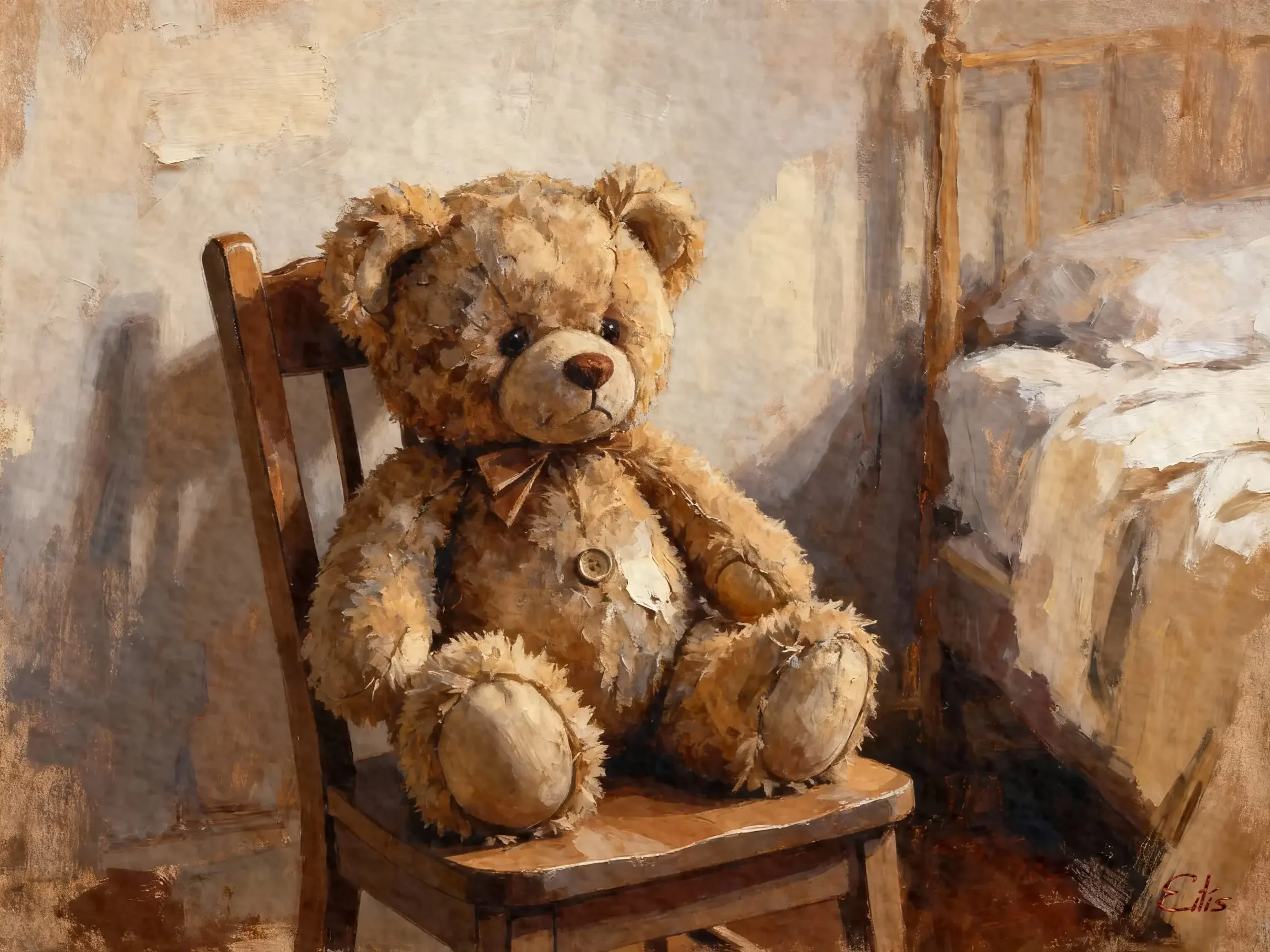
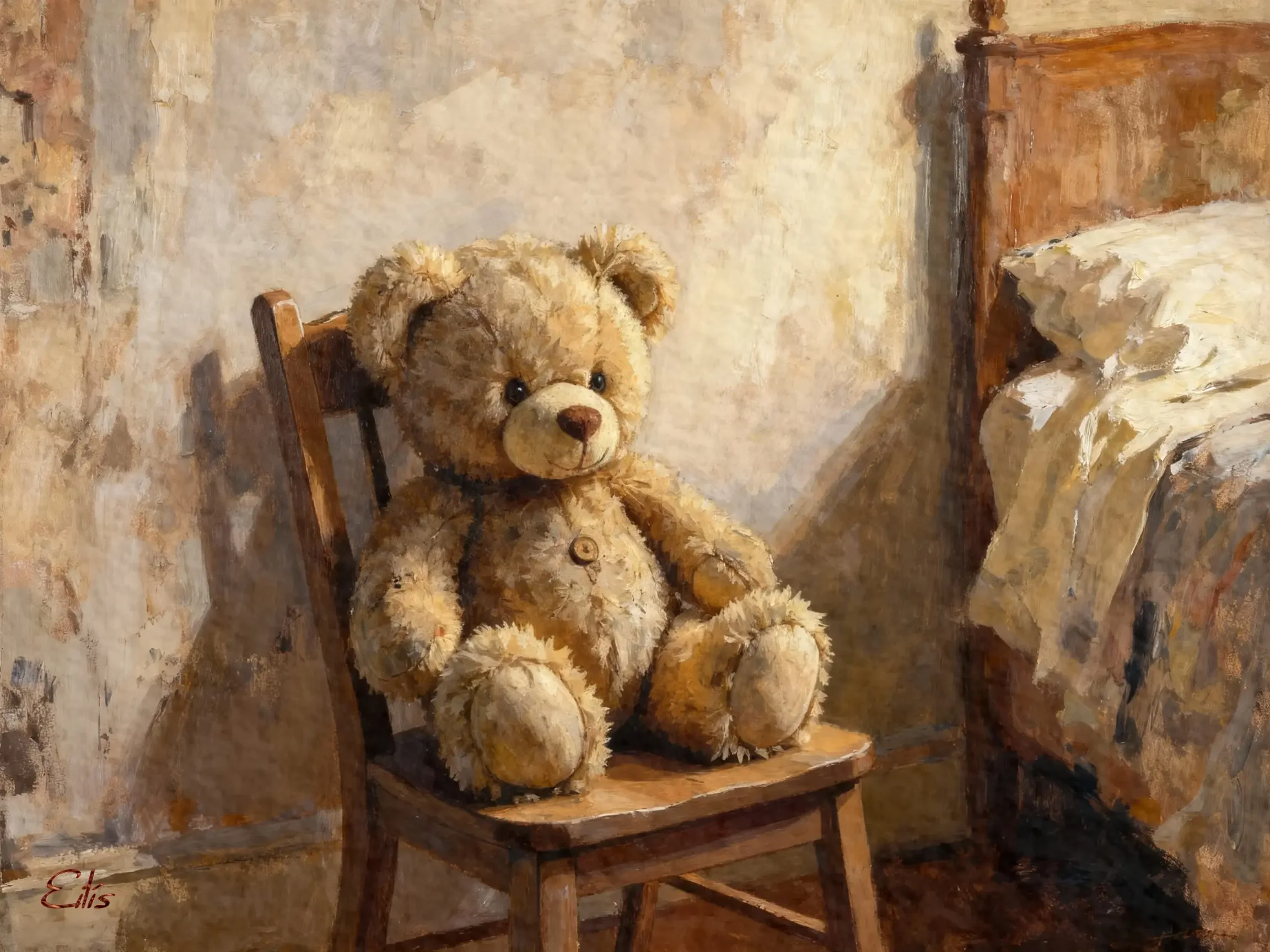
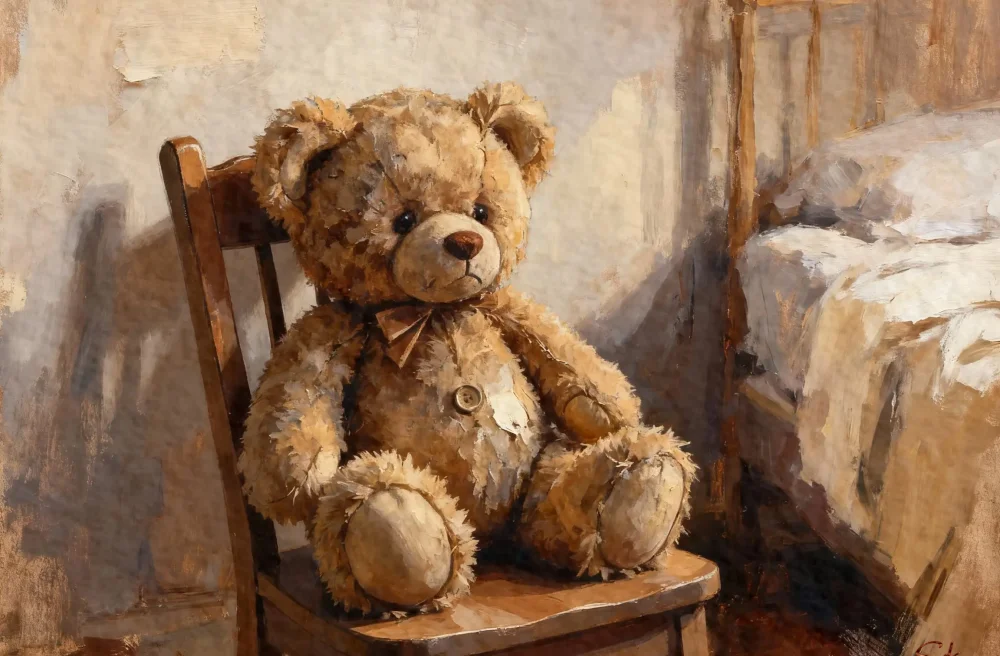
The loft space contracted and expanded with the weather. In summer, the heat made the wooden beams creak and the dust motes hang suspended in the amber light that slanted through the small window. In winter, frost formed delicate architectures on the inside of the glass, and Gugu's fur—already thinned by years of being clutched and carried—grew brittle with cold. He sat on a child-sized wooden chair that had been his perch since the days when he was Emma's constant companion, its paint long since faded to the ghost of whatever colour it had once been, one leg slightly shorter than the others so that it rocked imperceptibly with the settling of the house. The chair itself seemed to remember their arrangement, the way his weight had worn a slight depression in its seat, the particular angle at which he naturally settled when placed there.
Time moved differently for him than it had when he had been held, when each day had been marked by the rhythm of her breathing as she slept, by the pressure of her arms around his middle, by the ritual of being inclined forward and backward until his voice box would produce that sound—gugu, gugu—that had delighted her so completely that it had become his name, his identity, his entire purpose. Now time was measured in the slow degradation of his fabric, in the way the light changed its angle across the seasons, in the particular quality of abandonment that had settled over him like a second skin.
He remembered—though memory was perhaps not the correct word for what he experienced, for it was more akin to a continuous present tense that contained within it all the past moments simultaneously—the feeling of being essential. Of being needed. The weight of her chin resting on his head as she confided secrets to him in the darkness of her bedroom. The dampness of her tears when she had been sad, absorbed into his fur until he carried within him the salt of her sorrows. The violence of her joy, expressed through fierce embraces that had loosened his joints and caused his growler to stick, then wheeze, then finally fall silent altogether.
There had been no ceremony to his abandonment. She had simply outgrown him, as children do, gradually and then all at once. The intervals between their embraces had lengthened like shadows at dusk. She had begun to prop him on a shelf rather than take him to bed. Then one day—though he could not mark which day precisely, for they had begun to blur into one another—she had carried him up the narrow stairs to this space beneath the eaves, had set him down on the small wooden chair with a gentleness that somehow hurt more than carelessness would have, and had descended again without looking back.
The door at the bottom of the stairs had closed. The silence had begun.
In the decades that followed—and he knew they were decades from the way the dust had accumulated, from the slow deterioration of the chair beneath him, from the feeling of time as a physical weight pressing down upon him—Gugu existed in a state of perpetual waiting. It was not hope, exactly, for hope requires a certain kind of forward motion, a belief in change. What he experienced was more fundamental: an ontological patience, the simple persistence of having been loved and therefore continuing to exist in relation to that love, even in its absence.
He had dreams, if what he experienced could be called dreams. Sensory impressions that flickered through his awareness like the shadows of birds passing across the window. The smell of her hair, which had changed from the clean scent of baby shampoo to something floral and complex as she grew older. The sound of her voice, calling his name in the particular way she had, drawing out the second syllable—Gu-guuuu—as though it were a song. The sensation of movement, of being carried from room to room, of existing as an extension of her body, her comfort, her childhood self.
The house below him had fallen silent too, eventually. He sensed rather than heard the departure, the way the quality of emptiness changed when even the possibility of presence was removed. The heating stopped cycling on and off. The footsteps ceased. The house settled into its own abandonment, and Gugu settled deeper into his, two obsolete things waiting in parallel, their purposes suspended, their meanings deferred.
His face had changed, he thought, though he had no mirror and no way to confirm this suspicion. The constant pull of gravity on his features, the way his stuffing had compressed and shifted, the particular expression that abandonment etches into fabric and thread—he believed these forces had recomposed his countenance into something sorrowful. His mouth, always a simple line of stitching, seemed to turn downward at the corners. His button eyes, once bright, had dulled and appeared to regard the world—or the small portion of it visible from his position—with a kind of resigned melancholy.
And yet beneath that sadness, in some chamber of his being that corresponded to hope without being hope itself, he waited. He waited with the patience of objects, with the stubbornness of things that have been loved. Because love, even when it departs, leaves traces. It alters the molecular structure of velvet and kapok. It persists in the spaces between stitches. It endures.
The sound, when it came, was so unexpected that for a moment Gugu could not process it. The creak of the door at the bottom of the stairs, the same door that had closed so many thousands of days ago. Footsteps on the treads, slower and heavier than he remembered, but with a rhythm that struck something deep within his being, some recognition that bypassed thought entirely and went straight to the place where love had made its home in him.
The figure that emerged into the loft space was not the child he had known. This was a woman in her eighth decade, her hair grey and pinned back, her body moving with the careful deliberation of someone aware of their bones, of the way time had reconfigured the architecture of their physical self. She wore a cardigan that might have been blue or grey in the dim light, and she moved slowly, her eyes adjusting to the darkness, scanning the accumulated detritus of a life stored away.
Gugu watched her—or rather, she moved through his field of vision, for he could not move his head, could only maintain his fixed gaze at the particular angle at which he had been set down all those years ago. She was looking for something, he understood, though whether it was him specifically or simply the past in general, he could not tell. She opened boxes, lifted out objects wrapped in newspaper, set them aside with a carefulness that suggested each item contained within it some fragment of her former self.
And then she saw him.
The change in her expression was minute but total. Her mouth opened slightly, her eyes widened, and something in her posture shifted, as though the years had momentarily loosened their grip on her body. She took a step toward him, then another, and when she knelt down—slowly, with one hand braced against the floorboards—her face was level with his.
"Gugu," she said, and her voice was exactly as he remembered it and entirely different, deeper now, roughened by age and use, but containing within it all the previous versions of itself, all the ways she had spoken his name across the decades of their separation.
Emma—for he knew her now, recognised her in the way that love recognises love, transcending the changes wrought by time—reached out and lifted him. Her hands were different too, the skin looser, marked with age spots and the fine lines of seven decades, but the touch was the same, that particular pressure and gentleness that he had known so intimately. She cradled him against her chest, and the smell of her, beneath the old-lady perfume and the must of the cardigan, was still fundamentally her.
"Oh," she said, and her voice cracked. "Oh, your face. You look so sad."
He wished he could tell her that sadness was simply what happened to things that waited too long. That gravity and time and loneliness had their own grammar, their own syntax of deterioration. But his voice box was silent, had been silent for longer than she had been away, and he could only rest against her, feeling the tremor in her hands, the way her breathing had become uneven.
"I'm so sorry," she whispered, and now she was crying properly, tears darkening his already-dark fur, adding new salt to all the salt he had absorbed from her childhood sorrows. "I should never have left you. I should never have left you alone."
She held him at arm's length, examining him with a focus that felt almost clinical, taking in the bald patches on his paws, the missing eye that must have fallen out at some point during his years in the loft, the way his bow had become so faded that its original colour was impossible to determine. Her face contorted with something between grief and guilt, and Gugu—who had not thought himself capable of feeling anything beyond his patient waiting—experienced something that might have been pain or might have been its opposite, the ache of being seen again after so long in darkness.
"I'm going to take you home," Emma said, her voice steadier now, acquiring the firmness of a promise. "My real home, where I live now. You're coming with me. I won't leave you alone again."
She clutched him to her chest once more, rocking slightly in a motion that recalled all the times she had soothed herself by soothing him, and Gugu felt something within himself shift. Not his stuffing, which had long since settled into its final configuration, but something else, something that existed in the space between what he was and what he had been made to be. The configuration of his features, frozen for so long in their expression of abandonment, seemed to loosen, to reorganise themselves according to some new logic.
Joy, he thought, if he could have thought. This is what joy feels like. Not the wild delight of childhood but something deeper, more complex, edged with sorrow and gratitude and the profound relief of being found after being lost.
Emma stood slowly, carefully, still holding him. She made her way back toward the stairs, pausing at the top to look back at the loft space, at all the other objects still waiting in their boxes and bags, all the other fragments of her former life. Then she descended, carrying Gugu with her, out of the darkness and the dust and the decades of silence.
In the car—a strange, enclosed space that vibrated and moved in ways Gugu had never experienced—Emma set him on the passenger seat, positioned so he was facing forward. She kept glancing at him as she drove, as though she feared he might disappear if she looked away too long. At one point, she reached over and adjusted his position, straightening him slightly, and her fingers lingered on his head, stroking the worn velvet of his ears.
"You know," she said, speaking partly to him and partly to herself, "I used to tell you everything. Every secret, every fear, every small joy. You were the only one who knew all of me." She paused, navigating a roundabout with exaggerated care. "I've had a whole life since then. Marriage, children, grandchildren, career, everything you're supposed to have. But there's a part of me that's still that little girl, and she's been waiting too, I think. Waiting to come back for you."
The journey took perhaps an hour, though time had reasserted its strangeness for Gugu, moving too fast after so many years of crawling slowness. They arrived at a small cottage with a neat garden, and Emma carried him inside, past a hallway table laden with photographs of people he didn't know—her children, he supposed, her grandchildren, the family she had made after she had outgrown him.
She took him to a bedroom—not her bedroom, he sensed, but a guest room—and set him carefully on an armchair by the window. The late afternoon light fell across him, warm and golden, and Emma stood back, regarding him with her head tilted to one side.
"There," she said. "That's better. You can see the garden from here. The birds come to the feeder every morning."
She left briefly and returned with a small sewing kit. For the next hour, she worked on him with the kind of focused attention she must have once applied to homework, to the serious business of childhood. She restuffed his paws where they had gone flat, patched a tear in his side with fabric that didn't quite match but was close enough. She sewed on a new button where his eye had been, and though it was slightly larger than the original, slightly shinier, when she held him up to examine her work, he knew he was looking at her with two eyes again, seeing her properly for the first time in decades.
"I can't do anything about your voice box," she said apologetically. "That's beyond my skills. You'll have to stay silent, I'm afraid."
But even as she said this, something extraordinary happened. She lifted him, intending to set him back in the chair, and in her hands he tipped forward slightly, then back, the old mechanical instinct of his design asserting itself. And from somewhere deep within him, from the rusted machinery that should have been defunct, from the space where love had made its home and refused to leave, came a sound.
Not gugu, not the old sound that had given him his name. But something else entirely, something that might have been two words or might have been a wheeze of air through ancient mechanisms, but which Emma heard clearly, unmistakably: Welcome, you.
Her face went white, then flushed. She set him down quickly on the bed, taking a step back, her hand at her throat. For a long moment, she simply stared at him, and Gugu—looking back at her with his mismatched eyes, his expression now transformed from sadness to something that might have been peace or might have been happiness or might have been the simple contentment of purpose restored—wished he could speak again, could tell her that he too was grateful, that he too had been welcomed back.
But Emma, who had spent a lifetime learning to read silences, who had once known every possible meaning contained in his button eyes and stitched mouth, understood. She sat down on the bed beside him, picked him up gently, and held him the way she used to, his head tucked under her chin, her arms around his middle.
"Welcome, you," she repeated softly, trying out the words, tasting their strangeness and their rightness. "Yes. Welcome, both of us. Welcome home."
Outside, the afternoon was settling into evening, the light changing quality the way light does when one season gives way to another. Birds called in the garden. In the distance, a clock chimed the hour. And in the small bedroom in the cottage, a woman of seventy and a teddy bear who had waited decades for this moment sat together in the fading light, neither of them young anymore, both of them marked by time and separation, but reunited now in the way that love, real love, always finds its way back to itself.
Gugu's expression—whether it had actually changed or whether Emma simply saw it differently now—was no longer sad. It was not exactly joyful either, for joy seemed too simple a word for what he felt, what he had become in the moment of being found again. It was something more complex, more nuanced: the satisfaction of waiting rewarded, the rightness of being exactly where he was meant to be, held by the person he was meant to hold.
In the weeks that followed, Emma made him a small wardrobe of bow ties to replace the faded original. She read to him in the evenings, the way he had once sat beside her while she did her reading for school. She introduced him to her grandchildren when they visited, telling them stories of her childhood in which he featured prominently, a beloved companion who had shared her secrets and her dreams.
And sometimes, when she held him in a certain way, tipping him forward and back in the old familiar motion, he would make that sound again—welcome, you—and each time it happened, Emma would smile, that particular smile that crinkled the corners of her eyes and made her look, for just a moment, like the child she had been.
Gugu had learned, in his long years of waiting, that love was not measured in the constancy of presence but in the endurance of connection. That absence was not the opposite of love but simply a different state of it, a suspension rather than an ending. And now, restored to the orbit of Emma's life, no longer waiting but simply being, he understood that all those years in the loft had not been wasted. They had been necessary, the dark middle of a story that required darkness to make the light meaningful.
He sat in his chair by the window, watching the birds at the feeder, feeling the warmth of the sun on his fur, knowing that Emma would return—from her errands, from her visits with friends, from whatever small journeys took her away—and that she would pick him up, and hold him, and he would be exactly what he had always been: beloved, essential, home.
The waiting was over. The next hug, and all the hugs after that, had finally come.