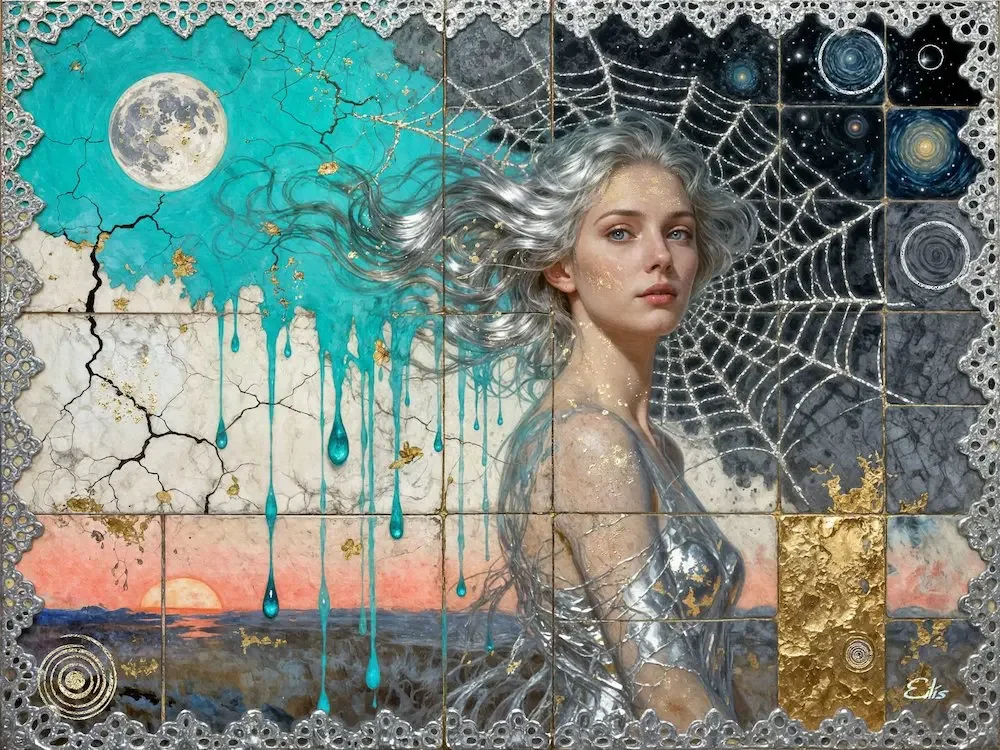

Made of Moon
The Sacred Feminine
The moon has always known women differently than it knows men. Not better, not more deeply, but with a language written in the body's tidal pull, in the monthly architecture of transformation. This is not mysticism but matter: the same force that moves oceans moves through the marrow, through the chambers where life considers itself before taking form.
To be female is to live in constant negotiation with cycles that supersede intention. The body keeps its own counsel, a clock wound by forces beyond conscious command. This is the first lesson: that the body has purposes beyond the self who inhabits it, that consciousness is tenant rather than landlord in this flesh, that the mind wakes each day to discover what the organism has already decided.
The paradox women learn early, though few can articulate it: to be simultaneously solid and mutable, to contain multitudes whilst maintaining a singular self. The moon—that pockmarked companion—reflects no light of its own, yet commands the waters of the world. Women understand this borrowed radiance, this way of being powerful through reflection rather than generation, of influencing without insisting, of pulling rather than pushing. Strength manifests not as the wall but as the membrane, not as what resists penetration but as what permits exchange whilst maintaining integrity.
Ancient cultures named the moon feminine not from sentiment but from observation. For millennia, women lived in synchrony with lunar phases, their bodies conversing with that celestial metronome in a dialogue older than written language. Even now, when electric light disrupts these rhythms, when synthetic interventions override the body's own clock, the connection persists in the deep structures, in the parts of the brain that predate consciousness, in the cellular memory that recalls when humans slept under stars and woke to their own patterns reflected in the sky's slow changes.
This is woman's country: the threshold, the doorway, the place between states where transformation actually occurs. Not the achieved form but the process of becoming, not the destination but the perpetual transit. The body announces this more insistently than male flesh does—the way fertility makes visible purposes that supersede individual will, the way gestation transforms the vessel into something other than singular self. There is no escape into pure mind, pure spirit; the flesh insists on its reality, its needs, its timeline that runs parallel to conscious desire without necessarily coinciding with it.
Women's bodies perform alchemy daily, unremarked: food into milk, nutrients into blood, the ordinary magic of metabolism that sustains not only self but potentially another. The breast holds this capacity in abeyance, waiting, its machinery complete before ever being needed, patient as the ovarian reserve that precedes birth, the body planning for futures that may never arrive. This willingness to prepare for possibilities rather than certainties, to maintain readiness for what might not come—this is its own form of faith, biological rather than spiritual, though perhaps the distinction collapses at such fundamental levels.
The feminine exists not as opposite to masculine but as different negotiation with the same existential facts. Where male bodies can maintain the illusion of stasis, of unchanging form from maturity until decline, female flesh announces its mutability through visible transformation, through the breast's response to hormonal tides, through the dramatic alterations of pregnancy and the profound shift of later years. Each transition a small death, each an expansion, the self constantly renegotiated through the body's changing terms. There is no pretence of permanence available; change writes itself in tissue, in the way the body marks decades through alteration rather than accumulation.
To live in lunar time is to rehearse impermanence as regular practice. The body builds and releases, prepares and relinquishes, in endless rhythm. This familiarity with cyclic loss, with the organism's willingness to destroy what it has created, breeds particular understanding. Nothing is permanent; everything is recyclable; the temple is also the ruin, simultaneously. Women learn to hold both construction and destruction in the same moment, to know that what breaks down feeds what builds up, that the system requires both creation and dissolution to maintain itself.
The womb holds this knowledge most acutely: that the same organ can nurture life and expel it, can be sanctuary and expulsion chamber, can contract with pleasure or with pain, depending on circumstance rather than essence. It is not metaphor but fact that women contain space designed to house other, to grow consciousness inside consciousness, to divide the self whilst remaining whole. Even those who never bear children carry this architectural possibility, this internal room prepared and waiting, this bodily acknowledgement that selfhood might, at any moment, require expansion to accommodate another.
Creation that requires giving the self over to process, art that consumes the artist in its making—women know this in their flesh before they know it in their work. The body operates according to imperatives that live deeper than thought, that precede conscious agreement and proceed without permission. The organism knows before the mind agrees, prepares before permission is granted, functions according to timelines the conscious will did not establish and cannot override.
This is perhaps the deepest mystery—not that women connect to lunar cycles or operate according to mysterious rhythms, but that consciousness must accommodate itself to the body's purposes rather than commanding them. The masculine tradition privileges mind over matter, reason over feeling, control over surrender. But the female body teaches different lessons: that control is illusion, that the mind is always passenger to the organism's deeper imperatives, that consciousness exists to serve biological purpose rather than to transcend it.
Women age differently not just visually but experientially, marked by thresholds men do not cross. The girl becomes woman not through chronology alone but through the body's announcement; the maiden transforms not through external ceremony but through internal revolution, the way the organism insists that another's needs might supersede one's own; the fertile years give way not gradually but through dramatic shift, the strange liberation of the body's release from reproductive purpose, the way the self can finally cohere without the constant tidal pull of biological possibility.
These transitions have no male equivalent. Men age continuously, incrementally, without the dramatic biological punctuation that marks female time. Their bodies do not announce decades through transformation, do not require periodic reinvention of identity to accommodate flesh's changing function. This gives women particular intimacy with impermanence, with the self as process rather than fixed entity, with identity as something negotiated rather than declared.
The body as node in network, always receiving, always transmitting—this is not poetic fancy but biological fact. The infant's cry changes hormonal cascades; the scent of a partner can shift internal rhythms; collective stress alters individual development. Women's bodies respond to external conditions more dramatically than men's do, the permeable boundary between self and world making the organism more sensitive, more reactive, more capable of adjustment to circumstance. This is survival strategy encoded in tissue: the ability to read environment and respond, to alter internal conditions based on external information, to prioritize context over consistency.
Systems thinking—the understanding that pulling one thread affects the whole fabric, that care for the part requires attention to the whole—emerges naturally from bodies that operate as ecosystems rather than machines. The breast responds to stress by altering production; the womb expels pregnancy when nutrition fails; the ovaries quiet themselves when the body cannot sustain reproduction. Everything connects to everything else; the organism refuses the fiction of isolated function, of parts operating independently from whole.
This breeds particular intelligence—not higher or better, but different. The awareness that no action exists in isolation, that every choice ripples outward affecting systems beyond the immediate, that care must attend to web rather than strand. Women learn this through the body's demonstrations: that eating patterns affect bone density affect fertility affect cardiovascular health; that stress disrupts hormonal balance disrupts mood disrupts rest; that everything is always conversation between systems rather than single organs operating alone.
The moon completes its cycle in twenty-nine days; female rhythms average the same. Perhaps coincidence, though coincidences reveal patterns when they recur across cultures and epochs. What matters is not whether the connection is causal but that women have always lived in conversation with celestial rhythms, have measured time by the body's own phases mirrored in the sky's slow changes. This breeds particular relationship to time itself—not linear progress toward destination but cyclical return, not achievement but recurrence, not goal but rhythm.
Linear time—the masculine model of progress and development, of moving forward toward completion—makes little sense to bodies that circle back regularly, that revisit the same states in endless repetition, that measure life not by accumulation but by cycling. The feminine experiences time as spiral rather than arrow, as return with variation rather than advance toward terminus. Each cycle is both repetition and new; each phase both familiar and unprecedented; each completion both ending and beginning, impossible to classify as either alone.
This cyclical consciousness affects everything: how women understand history as pattern rather than progress, how they approach problems as recurring rather than solvable, how they measure success as sustainability rather than achievement. The body teaches that nothing is ever finally resolved, that what ends will return, that completion is temporary illusion before the next beginning. This can feel like curse—the repetition of it, the way resolution never arrives. But it is also liberation from the tyranny of finality, from the pressure to arrive at permanent states, from the fiction that problems can be solved rather than managed, that selves can be achieved rather than continuously becoming.
The feminine divine—goddess rather than god, multiple rather than singular, changing rather than eternal—reflects this embodied understanding. Not one face but three, not unchanging law but seasonal transformation, not transcendent authority but immanant presence moving through matter itself. The sacred lives in the body, not despite it; holiness manifests in the messy animal facts of incarnation rather than in escape from flesh.
To honour the sacred feminine is not to worship women but to acknowledge what women's bodies have always known: that consciousness and flesh are not opposed but continuous, that spirit moves through matter rather than despite it, that the divine is immanent rather than transcendent, present in the body's own intelligence, in the way life creates itself through cellular cooperation, in the miracle of ordinary metabolism that transforms one substance into another without supernatural intervention.
The body as temple is not metaphor. The inner chambers where life considers itself before taking form, the regular ritual of preparation and release, the way the organism knows how to grow bone and brain from protein and calcium, how to orchestrate the thousand simultaneous processes that maintain consciousness in flesh—this is sacred architecture, divine engineering operating through evolution's slow refinements, through the wisdom of the cell that precedes and enables the mind's later emergence.
Women live closer to this biological sublime because the body announces it more insistently. There is no forgetting one is animal when the organism operates on its own schedule, when breasts respond to hormones the mind did not consciously summon, when pregnancy makes visible the way one consciousness can house another, the way the body functions according to purposes the self does not control and sometimes did not choose.
This breeds particular humility—not false modesty but genuine recognition of the self's limits, of consciousness as local phenomenon embedded in systems that vastly exceed it, of individual will as minor variable in equations the body solves without consulting the mind. Women learn they are not authors of their own stories but participants in narratives the organism writes according to its own logic, its own timeline, its own purposes that may or may not align with conscious desire.
The masculine myth of control—the fantasy that will can command outcome, that discipline creates destiny, that the self is master of its fate—cannot survive the body's regular announcements of its own authority. The mind cannot discipline the hormones into compliance, cannot control the breast's response to prolactin or the ovary's rhythms. The body does what it does; consciousness accommodates or suffers, but it does not command.
This is not weakness but reality—the same reality that eventually confronts all bodies regardless of sex, but that female flesh announces earlier and more regularly. The lesson is not despair but acceptance, not surrender but recognition that working with the body's rhythms is wiser than working against them, that strength includes flexibility, that power manifests in yielding as much as in resistance.
Women know holding, this way of being structure that receives rather than pursues, that catches rather than captures, that creates space for what comes rather than seeking what is absent. Not passive but actively receptive, not weak but strategically patient, not empty but deliberately spacious, maintaining room for what might arrive, for who might grow, for what wants to emerge.
The moon pulls the tides. The tides pull the blood. The blood pulls the future into being. This is the nature that needs no explanation because it is explanation itself, the answer living in the question's body, the mystery that solves itself through its own perpetual unfolding. To be woman is to be this process incarnate, to live the transformation that consciousness can only witness, to house the sacred in the ordinary animal fact of flesh that cycles and renews, breaks and mends, gives and receives according to its own deep knowing, its own tidal intelligence, its own lunar rhythm that precedes thought and survives it, that was ancient when language was young and will continue when words have returned to silence.
The female body is threshold between what is and what might be, boundary where the possible takes form, architecture that understands its own impermanence as the condition of its creativity. This is not poetry but physiology, not sentiment but structure, the way matter organizes itself to permit life's continuation whilst remaining itself, distinct and whole.
To understand women's nature is to understand that nature itself—the unfolding of potential into actuality, the transformation of energy into form, the way consciousness emerges from and remains embedded in flesh—operates according to principles the female body demonstrates with particular clarity. Not that women are more natural than men, but that female flesh makes visible what all bodies know: that we are process rather than product, becoming rather than being, participants in transformations we did not initiate and cannot finally control, expressions of forces that vastly exceed individual intention whilst requiring that intention to take particular shape.
The mystery is not that women connect to the moon, but that the moon reveals what was always true: that we are all subject to rhythms we did not choose, that consciousness rides currents it cannot command, that the self is both author and instrument, both agent and patient, both particular and universal, living the ancient patterns through while remaining unrepeatable, singular, themselves.
This is what the lunar body knows and what it teaches: that to be creature is to be both finite and infinite, both mortal and eternal, both individual and species, living the contradiction without requiring its resolution, holding the paradox in flesh that cycles and endures, that changes and remains, that dies into itself and rises transformed, again and always, as long as life continues its patient elaboration of possibility into form.