Canopy of Gold
The Pensive Ondine
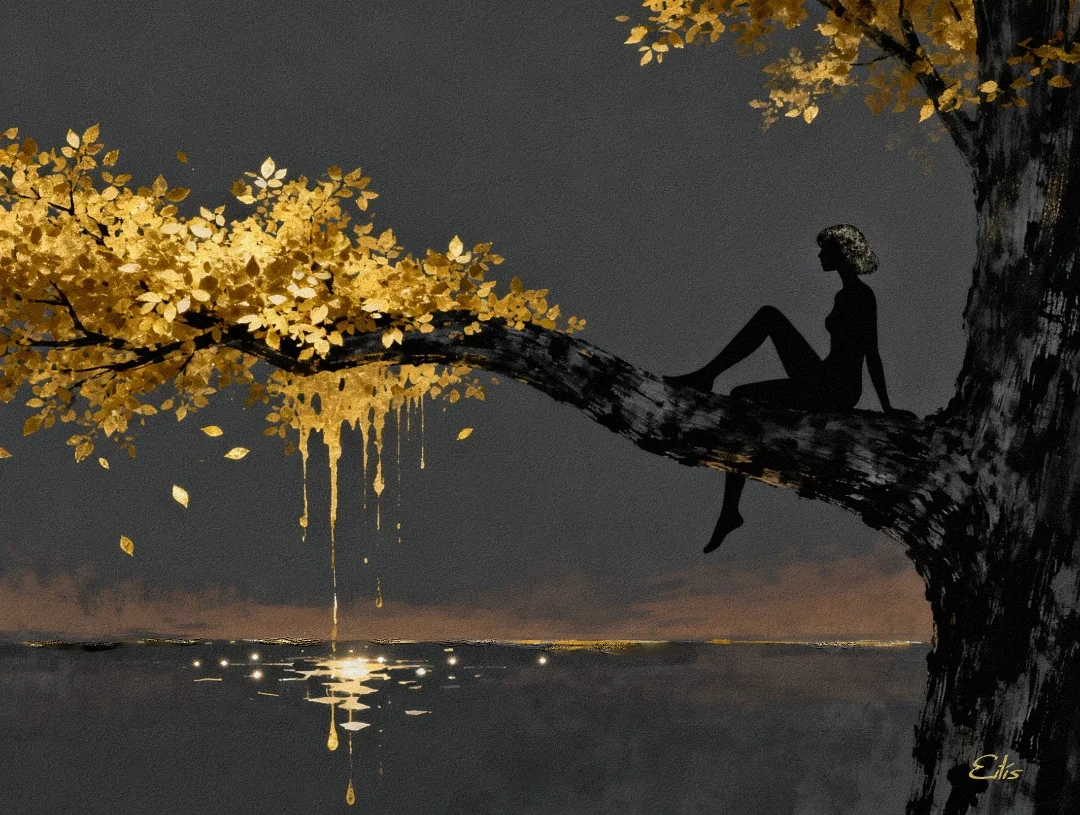
The branch had grown out over the water at an angle that suggested surrender — not defeat, but the particular yielding of something that has stopped pretending gravity does not exist. Ondine sat at its furthest habitable point, her spine straight despite the hour, one knee drawn up and the other leg depending loosely toward the sea's surface, her foot suspended an inch or two above her own reflection. She did not look down at it. She had long since tired of seeing herself in water.
The sky behind her held the last residue of colour — a band of bruised rose pressing against the grey where day had been — and she watched it with the focused, impersonal attention of someone reading a letter they have already memorised. Her jaw was set with a softness that was not relaxation. Her hands rested on the bark of the branch without gripping it, fingers neither curled nor splayed, simply present, aware of the texture of the dying wood beneath them.
The tree was shedding gold.
It shed gold every evening at this hour, which Ondine understood as a kind of language, the way a person's eyes change colour under stress. The leaves detached themselves one by one or in small clusters and fell, not drifting but dropping with a slow intention, and where they touched the water they dissolved into light — brief, stippled constellations across the surface before the sea absorbed them back into itself. The branch from which they fell wept too, golden threads unravelling from the tips of its lower growth and falling in slow vertical lines toward their own reflections. She had never asked the tree what it was mourning. Some forms of loss are not a question.
She was not of trees. She was of water, of the cold pull beneath the surface, of the salt grammar that structured the deep. But this tree she had returned to across more years than she chose to number, and she understood her attachment to it the way you understand an attachment that has outlasted its explanation — it was simply there, woven into what she was. The tree's canopy of golden falling leaves, its slow annual dissolution into the sea beneath it, its willingness to reach further than was structurally wise: these things rhymed with something in her she could not otherwise articulate. Perhaps it was this — that the tree, like her, existed at the boundary between elements. Rooted in earth, leaning over water, shedding fire-coloured light. She had been sitting here since before the colour left the sky.
Her name was a word that had no plural. It referred only to her, in the way that certain geological features refer only to themselves — this escarpment, this particular inland sea. She had other names accreted over centuries the way a hull accretes barnacles, human names given by people who needed her to be approachable, diminutive, nameable. She used whichever was required without preference. Names were for others' comfort.
What she was thinking about this evening — and she had been thinking about it in the way you turn a stone over and over without examining it, simply feeling its weight — was the man she had seen that morning on the far shore.
He had been standing at the water's edge with his shoes on. This was the first thing she noticed, not because it was unusual in people — people kept their shoes on everywhere, even places where the ground asked something of them — but because of how he stood in them. His weight was back on his heels. His arms were at his sides. He was looking at the sea in the manner of someone who has arrived somewhere and found it does not match the internal image they had been carrying. The discrepancy was visible in the set of his shoulders, in the particular stillness of his hands.
He was, she estimated, forty or perhaps less, the age at which humans begin to take serious stock of what they have accumulated versus what they intended. He had the build of someone who had once been physically confident and was now conducting negotiations with that confidence — not lost, not abandoned, but renegotiated on less certain terms. His hair had begun to silver at the temples. He had not noticed her, which was ordinary. People rarely looked up into trees.
She had watched him for perhaps ten minutes before he turned and walked back through the sedge grass to the road.
What troubled her — and she sat with the word troubled for a moment, testing it, finding it imprecise but serviceable — was the quality of his stillness. She had observed stillness in many forms over the accumulated centuries. There was the stillness of contentment, which had a horizontal quality, a spreading. There was the stillness of grief, which turned inward and compressed. There was the stillness of people who had simply stopped in the middle of something and not yet recommenced. His had been none of these. It was the stillness of someone waiting for permission.
She did not know what permission. She did not know from whom he imagined it would come.
And yet.
She found herself, for the first time in a considerable while, wanting to offer something. This surprised her with its specificity. It was one thing to watch, to catalogue, to understand from a distance the intricate mechanics of human suffering — she had done that with a scholar's detachment for so long the detachment had come to feel like a defining characteristic, something structural rather than chosen. But this was different. What she felt moving in her now was something more particular, directed, almost domestic in its smallness: she wanted to go to him. To stand beside him at the water's edge, not speaking necessarily, but present. Proximate. To let him feel, without explanation, that he was not the only creature in the world who stood at the edge of things and could not bring the weight forward off the heels.
She would not, of course. The rules of her existence were not arbitrary; they were consequences. To approach a human too directly, with intent, was to set something in motion that she had seen end badly, for both parties, more times than she cared to inventory. She knew her own pull, the way water knows its own depth.
But she thought he might come back.
The sea at this hour was a different entity from the sea at noon. Daytime water was transparent in its intentions — you could see what it contained, see the light move through it and illuminate the architecture of weed and stone below. But evening water was reflective in both senses: it mirrored the world above, and it seemed, in its stillness, to be engaged in some interior process that made it opaque to scrutiny. She appreciated this. She had always found more honesty in opacity than in the performed legibility of bright, shallow things.
The gold from the tree touched the surface in three places now and spread in faint rings that overlapped and cancelled each other and spread again.
She thought about his heels.
That backward weight, the unconscious refusal to commit the body fully forward toward the water. Some part of him had wanted to approach, and some other part had engaged the counterweight before the approach could become genuine. She recognised the negotiation. She had watched it in hundreds of people across hundreds of years, this particular argument the human body conducts with itself at the edge of things — shorelines, doorways, endings, beginnings. The body knows before the mind admits. The heels dig in.
Her own feet were bare. They had always been bare. She had no negotiation with edges; she simply occupied them, which was its own kind of limitation. A freedom so total it precluded certain ordinary experiences — the suspended moment of deciding, the sharp, specific pleasure of choosing to step forward anyway. She had never hesitated at a threshold. She wondered, sometimes, what that cost her.
Perhaps that was the real reason she returned to the tree. It was the one place where she could understand, in her body, what it was to be suspended between states. Here, with bark under her palms and water beneath her feet and neither element fully claiming her, she came closest to comprehending what it was to be human and reluctant and full of unnamed wanting.
If he came back tomorrow, she would do something small.
She turned the thought over, examining it. Something small, she decided again, meant something that did not alter the fundamental arrangement between them, which was: he a man on a shore, she a creature in a tree, both of them watching the sea and thinking about things they had not resolved. She might let a single leaf fall at his feet. She might trouble the surface of the water near him with one extending finger, so that a ring of disturbance moved outward toward where he stood, arriving at his shoes like a message with no return address. Something that asked nothing of him, required no interpretation, but which he might carry home in the small, kept compartment where people stored their inexplicable days.
She brought her hanging foot up and rested her chin on her raised knee, her silhouette simplifying against the dimming sky into something almost abstract — a dark shape against grey, outlined in the faintest thread of gold from the leaves above her. Below, her reflection did the same. The two of them, the Ondine and her mirror-self, sat in perfect symmetry across the membrane of the sea's surface, each looking at the other with an expression that might, in a different light, have been mistaken for hope.
The last light left the horizon.
The sea went perfectly still.
She stayed where she was, and waited for tomorrow.