The Hero Who Wept for His Dog
Argos and Ulysses
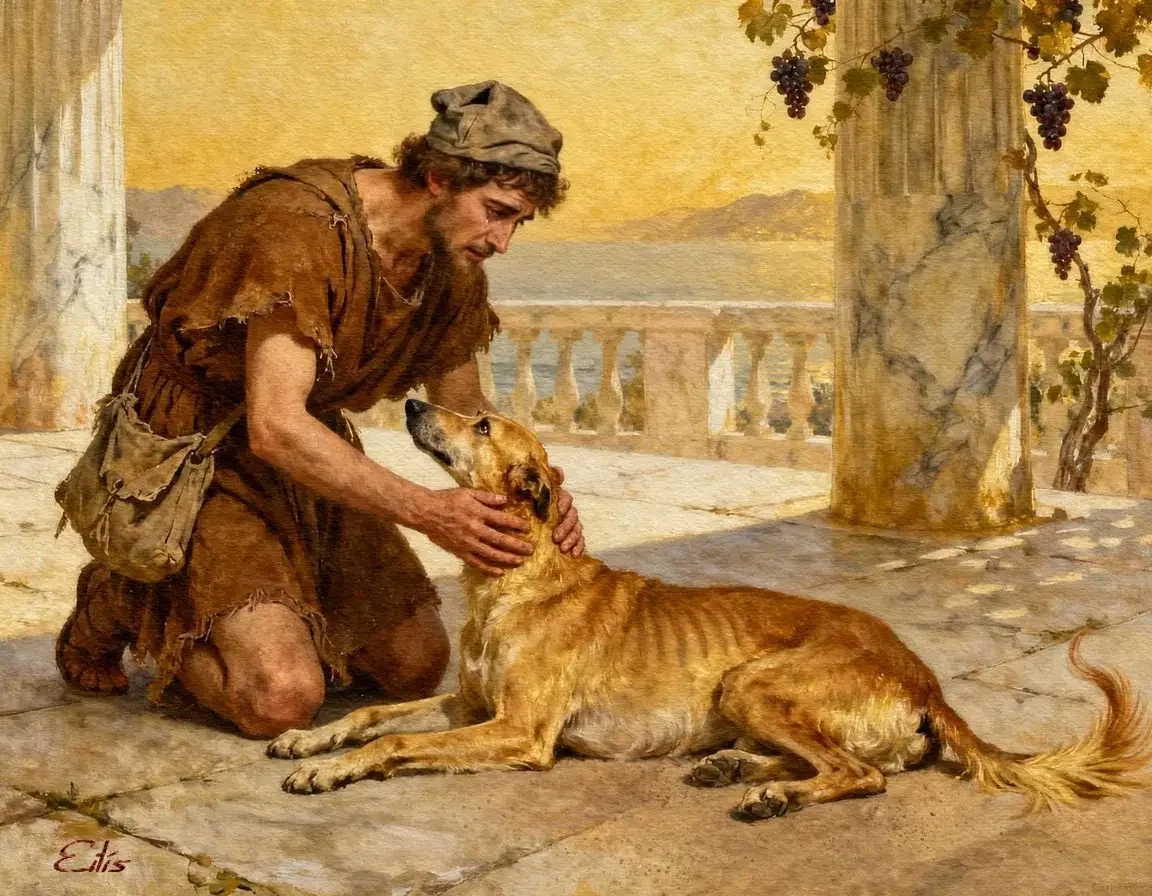
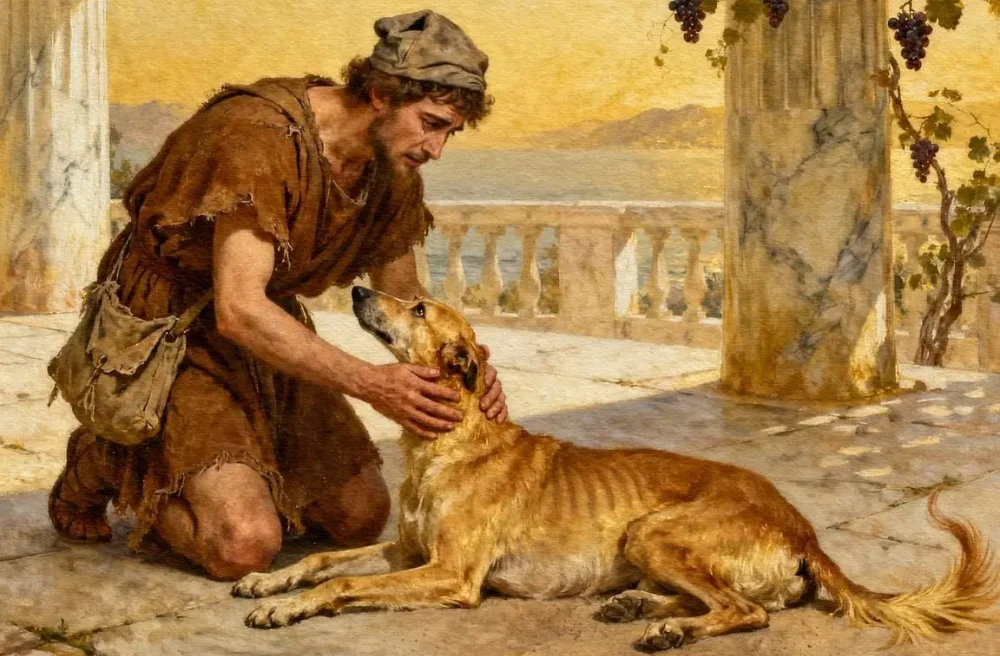
“There lay the hound Argos, full of vermin; yet even now, when he marked Odysseus standing near, he wagged his tail and dropped both his ears, but nearer to his master he had no longer strength to move. Then Odysseus looked aside and wiped away a tear, easily hiding from Eumaeus what he did.”
Twenty years was a long time to be gone. Long enough for a kingdom to drift, for suitors to gather like crows around a widowed throne, for a wife to grow old wondering, for a son to become a man without ever knowing his father's face. Odysseus had survived a war, the wrath of gods, monsters, storms, the slow erosion of every companion who had sailed with him from Troy. He returned to Ithaca disguised as a beggar, a man who had learned, the hard way, to hide everything.
Everything except this.
Argos lay in the dung outside the palace gates, the hunting dog no one bothered with any longer, old and flea-ridden and forgotten by everyone but the poet who first told this story. He had once run beside Odysseus through the hills, quick and bright-eyed, the kind of dog a king is proud to walk beside. Now he could not lift himself from the ground. And yet, when the ragged stranger passed, something in the old dog's failing senses recognised him. His ears lifted. His tail moved, once, faintly, in the dust.
Argos knew him instantly. And here, of all places — not in the halls where his wife wept for him, not in the moment he finally revealed himself to his son — here, beside a dying dog, the mask nearly slipped. Homer tells us he turned aside and wiped away a tear, careful that his guide should not see it. A man who had crossed the wine-dark sea and outwitted a cyclops did not want to be caught grieving over a dog. And yet he was.
There is something almost startling in that detail, sitting as it does among so much strategy and disguise. Odysseus was, by every measure his own age understood, a hero — cunning, battle-hardened, capable of terrible violence when the suitors' hour finally came. But Homer chose to show him first as a hero made human by true love. The love that had carried him across the sea toward Penelope and Telemachus was real, but it was tangled up with the reclaiming of a kingdom, with pride, with the shape a man's life was supposed to take. Argos asked for none of that. Argos had simply waited, the way dogs wait, without calculation, without any stake in the outcome except the return of the one he loved.
That is the part of the story that outlasts the war and the plotting and the blood that would soon follow in the great hall. A dog who remembered, after twenty years, the smell and shape of the man who once fed him. A dog who held on, it seems, for exactly as long as it took — no longer. Argos died there in the yard, his part in the story finished the moment his master came home.
It is tempting to read the whole Odyssey as an epic of return, of a man fighting his way back to reclaim what is his. And it is that. But this small scene, tucked between larger events, suggests something quieter and perhaps truer: that the man capable of such fierce ambition was also capable of being brought entirely undone by the memory of a dog's loyalty. He did not stop to embrace him. He could not risk it. But he wept — and Homer, writing three thousand years ago, thought that worth telling us.
Anyone who has loved a dog will recognise the shape of it. That particular grief that arrives sideways, disguised as something else, catching you by the throat when you least expect it. Dogs do not know about thrones or wars or the long, complicated business of being human. They know only the length of an absence and the fact of a return. Argos's loyalty needed no justification and expected no reward — which may be why, of everyone waiting in Ithaca that day, it was the dog Odysseus could not bear to face without breaking.
“But as for Argos, the fate of black death seized him straightway when he had seen Odysseus in the twentieth year.”